Yes, Etsy is a legitimate marketplace with real payment protections built into every transaction. The platform encrypts your payment data and offers Purchase Protection on qualifying orders, but the biggest risk you'll face has nothing to do with Etsy's infrastructure. It comes from individual sellers, especially ones who push you toward off-platform payments. Stay inside Etsy's checkout, and most of the danger disappears.
TL;DR:
- Most scams involve sellers requesting off-platform payments via Venmo, Zelle, or gift cards, which bypass Etsy's protections and pose high risk.
- Etsy's security infrastructure, including encryption and payment tokenization, protects valid purchases made within the platform, but high-value orders may face refund caps of around $250.
- Thoroughly reviewing recent photos, shop policies, and tracking options helps identify trustworthy sellers versus counterfeit or cloned listings.
- Documenting all communication and relying on Etsy's dispute system improves chances of recovery if an order goes wrong, especially within the platform's coverage limits.
- External links sent by sellers should be checked with verification tools, as Etsy protections do not extend to third-party sites or off-platform transactions.
Table of Contents
- Is Etsy Safe? How the Platform Protects Buyers
- Common Etsy Scams and the Red Flags That Expose Them
- How to Vet an Etsy Seller Before You Buy
- What to Do If an Etsy Order Goes Wrong
- Quick Safety Checklist Before You Hit Checkout
- How Site Verification Tools Help With External Links
- Etsy's Privacy Protections and How Your Data Gets Used
- How Fast Does Etsy Actually Respond to Problems?
- What to Do If You Receive a Counterfeit, Damaged, or Wrong Item
- Spotting Secure Listings vs. Counterfeit or Unauthorized Products
- A Practical Final Take on Etsy Safety
- Verify Any External Link Before You Trust It
- Sources
- FAQ
Is Etsy Safe? How the Platform Protects Buyers
Etsy's technical security is solid. The site uses TLS/SSL encryption and payment tokenization, which means a seller never actually sees your card number. Your payment details get converted into a token before they reach anyone on the other end of the transaction. That's handled through Etsy Payments, the platform's centralized checkout system that routes nearly every transaction through Etsy rather than letting buyers and sellers arrange payment on their own.
An independent audit found Etsy's infrastructure meets baseline e-commerce standards, including TLS and PCI-DSS compliance. That same audit also flagged something worth knowing upfront: Etsy Purchase Protection covers qualifying orders, but platform-funded refunds have been reported capped around $250. For pricier purchases, that cap matters.
Account-level protections matter too. Etsy supports two-factor authentication and sends sign-in alerts when your account is accessed from a new device.
Here's what these protections do not cover:
- Payments made outside Etsy (Venmo, wire transfer, cash apps)
- Shipping delays or quality disputes once you've left the platform's dispute process
- Losses beyond the Purchase Protection cap on high-value orders
Quick fact: Norton reports Etsy serves roughly 96 million active buyers worldwide, a scale that makes it a legitimate, established marketplace rather than a fringe operation.
Common Etsy Scams and the Red Flags That Expose Them
Most Etsy fraud follows a handful of predictable patterns. Knowing them cuts your risk dramatically before you ever hit "buy."
- Off-platform payment requests. A seller asks you to pay via Venmo, Zelle, crypto, wire transfer, or gift cards instead of Etsy checkout. This is the single biggest red flag on the platform, and Avast's research confirms it's how most buyer losses happen, since it strips away every protection Etsy offers.
- Phishing messages impersonating Etsy. Legitimate Etsy communications carry a "From Etsy" badge in your inbox. Etsy's own help center says if a message lacks that badge, treat it as suspicious and don't click anything inside it.
- Misleading listings and counterfeit goods. Stock photos get lifted and reused across dozens of shops selling the same "handmade" item.
- Tracking manipulation. Some sellers mark orders "delivered" using fake or mismatched tracking numbers.
- Suspicious seller profiles. Watch for zero reviews, copied shop policies, or contact information that doesn't match the shop's stated location.
How to Vet an Etsy Seller Before You Buy
A few minutes of checking before checkout eliminates most of the risk on this list. Here's the sequence worth running on any listing that gives you the slightest pause.
- Check the reviews. Look specifically for recent reviews with photos, not just star ratings. A shop with hundreds of five-star reviews from three years ago and nothing since is worth a second look.
- Read the shop policies. Processing times, return windows, and shipping methods should be spelled out clearly. Vague or missing policies are a warning sign.
- Confirm tracked shipping is offered. Untracked shipping makes disputes nearly impossible to win.
- Inspect the photos closely. If something feels off, run a reverse image search. Cloned product photos show up across multiple unrelated shops.
- Message the seller with a specific question. Ask about materials, customization, or shipping timeline. A vague, delayed, or copy-pasted answer tells you more than any review can.
- Verify checkout uses Etsy Payments. If a seller asks you to pay any other way at any point, stop.
Pro Tip: Sellers with genuinely strong track records rarely mind detailed questions. Hesitation, vague answers, or an immediate push to "just send payment directly" is the tell you're looking for.
What to Do If an Etsy Order Goes Wrong
Problems happen even with good sellers, but your recovery odds depend heavily on documentation and staying on-platform.
- Keep every message and screenshot, and keep all communication inside Etsy's messaging system rather than email or text.
- Contact the seller first. Most disputes resolve at this stage, and Etsy expects you to try.
- Open a case if the seller doesn't respond or resolve the issue. Include order details, message history, and photos of the item if it arrived damaged or wrong.
- If the dispute involves non-delivery, carrier delivery confirmation, including GPS delivery coordinates when the carrier provides them, materially improves your odds of a favorable ruling.
- If you paid off-platform, contact your card issuer or payment provider immediately. A chargeback may be your only path to recovery, since Purchase Protection doesn't apply outside Etsy checkout.
- Report phishing or impersonation attempts to [email protected], per Etsy's own guidance.
Quick fact: Purchase Protection eligibility and refunds are reported capped around $250 per qualifying order, so higher-value purchases carry more residual risk if something goes wrong.
Quick Safety Checklist Before You Hit Checkout
Run through this in under a minute before any Etsy purchase:
- Confirm you're on etsy.com and complete the purchase through Etsy checkout, not an external link.
- Enable two-factor authentication on your account if you haven't already.
- Pay with a credit card rather than a debit card for added chargeback protection, a step Norton specifically recommends.
- Scan recent reviews and read the shop's return and shipping policies.
- Confirm the listing offers tracked shipping.
- Walk away immediately if the seller suggests paying outside Etsy.
How Site Verification Tools Help With External Links
Etsy's protections cover what happens inside the platform. They stop being useful the moment a seller sends you an external link, whether that's a "custom order" page, a supposed shipping-fee portal, or a website claiming to offer a discount for paying directly.
That's the exact gap a tool like Verified is built for. It checks over 200 signals, including SSL setup, WHOIS registration data, and hosting reputation, then returns a 0 to 100 trust score with a plain-language breakdown. Site-verification tools like this are most useful for vetting external pages a seller links to, not the seller's actual Etsy shop page, which you should still evaluate using reviews and policies as covered above.
- Paste the URL of any external link a seller sends before entering payment information.
- Newly registered domains and unfamiliar payment portals are exactly the cases where a quick check pays off.
- Etsy's own dispute process and Purchase Protection still apply only to purchases made through etsy.com.
Pro Tip: If a seller's "official website" was registered a few weeks ago and has no reviews anywhere online, that's often reason enough to stay inside Etsy checkout instead.
Etsy's Privacy Protections and How Your Data Gets Used
Etsy collects the data you'd expect: your name, shipping address, order history, and browsing behavior on the site. Where it gets more complicated is advertising. An independent audit flagged concerns around advertising pixel tracking on Etsy's platform, including a 2025 lawsuit related to tracking-technology privacy claims (CIPA, California's Invasion of Privacy Act).
This doesn't mean your payment data is exposed. Card information stays tokenized and separate from the browsing and ad-tracking systems that raised privacy concerns. But it does mean Etsy, like most large marketplaces, shares behavioral data with advertising partners for targeting purposes. If that bothers you, adjusting your ad-personalization settings in your Etsy account privacy preferences limits some of this sharing, though it won't eliminate it entirely.
The practical takeaway: your financial data is well protected through encryption and tokenization. Your browsing and shopping behavior is less private, and that's worth knowing if you're buying something you'd rather not have followed by targeted ads for weeks afterward. This is a tradeoff common to nearly every major online marketplace, not something unique to Etsy, but it's still worth factoring into how much personal browsing you do while logged in.
How Fast Does Etsy Actually Respond to Problems?
Etsy's support system leans heavily on self-service before you reach a live person. Most buyers start with the Help Center or the case-resolution flow inside their order details, and Etsy's own guidance confirms that genuine support requests never involve someone asking for your password or unsolicited phone calls.
Response times vary by issue type. Simple case openings, like a "item not as described" claim with clear photo evidence, tend to move faster because the seller has a defined window to respond before Etsy steps in. More complex disputes, particularly ones involving non-delivery claims where tracking data is ambiguous, take longer because Etsy needs time to review carrier information and seller responses.
The realistic expectation: don't expect a resolution within hours. Case reviews typically unfold over days, not minutes, especially once a dispute escalates beyond seller communication into a formal Etsy case. That's a reasonable tradeoff for a platform processing purchases from tens of millions of buyers, but it means patience matters if you're hoping for same-day resolution on a shipping problem.
The fastest path to a quick resolution is thorough documentation submitted upfront: order number, screenshots of seller messages, and photos of the item if it arrived damaged or incorrect. Cases with complete evidence from the start move noticeably faster than ones where Etsy has to request additional information before it can rule.
What to Do If You Receive a Counterfeit, Damaged, or Wrong Item
Getting the wrong item, a damaged package, or an obvious counterfeit is frustrating, but the resolution path is straightforward if you move quickly and document everything.
Step one: Photograph the item and packaging immediately, before you touch or use it further. This applies whether it's damage from shipping or a product that clearly isn't what was advertised.
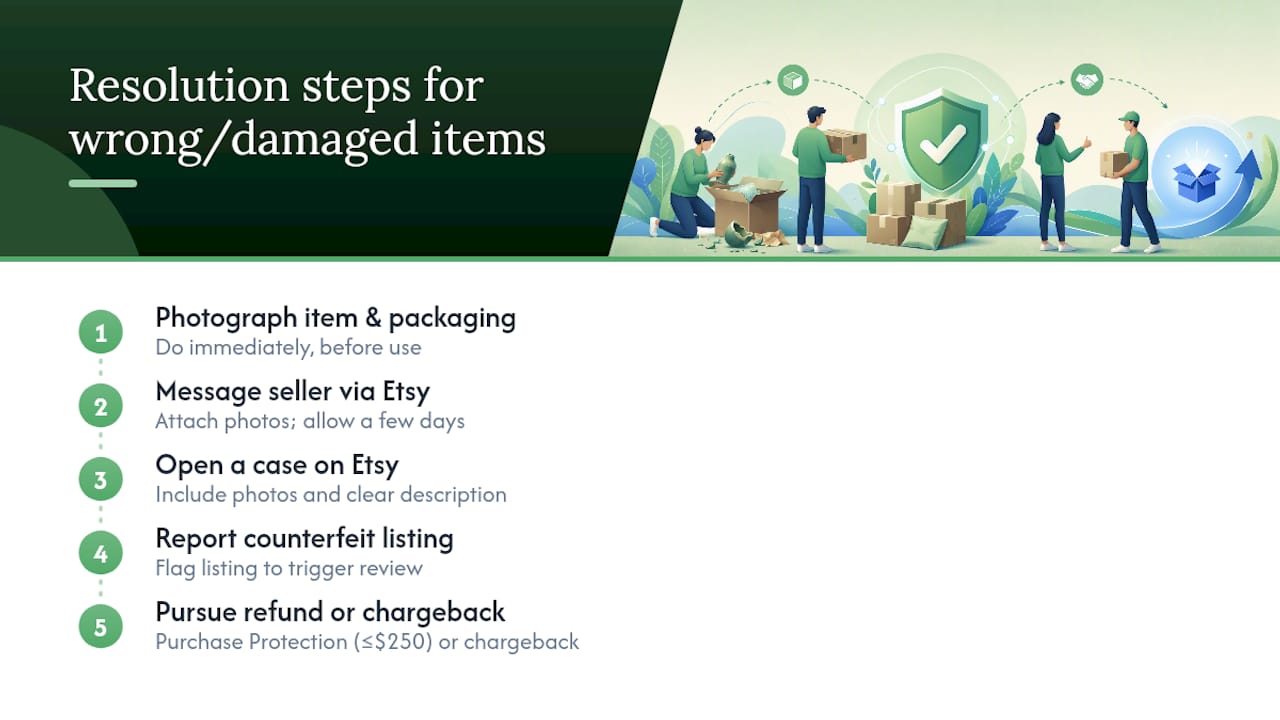
Step two: Message the seller directly through Etsy's messaging system, describing the problem and attaching your photos. Give them a reasonable window, typically a few days, to offer a resolution, since many disputes get settled here without escalation.
Step three: If the seller doesn't respond or refuses a reasonable fix, open a case through your Etsy order page. Include the same photo evidence and a clear description of what you received versus what was listed.
Step four: For counterfeit items specifically, note that Etsy prohibits the sale of counterfeit goods under its policies. Flagging the listing as counterfeit alongside your case can trigger a broader platform review of the shop, not just your individual order.
Step five: If the case doesn't resolve in your favor and you paid through Etsy Payments, Purchase Protection may cover a refund up to the reported $250 cap on qualifying orders. If you paid off-platform, your only recourse is likely a chargeback through your card issuer, which is one more reason to never leave Etsy checkout in the first place.
Spotting Secure Listings vs. Counterfeit or Unauthorized Products
Not every listing on Etsy is equally trustworthy, even within legitimate product categories. A few visual and structural cues separate a secure, well-run listing from one selling unauthorized or counterfeit goods.
Legitimate handmade or vintage listings typically show original photography, often with multiple angles and some imperfections that indicate a real, individual item rather than a mass-produced stock photo. If the exact same image appears across a dozen different shops with different shop names, that's a strong signal of a cloned or drop-shipped listing rather than genuine artisan work.

Check the seller's "About" section and shop history. Established sellers usually have a coherent story, consistent branding, and a sales history that lines up with their claimed years of operation. A shop claiming to have sold for a decade with only twelve total reviews doesn't add up.
Pricing is another tell. Branded or licensed items priced dramatically below market value, especially anything claiming to be an authorized reseller of a known brand, deserve extra scrutiny since Etsy's marketplace model is built around independent and handmade goods, not authorized retail distribution.
Finally, check whether the listing links anywhere off Etsy for "more options" or "custom requests." Authentic sellers keep the full transaction inside Etsy. A listing that routes you to an external site to "complete" your order or unlock a discount is one of the clearest signs you're looking at an unauthorized or fraudulent operation rather than a legitimate shop.
A Practical Final Take on Etsy Safety
Etsy earns its safety reputation because the infrastructure genuinely holds up. Encryption, tokenization, and Purchase Protection aren't marketing language. They're real safeguards that do their job. Where things go wrong is almost always human, not technical: a buyer talked into paying outside checkout, or one who skipped the two minutes it takes to read seller reviews.
If a deal only works when you leave Etsy's checkout, it's not a deal. Walk away.
— Nick
Verify Any External Link Before You Trust It
Etsy's own protections stop working the moment a seller sends you off-platform, whether that's a "custom order" invoice, a shipping-fee page, or a discount code redirecting to some unfamiliar site. That's the gap Verified exists to close for shoppers who want a second opinion before they type in a card number.
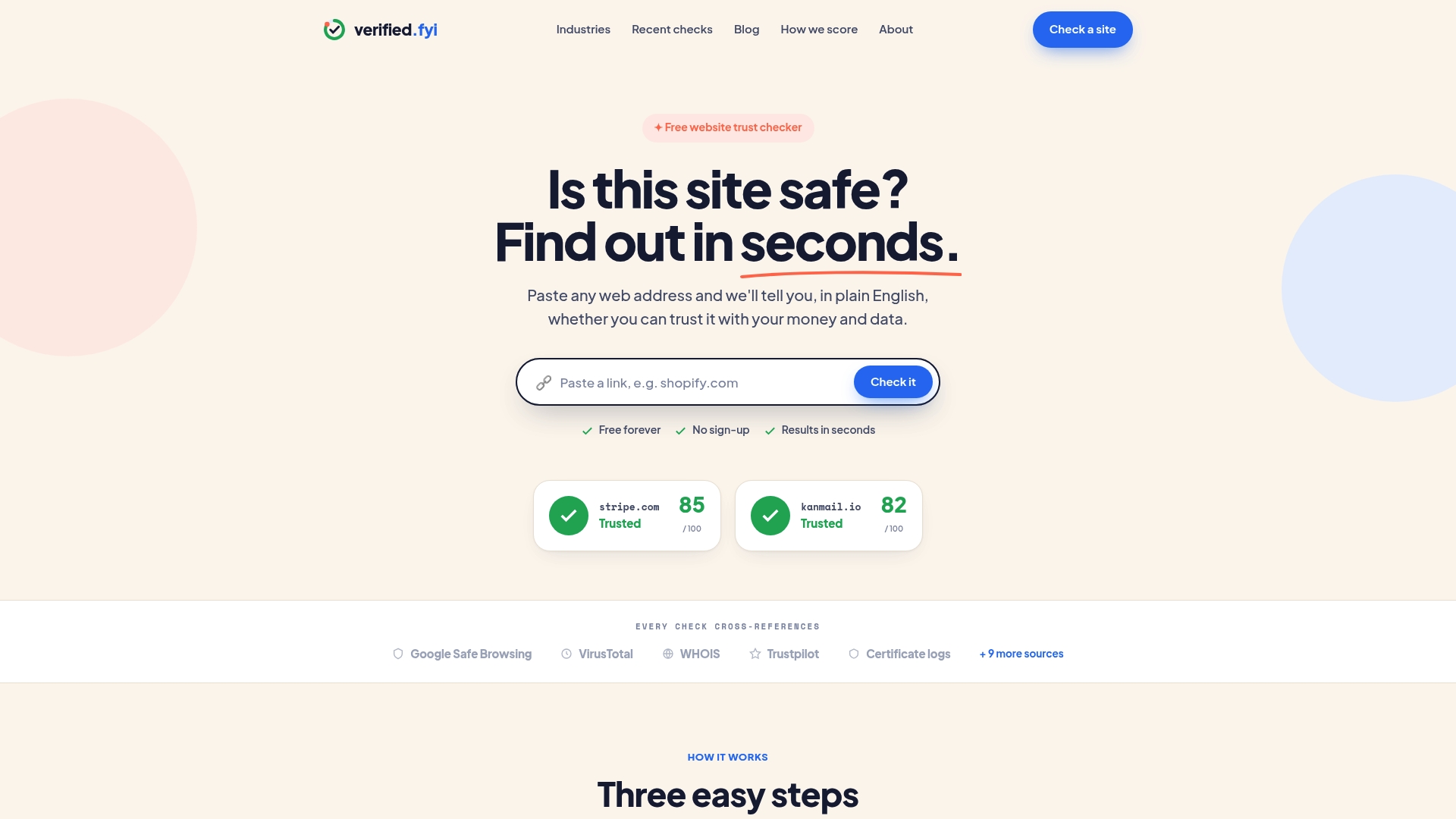
Paste any URL into Verified.fyi and get a trust score from 0 to 100 in seconds, built from over 200 signals including SSL setup, domain age, hosting reputation, and public reviews. It's not a replacement for Etsy's own checkout protections. It's a quick gut check for the moment a seller pushes you toward a site you've never heard of. You can see how the scoring works on the methodology page, or browse recently checked websites to see what a flagged site actually looks like before you run your own check on that suspicious link.
Sources
- Tips for Buying Safely on Etsy — Etsy Help
- Is Etsy Safe? We Ran a Full Audit (2026 Verdict) — Axis Intelligence
- Is Etsy Legit? How to Stay Safe From Etsy Scams & Fraud — Avast
FAQ
Is It Safe to Purchase From Etsy?
Yes. Etsy uses encrypted, tokenized payments and offers Purchase Protection on qualifying orders, though the platform serves roughly 96 million active buyers with generally reliable outcomes as long as you stay inside Etsy checkout.
How Can I Tell if an Etsy Seller Is Legit?
Check for recent reviews with photos, clear shop policies, consistent seller history, and prompt, specific answers to direct messages. Vague policies or a seller pushing off-platform payment are the clearest warning signs.
Can I Trust Etsy With My Card Information?
Yes. Etsy Payments tokenizes your card data, meaning sellers never see your actual card number, and the platform's infrastructure meets standard e-commerce security practices, including TLS encryption.
Will Etsy Refund Me if I Get Scammed?
If you paid through Etsy Payments and your order qualifies, Purchase Protection can issue a refund, though platform-funded refunds have been reported capped around $250 per order. Payments made off-platform aren't covered at all.