Shein is a legitimate retailer, not a scam, but that verdict comes with real caveats. Its parent company settled with New York regulators over a mishandled data breach, independent tests have flagged hazardous chemicals in some sampled items, sizing and quality vary widely from listing to listing, and customer service can be slow to resolve disputes. For cheap trend pieces, Shein is reasonably safe with basic precautions. For anything safety-sensitive, expensive, or time-critical, look elsewhere.
TL;DR:
- Shein has a history of a large-scale data breach involving 39 million accounts and ongoing privacy concerns related to app permissions and tracking behavior.
- While checkout security is standard, customers should use strong anti-scam practices like virtual cards, PayPal, and multi-factor authentication to mitigate impersonation scams.
- Chemical testing shows some items contain hazardous substances, making it essential to evaluate product safety on a case-by-case basis, especially for children's items and accessories.
- Shipping issues like delayed packages and slow refunds are common, so documenting every step and using tracked returns can speed resolution of disputes.
- Verifying unfamiliar links and promo pages on any platform before entering sensitive data is crucial, with tools available to assess site safety rapidly.
Table of Contents
- Is Shein Safe to Buy From, and Will Your Order Arrive?
- What Happened With Shein's Data Breaches and Regulatory Actions?
- Are Shein Products Safe? What Chemical Tests Have Found
- How Do Payment and Impersonation Scams Target Shein Shoppers?
- What Shipping, Returns, and Support Problems Should You Expect?
- How Can You Shop Safely on Shein?
- When Should You Avoid Shopping on Shein?
- How Verified fyi Helps You Check Any Site Before You Buy
- My Take: How I Decide What's Worth the Risk on Shein
- Check Any Site's Safety Before You Enter a Card Number
- Sources
- FAQ
Is Shein Safe to Buy From, and Will Your Order Arrive?
Yes, in the most literal sense. Shein is a functioning global retailer that processes millions of transactions, ships from international fulfillment centers, and has built one of the largest fast-fashion operations in the world. Your order will very likely arrive. That's the baseline question most people are actually asking when they type "is Shein safe" into a search bar, and the honest answer is that legitimacy isn't in serious doubt.
What "legitimate" means in practice is narrower than shoppers assume. It means the payment processing works, orders get fulfilled, and there's a buyer-protection system if something goes wrong. It does not mean every transaction goes smoothly, that the product matches the photo, or that support resolves your complaint quickly.
That distinction matters because Shein's review landscape is genuinely polarized. Plenty of shoppers order regularly with no issues at all. Others describe a frustrating cycle of wrong sizes, misdelivered packages, and refund delays. Both experiences are real, and both show up constantly in customer feedback:
- Large order volumes with successful, on-time delivery reported by many repeat customers.
- Recurring complaints about refund processing speed and automated support responses.
- Wide variance in product-to-photo accuracy depending on the specific item and seller.
- A functioning dispute and refund mechanism, though shoppers report it can require persistence.
An Atop Legal assessment lands on roughly the same conclusion, giving Shein a trust score near 60 out of 100 across security, data protection, feedback, and marketplace safeguards. That's not "avoid this site," and it's not "shop with total confidence" either. It's "trustworthy with caveats," which is exactly the territory this guide covers.
So legitimacy answers whether Shein is a real company doing real business. It says nothing about whether a specific product is made from safe materials, whether your data stays protected, or whether a return goes smoothly. Those are separate questions, and they deserve separate scrutiny.
What Happened With Shein's Data Breaches and Regulatory Actions?
Shein's privacy track record includes one confirmed large-scale breach and an ongoing pattern of tracking scrutiny that shoppers should factor into how they use the app and site.
In 2018, Shein's parent company suffered a security breach. When New York's Attorney General investigated, the findings were worse than the company had initially disclosed.
The breach compromised 39 million Shein accounts, and the New York Attorney General secured a $1.9 million settlement in 2022 over deceptive handling of the incident.
The settlement wasn't just about the breach itself. Regulators found that the company had understated the scope of what happened when it first notified affected users, which is often the more troubling part of these cases. A breach is a security failure. Downplaying one is a trust failure.
That history doesn't mean Shein's systems are unsafe today, but it's the kind of track record that should shape how cautious you are with the data you hand over. ESET's analysis concludes Shein is a legitimate retailer while still flagging privacy concerns and impersonation scams as ongoing risks worth managing, not historical footnotes.
Beyond the 2018 breach, security researchers have raised separate concerns about how the Shein app behaves on your device. ExpressVPN's review notes that checkout traffic runs over standard HTTPS encryption, which is table stakes for any retailer, but flags invasive app permissions and tracking behavior that goes beyond what comparable retail apps request. AVG's security team reaches a similar conclusion: the checkout connection itself is fine, but the company's regulatory history has dented overall privacy trust.
Given that combination, a few habits go a long way toward limiting your exposure:
- Use a unique password for your Shein account, never one reused from email or banking logins.
- Turn on multi-factor authentication if the app or site offers it.
- Review app permissions and deny access to contacts, location, or photos unless a feature genuinely requires it.
- Use a virtual or single-use card number instead of your primary card for checkout.
- Check your bank and account activity periodically for anything unfamiliar, especially in the weeks after a purchase.
Pro Tip: Before installing any shopping app, check its permission requests against what the app actually needs to function. A retail app asking for your contact list or precise location has no functional reason to request either.
None of this means Shein is actively unsafe to use today. It means the company has a documented history of mishandling a large-scale incident, and the practical response is the same one security professionals recommend for any large platform: assume some exposure, and limit what you're exposed with.
Are Shein Products Safe? What Chemical Tests Have Found
Product safety is where Shein's low prices start to raise legitimate questions, and the evidence here is more mixed than a simple yes-or-no answer.
Independent testing and reporting have found hazardous substances, including lead, phthalates, and formaldehyde, in some sampled Shein items sold in different markets. ExpressVPN's coverage documents these findings while noting an important limitation: the tests involved specific samples in specific jurisdictions, not the platform's entire catalog. Shein sells an enormous, constantly rotating inventory sourced from many manufacturers, so a chemical finding in one batch of jewelry or one style of jacket doesn't tell you what's true of the shirt you're about to order.
That inconsistency cuts both ways. It means plenty of items are perfectly fine, and it means there's no reliable way to know which ones aren't just by browsing a product page.
Part of the problem is traceability. Many Shein listings offer limited information about the specific factory, material sourcing, or safety certification behind an individual item. When a platform publishes broad supplier-audit or sustainability claims without product-level detail, you're left assessing safety from item reviews and photos rather than anything verifiable. That's a structural limitation of ultra-fast-fashion marketplaces generally, not a flaw unique to Shein.
A few categories deserve extra caution on any low-cost fast-fashion marketplace:
- Children's clothing, toys, and anything a baby or toddler might mouth or wear against skin for long periods.
- Jewelry and accessories, where lead and cadmium have shown up in past testing across multiple retailers.
- Items marketed as protective gear, activewear with safety claims, or anything with a certification claim you can't independently verify.
- Fragrances, cosmetics, and skin-contact items without ingredient transparency.
For lower-stakes categories like basic tops, accessories, or trend pieces, reading item-level reviews carefully, checking the material description against buyer photos, and ordering one piece before buying five of the same item in different colors all reduce your risk meaningfully. Independent reviewers consistently describe this small-sample-first approach as the most practical way to manage Shein's quality variance.
How Do Payment and Impersonation Scams Target Shein Shoppers?
Shein's checkout itself uses standard encryption, but the bigger payment risk isn't the platform. It's the wave of scams that use Shein's brand recognition against you.
Because Shein is one of the most recognized names in online retail, it's also one of the most impersonated. Common schemes include fake "you won a Shein gift card" links sent by text or social media, spoofed seller pages that mimic the real app's checkout flow, and phishing emails claiming a package is delayed and asking you to "verify" payment details through a link. None of these come from Shein. They exploit the fact that millions of people have a real Shein account and might not look closely at a message that seems plausible.
The same impersonation logic shows up across other major platforms, and the warning signs of fake accounts and spoofed listings tend to overlap: urgency, a link that doesn't match the official domain, and a request for information the real company would never need over text or email.
A few payment habits limit how much damage any single scam or breach can do:
- Pay through PayPal when it's offered, since it adds a dispute layer between your bank account and the merchant.
- Use a virtual, single-use card number for Shein purchases instead of your primary debit or credit card.
- Put purchases on a credit card rather than a debit card, since credit cards carry stronger chargeback protections under US consumer law.
- Enable multi-factor authentication on your Shein account and use an email alias if your provider supports one.
- Watch your statement for any charge you don't immediately recognize, and report it the same week you see it.
If a charge does go wrong, whether it's a scam or a legitimate order that never shipped, document everything: order confirmation, tracking number, and any chat transcript with support. ESET's security guidance specifically recommends this combination of MFA and safer payment methods because credential-stuffing attacks against large retail platforms remain common. A documented paper trail is also what makes a chargeback claim through your card issuer go smoothly if Shein's own support doesn't resolve things fast enough.
What Shipping, Returns, and Support Problems Should You Expect?
Shipping and returns are where Shein's customer experience shows the most friction, and the pattern in customer reviews is consistent enough to plan around.
Reviews on Trustpilot show recurring one-star complaints centered on three issues: packages marked delivered that never arrived, refunds that take weeks longer than promised, and support responses that feel automated and repetitive rather than genuinely helpful. Some reviewers describe disputes where Shein's team questioned whether an item had actually been returned, leaving the customer to prove a negative.
Shein's standard returns flow works: you request a return through the app, print or request a label, ship the item back, and wait for the refund to process. The friction shows up in the details. Return windows are limited, some categories are excluded from returns entirely, and if your tracked return doesn't scan correctly at the carrier's facility, you may need to fight for a refund you're clearly owed.
A handful of habits make that fight much shorter if it ever happens:
- Photograph the package and its contents the moment it arrives, before you touch anything inside.
- Save your order confirmation, tracking number, and any promotional terms tied to the purchase.
- Always use a tracked return method rather than an untracked drop-off, even if it costs slightly more.
- Keep a copy of every support chat, since Shein's live chat doesn't always retain history on your end.
- Escalate to your card issuer or PayPal for a chargeback if support stalls past a reasonable window, generally two to three weeks past the promised resolution date.
None of this is unique to Shein among high-volume, low-cost marketplaces. But the scale of complaints on public review sites suggests it's frequent enough that treating documentation as routine, not paranoid, is the smarter default.
How Can You Shop Safely on Shein?
A short pre-purchase and post-purchase routine handles most of the risk this guide has covered, without requiring you to give up the savings that brought you to Shein in the first place.
- Confirm you're on the official Shein app or shein.com before entering any information; bookmark it rather than clicking links from texts or social ads.
- Read item-specific reviews and photos, not just the overall store rating, since quality varies listing by listing.
- Favor items with multiple buyer photos and clear measurements over listings with only studio images.
- Pay with PayPal or a virtual card instead of your main debit card.
- Turn on multi-factor authentication and limit app permissions to what checkout and shipping actually require.
- Keep your phone's operating system updated and never click a "track your package" link from an unexpected text.
- Photograph items as soon as they arrive and start any return within the first few days of the window, not the last.
Pro Tip: Before you buy from any new or unfamiliar site claiming to be a Shein promotion or partner, paste the URL into a site verification tool first. A ten-second check catches most spoofed pages before you ever reach a payment screen.
None of these steps take more than a minute or two, and together they close off the most common ways Shein orders go wrong, whether the cause is a scam, a data exposure, or an ordinary shipping error.
When Should You Avoid Shopping on Shein?
Some purchases aren't worth the discount, no matter how good the price looks.
Skip Shein for infant and toddler items, protective or safety-certified gear, and anything expensive or custom-made where quality control genuinely matters. Skip it too when you need guaranteed, fast customer support, like a gift with a hard deadline, since resolution can take longer than the situation allows. If you've been a victim of identity theft before or you're simply not comfortable with a platform that has a breach and tracking history behind it, a retailer with more transparent data practices and a local return counter is the safer call.
How Verified fyi Helps You Check Any Site Before You Buy
You don't have to take a retailer's word for its own trustworthiness. Verified fyi analyzes more than 200 security, ownership, reputation, and compliance signals for any URL you paste in, then returns a 0 to 100 trust score with a plain-language verdict.
- Categorized results ranging from "dangerous" to "trusted," so you're not left guessing what a raw score means.
- Real case examples, including reviews of sites like smilemisty.shop and gemashenwing.shop, showing exactly what suspicious signals look like in practice.
My Take: How I Decide What's Worth the Risk on Shein
I treat Shein the way I treat any low-cost marketplace: fine for things I can afford to get wrong, off-limits for things I can't. A $12 top or a phone case is an acceptable gamble. A car seat, a "certified" safety product, or anything going straight against a baby's skin is not, and no discount changes that math. Nothing in the breach history or the chemical testing suggests Shein is secretly dangerous. It suggests you should apply the same skepticism here you'd apply to any large platform handling your card and your data. The BLUF at the top of this piece still holds: legitimate company, real caveats, proceed accordingly. When in doubt about a specific link, checkout page, or "official" promo, run it through a verification check before you type in a card number.
— Nick
Check Any Site's Safety Before You Enter a Card Number
Shein's own checkout is reasonably secure, but the scams built around its name, the spoofed promo pages, the fake tracking texts, the impersonation emails, are where most shoppers actually get burned. Verified fyi gives you a way to check any of those links in seconds instead of guessing.
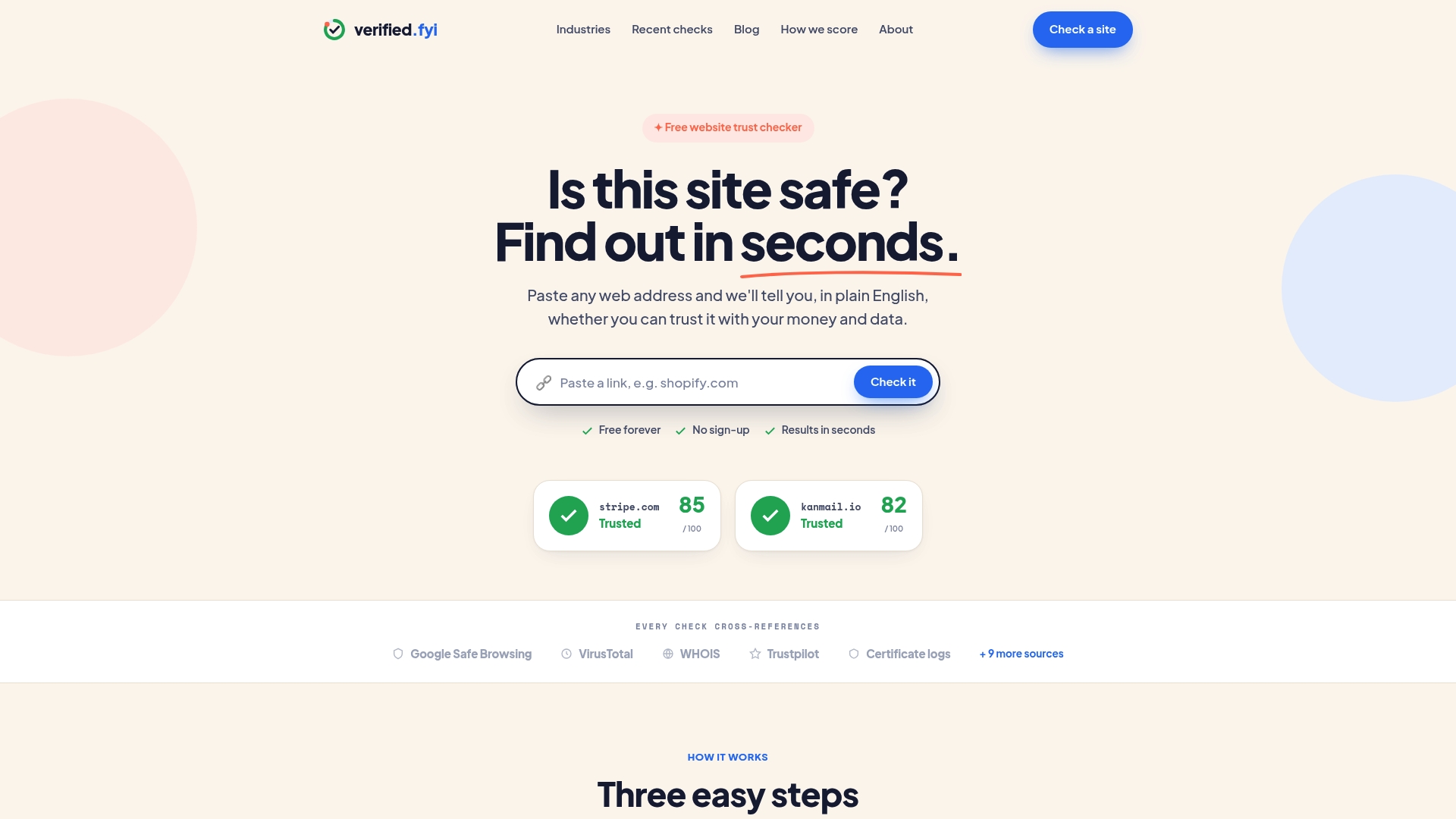
Paste a URL into Verified fyi and you'll get a 0 to 100 trust score built from over 200 signals, along with a clear verdict instead of a wall of technical data. It's free to use, and it takes less time than reading a suspicious text message twice. If you want to see the tool in action first, browse the recently checked sites to see real examples of how risky domains get flagged. Next time a "Shein giveaway" link lands in your messages, check it before you click it.
Sources
- Attorney General James secures $1.9 million from e-commerce Shein and Romwe owner Zoetop for deceptive data breach handling
- Is it safe to buy from Shein?
- Is Shein Legit and Safe to Buy From?
- SHEIN Reviews | Read Customer Service Reviews of www.shein.com
FAQ
Why do people say not to order from Shein?
The main concerns are a 2018 data breach that compromised 39 million accounts, reports of hazardous chemicals in some sampled items, and frequent customer complaints about refunds and support response times.
Is Shein safe for my credit card?
Checkout uses standard encryption, but using a credit card, PayPal, or a virtual single-use card gives you stronger dispute protections than a debit card if something goes wrong.
Why is Shein stuff so cheap?
Shein relies on high-volume, fast-turnaround manufacturing with limited product-level traceability, which keeps prices low but also makes quality and material safety inconsistent across listings.
Which is safer, Temu or Shein?
Both platforms carry similar categories of risk, including data-privacy scrutiny and inconsistent product quality, so the safer choice depends more on your payment method and precautions than on the platform itself. Running any unfamiliar retail link through a trust checker before you buy is a more reliable comparison than picking one brand over the other.