TL;DR:
- Gaming sites pose serious cybersecurity, financial, social, and mental health risks to players of all ages. Protecting oneself requires verifying site safety, setting spending limits, and practicing privacy measures to avoid scams, scams, grooming, and addictive behaviors. Regular site checks and awareness of evolving threats are essential to play safely and responsibly.
Gaming sites carry real dangers that go far beyond a bad internet connection. Cybersecurity professionals use the term "online gaming hazards" to describe a cluster of threats: malware infections, financial scams, social exploitation, and psychological harm. These risks affect players of all ages, and recent data confirms the scale is serious. Understanding why gaming sites can be risky is the first step toward protecting yourself before you click, download, or sign up.
What are the primary cybersecurity risks on gaming sites?
Gaming sites are a prime target for cybercriminals because they attract large, trusting audiences who regularly download files and enter payment details. The FBI identified eight games on Steam that harvested credentials and cryptocurrency wallets between 2024 and 2026. One campaign alone, using a malicious game called "PirateFi," exposed over 1,500 Steam users to the Vidar infostealer. That is a significant breach from a single title on one of the world's most recognized platforms.

Fake download sites make the problem worse. Cybercriminals buy expired reputable domains to inherit their trust scores, then use those sites to distribute Trojans, spyware, and viruses disguised as popular games. A site that looks legitimate because it has an established domain age can still be actively malicious. Trust signals like site age alone are not enough to confirm safety.
Browser game portals add another layer of risk. A portal that was safe six months ago can turn dangerous as its ad network changes, aggressive pop-ups appear, or new login prompts request unnecessary permissions. These changes happen quietly, without any notification to users.
The most common entry point for gaming scams is social engineering. Scammers promise free premium content to bypass suspicion, then deliver malware or steal credentials through fake redemption pages. The offer feels credible because it matches what gamers genuinely want.
Key cybersecurity red flags to watch for:
- Downloads from unofficial sources or third-party mirrors
- Login prompts on browser game portals that request email or social accounts
- "Free" skin, currency, or DLC offers from unknown sites
- Game executables built on open-source engines like Ren'Py, which have been weaponized to hide malware
- Sites with recently changed ownership or domain names that do not match the developer
Pro Tip: Before downloading any game file, paste the site URL into Verified fyi. It analyzes over 200 security and reputation signals and returns a trust score from 0 to 100 in seconds.
How do financial risks manifest on gaming platforms?
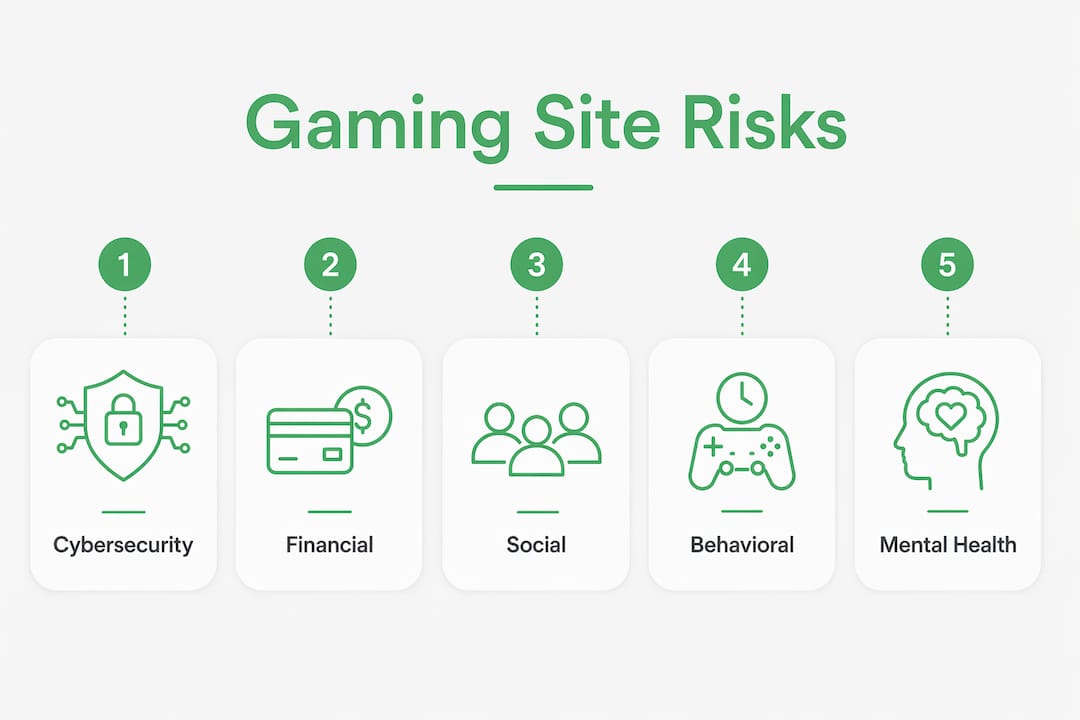
Gaming sites create financial risk through both direct fraud and subtler psychological manipulation. Predators sometimes coerce players into sharing payment details or making purchases under pressure, particularly in multiplayer environments where social dynamics are intense. Fake game versions sold on unofficial storefronts charge real money for software that either does not work or installs malware alongside the game.
The more systemic financial danger comes from game monetization design. Loot boxes, battle passes, and randomized reward systems mimic gambling mechanics, creating spending patterns that can escalate quickly. Experts confirm that these features increase the risk of financial harm, especially among younger players who have not yet developed strong impulse control.
To reduce financial exposure on gaming platforms:
- Buy only from official storefronts. Authorized platforms like a game's own website or a major console marketplace verify seller identity. Third-party resellers do not.
- Set hard spending limits before you play. Decide on a monthly ceiling for in-game purchases and treat it as non-negotiable.
- Disable one-click purchasing. Requiring a password or PIN for every transaction adds friction that prevents impulsive spending.
- Check unfamiliar gaming sites before paying. A quick site safety check can reveal whether a storefront has fraud signals before you enter card details.
- Treat "limited-time" offers with skepticism. Artificial urgency is a standard manipulation tactic designed to override careful thinking.
What social risks do gamers face on these sites?
Gaming communities are social spaces, and that social dimension creates real vulnerability. 32% of young gamers reported experiencing bullying or abuse during online play in 2026. That figure comes from research covering 89% of Australian children aged 8–17 who played online games, with 40% socializing with unknown players. The combination of anonymity and competition creates conditions where harassment thrives.
The risks extend beyond name-calling. Offenders use gaming platforms to initiate contact, then move victims to less-moderated environments through a tactic called platform hopping. A conversation that starts in a game's chat moves to a private Discord server or messaging app, where there is less oversight and more opportunity for grooming, sexual exploitation, or image-based abuse. Children with disabilities face heightened vulnerability because offenders specifically target users who may be more isolated or eager for social connection.
Practical steps to reduce social risk:
- Use in-game privacy settings to limit who can send friend requests or direct messages
- Never share personal information, including school, location, or real name, in gaming chats
- Report harassment through the platform's official tools rather than engaging directly
- Monitor which platforms a conversation moves to, since migration to social media from gaming is a recognized exploitation pattern
Pro Tip: Parents should check which platforms their child's gaming contacts are also active on. Offenders rarely stay within a single app.
What mental health and behavioral risks are associated with gaming?
Internet Gaming Disorder, or IGD, is the clinical term for problematic gaming that causes significant impairment in daily life. A longitudinal study found that 13.9% of adolescent gamers exhibited IGD symptoms at a one-year follow-up, with documented impacts on academic performance and interpersonal relationships. That is not a fringe statistic. It represents a meaningful share of the gaming population.
| Warning sign | What it looks like |
|---|---|
| Preoccupation | Thinking about gaming constantly when offline |
| Withdrawal | Irritability or anxiety when unable to play |
| Tolerance | Needing more hours to feel satisfied |
| Loss of control | Failed attempts to cut back on play time |
| Continued use despite harm | Playing despite poor grades or damaged relationships |
The psychological risks are compounded by platform design. Research links excessive gaming to impulsivity and emotion regulation deficits, which are the same traits that increase vulnerability to gambling addiction. Loot box mechanics exploit these deficits directly. First-year university students face elevated risk because psychosocial pressures during that transition increase reliance on online activities as a coping mechanism. Recognizing the warning signs early makes intervention far more effective than waiting for a crisis.
Key Takeaways
Gaming sites pose layered risks across cybersecurity, finances, social safety, and mental health, and each category requires a distinct protective response.
| Point | Details |
|---|---|
| Malware is embedded in games | The FBI confirmed credential-harvesting games on Steam; only download from verified official sources. |
| Financial manipulation is by design | Loot boxes mimic gambling mechanics and can escalate spending into real financial harm. |
| Social risks include grooming | 32% of young gamers faced abuse, and platform hopping moves victims to less-moderated spaces. |
| IGD affects nearly 14% of adolescents | Internet Gaming Disorder causes academic and relationship damage; recognize warning signs early. |
| Site verification is a non-negotiable | Trust signals like domain age are insufficient; always check a site's full safety profile before engaging. |
The risk you cannot see is the one that gets you
Most gamers I talk to focus on obvious scams: the fake giveaway, the phishing email. Those are real, but they are not the threats that catch careful people off guard. The ones that do are the slow-burn risks: the browser game portal that was fine last year and quietly changed its ad network, the loot box system that normalized spending $5 at a time until the monthly total became alarming, the gaming friend who gradually moved the conversation off-platform.
What I have learned from years of watching how online fraud evolves is that static safety checks are not enough. A site that scored clean six months ago may not score clean today. Domain shadowing, expired domain acquisition, and ad network changes all happen without any visible signal to the user. The only reliable habit is checking before you engage, every time, not just once when you first discover a site.
Digital literacy matters here too. Teach yourself and anyone you game with to ask one question before clicking: "Why does this site need this from me?" If the answer is not obvious, that is your red flag. Combine that critical habit with a tool that does the technical analysis, and you cover both the human and the automated attack vectors.
Gaming is worth protecting. The goal is not to stop playing. The goal is to play with your eyes open.
— Nick
Check any gaming site before you play
Knowing the risks is only half the equation. The other half is having a fast, reliable way to act on that knowledge before a threat reaches you.
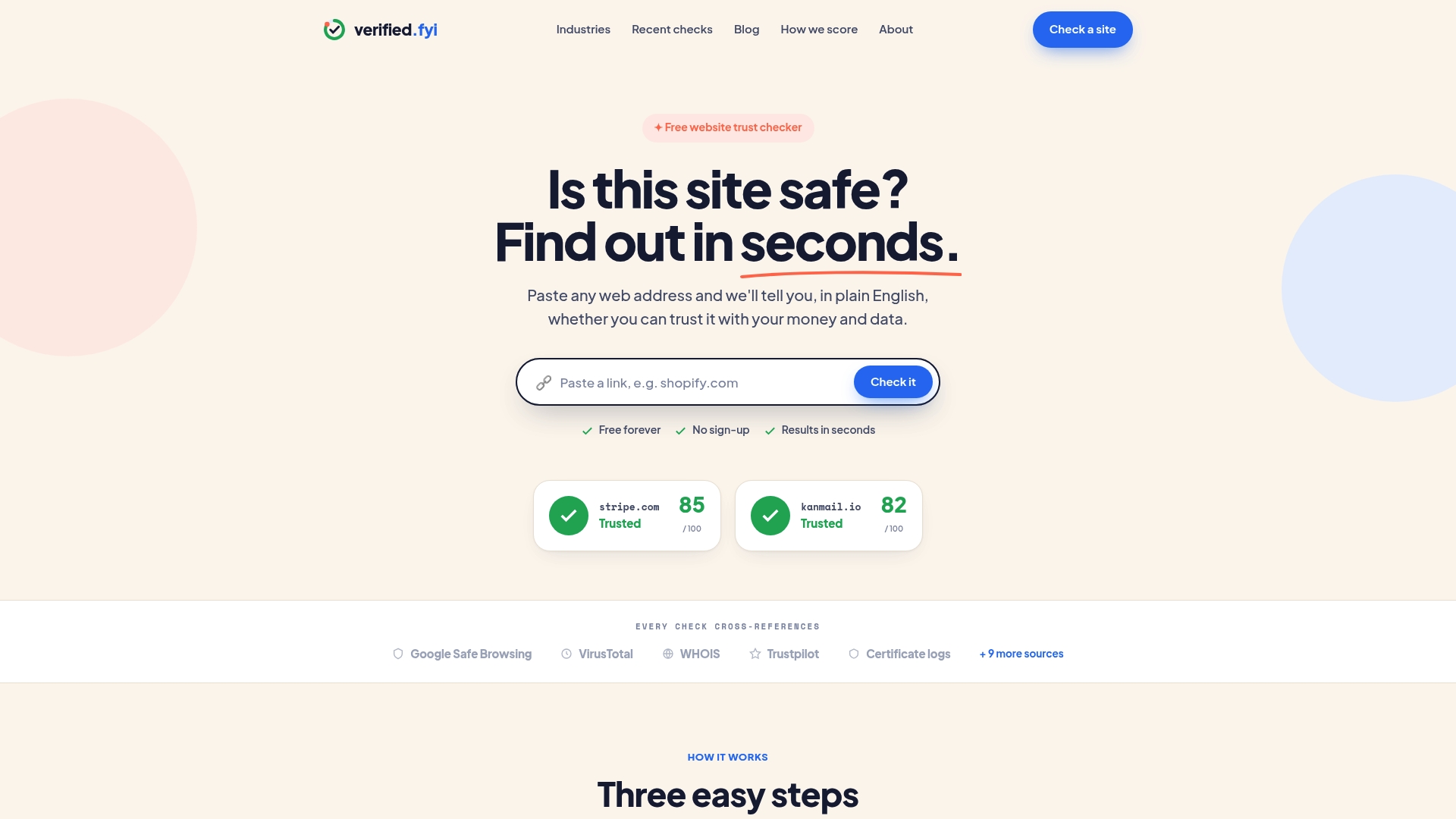
Verified fyi analyzes over 200 security and reputation signals for any website URL and returns a clear trust score from 0 to 100 in seconds. You can check recently flagged gaming sites to see which domains are currently raising red flags, or paste any URL directly into the tool for an instant verdict. Verified fyi also maintains a list of trusted gaming platforms so you can start from a verified baseline rather than guessing. Before you download, pay, or sign up on any gaming site, a 10-second check is the simplest protection you can add to your routine.
FAQ
Why are gaming sites more dangerous than other websites?
Gaming sites combine large user bases, frequent file downloads, and payment processing, making them high-value targets for malware, phishing, and financial fraud. The FBI confirmed credential-harvesting campaigns on major platforms like Steam as recently as 2026.
How can I tell if a gaming site is safe?
Check the site's full security profile using a verification tool like Verified fyi, which analyzes over 200 signals including domain history, SSL status, and reputation data. Domain age alone is not a reliable indicator, since cybercriminals actively acquire expired reputable domains.
What is platform hopping and why does it matter?
Platform hopping is when an offender moves a victim from a moderated gaming platform to a less-regulated social media or messaging app. The WeProtect Global Alliance identifies this tactic as a key method used to escalate grooming and exploitation.
Are loot boxes a form of gambling?
Experts classify loot box mechanics as gambling-adjacent because they use randomized rewards and variable reinforcement schedules that mirror slot machine design. Research links loot box engagement to increased risk of problem gambling, particularly among adolescents and university students.
What is Internet Gaming Disorder?
Internet Gaming Disorder (IGD) is a clinical condition defined by persistent, uncontrolled gaming that causes significant impairment in daily functioning. A 2026 longitudinal study found that 13.9% of adolescent gamers met IGD criteria at a one-year follow-up.