Business identity fraud is the unauthorized use of your company's legal, financial, or public identity to commit crimes. It can mean someone files a fake tax return using your EIN, opens a credit line in your business's name, or clones your website to steal from your customers. The IRS, FTC, and Experian all track this crime because it creates debt, tax headaches, wrecked credit, and reputational damage that can take months to untangle.
Key Takeaways
Business identity fraud combines legal, financial, and digital impersonation, and stopping it requires layered controls plus fast reporting through the IRS, FTC, and credit bureaus.
| Point | Details |
|---|---|
| Know the definition | It's unauthorized use of your company's legal, financial, or public identity to commit fraud. |
| Watch tax-specific signs | Rejected e-filings and surprise W-2 notices call for IRS Form 14039-B. |
| Separate financial duties | No single employee should both initiate and approve payments. |
| Monitor credit continuously | Enroll in business credit monitoring through a bureau like Experian to catch unfamiliar inquiries. |
| Verify before you pay | Check WHOIS, certificates, and use a tool like Verified fyi before trusting an unfamiliar site or vendor. |
This article is general information, not a substitute for advice from a qualified financial advisor. Consult a qualified financial professional about your own circumstances before acting on anything here.
Table of Contents
- What Does Business Identity Fraud Look Like?
- How Do Criminals Pull Off Business Identity Fraud?
- What Are the Warning Signs of Business Identity Theft?
- What Happens After Business Identity Fraud Hits?
- How Can You Prevent Business Identity Fraud?
- What Should You Do If You Suspect Business Identity Fraud?
- How Do You Recover From Business Identity Fraud?
- How Do You Verify a Website or Vendor Is Legitimate?
- A Practitioner's View on Trust and Controls
- Protect Your Business Before Fraud Happens, Not After
- Sources
- FAQ
What Does Business Identity Fraud Look Like?
The methods vary, but they all exploit the same thing: nobody double-checks who's really on the other end of a filing, invoice, or login.
- Tax return fraud — a criminal files a return using your EIN to claim refundable credits or reports fake wages.
- Business credit or loan fraud — someone applies for a credit card or loan using your company name and registration details.
- Web impersonation — a lookalike site copies your branding to trick your customers or vendors.
- LLC or trademark abuse — a fraudster files paperwork to "reclaim" or transfer your business registration.
- Business email compromise — attackers hijack or spoof an executive's email to redirect payments.
A common variant: a fake vendor emails your accounts payable team with new "updated" bank details, and the payment goes straight into a criminal's account. Another: someone registers a domain one letter off from yours and starts quoting your prices to your own leads. This differs from personal identity theft in scale, since the damage hits the company's credit and legal standing rather than one person's. It also differs from simple brand impersonation, which usually just fakes your customer-facing image rather than your legal or financial records.
How Do Criminals Pull Off Business Identity Fraud?
Most schemes follow a predictable arc: gather data, build a convincing impersonation, then cash out before anyone notices.
- Lookalike domains that swap a letter or add a hyphen to your real URL.
- Stolen EINs, often pulled from public filings, old invoices, or a breached vendor database.
- Compromised email accounts, giving attackers a real inbox to send fraudulent requests from.
- Social engineering, where a caller poses as a bank rep or IRS agent to extract sensitive details.
- Fraudulent business filings, quietly changing your registered agent or address with the state.
Criminals often start with public records. Your WHOIS registration data, state business registries, and even your own marketing materials hand over exactly the details needed to sound legitimate. Once they have a name, an address, and an EIN, the leap to a fraudulent loan application or fake vendor invoice is short.
What Are the Warning Signs of Business Identity Theft?
Tax-related fraud and non-tax fraud show up differently, so it helps to check both lists.
Tax-specific signs (per IRS guidance):
- Your e-filed return gets rejected because one already exists. File IRS Form 14039-B immediately.
- You receive notices about W-2s or 1099s you never issued. Contact the IRS Business Identity Theft line.
- Your business address changes in IRS records without your action. Verify with your registered agent and the IRS.
Non-tax signs:
- Unfamiliar credit inquiries appear on your business credit report. Pull your report from Experian or another bureau.
- A vendor sends an invoice you didn't authorize. Call the vendor using a known number, not the one on the invoice.
- Payments get diverted to a new account. Freeze the payment and verify by phone.
- A new domain or social account mimics yours. Report it to the platform and check ownership via WHOIS.
What Happens After Business Identity Fraud Hits?
The damage compounds quickly once fraudulent activity is underway.
- Unpaid debt and collections notices for accounts you never opened.
- Cash-flow disruption while payments get frozen or redirected.
- Damaged business credit that raises your borrowing costs for years.
- IRS audits triggered by fraudulent filings tied to your EIN.
- Reputational harm if customers were scammed through a cloned site.
Resolution timelines vary widely and are difficult to pin down precisely, since each case depends on how many institutions are involved and how fast records get corrected. Simple credit disputes might close in weeks. Tax-related identity theft, especially anything routed through Form 14039-B, can stretch much longer while the IRS verifies the legitimate filer. If losses are substantial or fraudulent filings are extensive, bringing in a forensic accountant or certified fraud examiner early tends to shorten the overall timeline rather than lengthen it.
How Can You Prevent Business Identity Fraud?
Prevention works best as a layered system, not a single fix, as shown in data-driven detection and monitoring efforts in fintech applications like those documented in Cases Related to FinTech - Silk Data. Start with the fires that need putting out today, then build the controls that keep new ones from starting.
Immediate fixes:
- Change passwords on financial accounts and email, and enable multi-factor authentication.
- Place a fraud alert or credit freeze with business credit bureaus.
- Verify all bank payment instructions by phone before honoring a change request.
Ongoing controls: 4. Separate financial duties so no single employee can both initiate and approve payments. 5. Build an approval hierarchy for anything above a set dollar threshold. 6. Run periodic soft audits of vendor lists, payroll, and account changes. 7. Enroll in continuous business credit monitoring through a firm like Experian to catch unfamiliar inquiries fast. 8. Train employees to recognize lookalike domains and confirm any payment-change request through a second channel, as the FTC recommends.
The ACFE notes that policies and training reduce opportunity but can't eliminate fraud outright, so ongoing monitoring has to run alongside prevention, not instead of it.

Pro Tip: Segregation of duties isn't a vote of distrust in your team. It's a structural safeguard, and leadership setting a clear "tone at the top" matters as much as the controls themselves, since employees follow the example set above them.
What Should You Do If You Suspect Business Identity Fraud?
Move fast and document everything. Here's the order that limits damage best:
- Contain the breach — lock down compromised accounts and rotate credentials.
- Document evidence — save emails, invoices, screenshots, and timestamps before anything gets deleted.
- Contact your bank and card issuers to freeze affected accounts and dispute unauthorized transactions.
- Place fraud alerts with business credit bureaus, including Experian.
- File IRS Form 14039-B if the fraud involves tax filings, W-2s, or your EIN.
- Report to the FTC for non-tax identity theft, including web impersonation or fraudulent credit applications.
- Notify local law enforcement to create an official record for insurance or legal purposes.
Keep every log, screenshot, and communication organized in one file. Investigators and banks will ask for a timeline, and a scattered paper trail slows everything down.
How Do You Recover From Business Identity Fraud?
Recovery is a sequence, and skipping steps usually means redoing them later.
- Dispute fraudulent accounts directly with the creditor and in writing.
- Contact all three major credit bureaus to correct your business credit file.
- Take down fake domains and accounts through registrar and platform abuse reports.
- Update your business registrations with the state if filings were altered.
- Re-establish payment lanes with vendors using verified, updated contact details.
If losses are significant or the fraud touched multiple accounts, bring in a forensic accountant or certified fraud examiner to trace the full scope before you close the case. Legal counsel becomes worth the cost once you're disputing large debts or considering litigation against a repeat offender. Rebuilding trust afterward means proactively notifying vendors and customers, showing them what you fixed, not just what went wrong.
How Do You Verify a Website or Vendor Is Legitimate?
A few quick checks catch most fakes before money changes hands.
- Pull the domain's WHOIS registration and compare it against the company's claimed history.
- Check the site's TLS certificate for mismatches or recent issue dates on a supposedly established business.
- Search for lookalike domains that swap characters or add extra words.
- Trace the provenance of contact information. Does the phone number match public records?
- Look for copied images or inconsistent content lifted from a legitimate competitor.
Running the URL through a site-verification tool like Verified fyi gives you an instant trust score built from over 200 signals, which is faster than manually chasing down WHOIS records and certificate details yourself. Cross-check anything suspicious against public state registries too.
Pro Tip: Stop the transaction the moment you see two or more of these together: an unusual payment method, pressure to act immediately, and contact details that don't match what you had on file last month.
A Practitioner's View on Trust and Controls
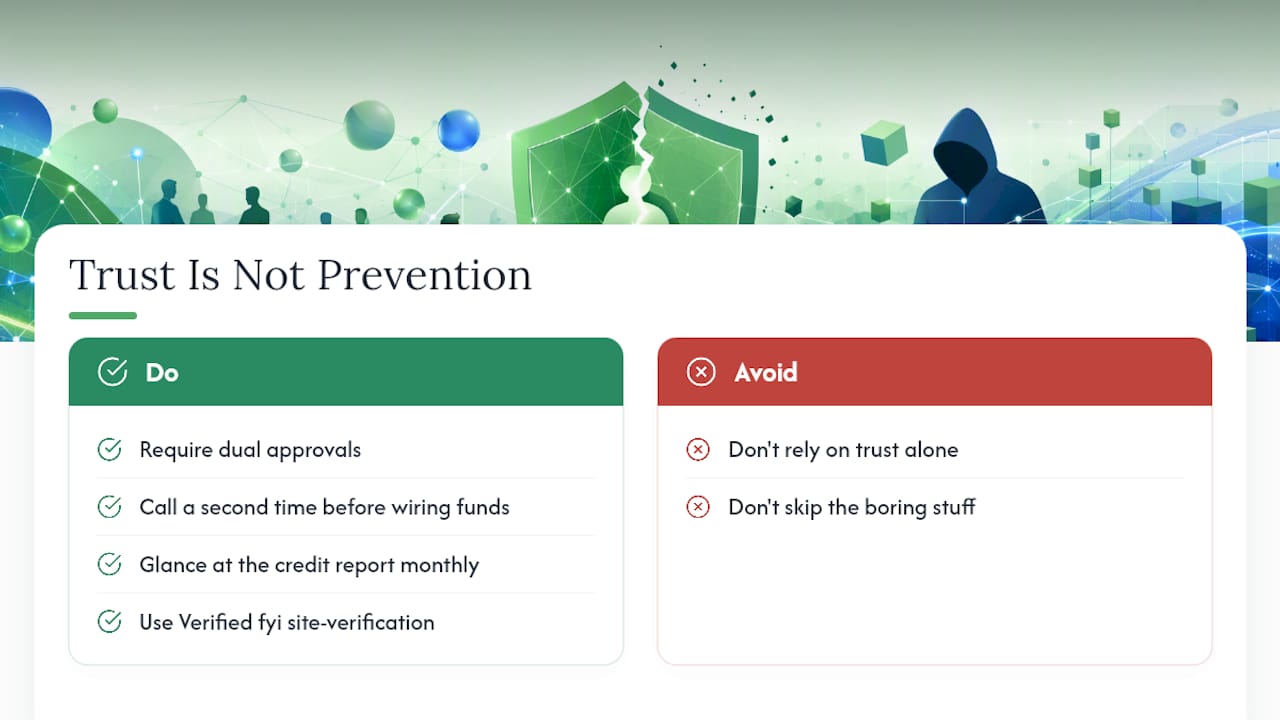
Trust is not a prevention strategy. The businesses that get burned hardest usually skipped the boring stuff: dual approvals, a second phone call before wiring funds, a monthly glance at the credit report. None of that requires suspicion of your team. It requires treating your financial systems the way you'd treat a locked door, not a leap of faith.
Building that habit starts with the checks outlined above, and resources like Verified fyi's site-verification tool make the vendor and domain side of it a five-second task instead of a guessing game.
Protect Your Business Before Fraud Happens, Not After
Most of the prevention steps above cost nothing but a few minutes of attention. The gap usually isn't awareness, it's follow-through, especially when checking a new vendor's website or a payment portal that showed up in your inbox unannounced.
Before wiring funds or sharing account details with an unfamiliar site, run the URL through Verified fyi to get an instant trust score built from over 200 security and reputation signals. It takes seconds, and it catches the lookalike domains and cloned payment pages that slip past a quick glance.
Sources
FAQ
What Is Business Identity Fraud in Simple Terms?
It's when someone uses your company's legal, financial, or public identity, like your EIN, credit profile, or website, to commit fraud without your permission.
How Is Business Identity Fraud Different From Personal Identity Theft?
Personal identity theft targets an individual's Social Security number and personal credit, while business identity fraud targets a company's EIN, registration records, and business credit.
What Should I Do First If I Suspect Business Identity Fraud?
Contain the breach by locking down compromised accounts, then document everything before contacting your bank, credit bureaus, and either the IRS or FTC depending on whether the fraud is tax-related.
When Do I File IRS Form 14039-B Instead of Reporting to the FTC?
File Form 14039-B for tax-related fraud, like rejected e-filings or fake W-2s; report everything else, including credit fraud and web impersonation, to the FTC.
Can Verifying a Website Prevent Business Identity Fraud?
Checking a site's WHOIS data, certificate, and reputation before paying or sharing credentials catches many lookalike domains and cloned payment pages before money changes hands.