
Mercari is a legitimate marketplace, not a scam operation, but its safety depends on you. The platform holds your payment in escrow, offers an Authenticate program for luxury goods, and gives you a 72-hour window to flag problems. Those protections vanish the moment you move a conversation or a payment outside the app.
TL;DR:
- Mercari’s escrow system holds funds until the buyer confirms receipt and has 72 hours to report issues, but protections vanish if users switch to off-platform payments.
- Verifying seller ratings, completed sales, and requesting detailed photos for luxury items are crucial steps to assess trustworthiness and avoid scams.
- Most fraud is caused by social engineering, such as off-platform payment requests, phishing messages, counterfeit listings, and pressure to share personal information.
- Always pay through the Mercari app, photograph all shipments before and after sending, and file claims within the 72-hour window to maximize dispute chances.
- Use independent link checkers before clicking unfamiliar URLs or external payment requests to avoid falling for scams that Mercari's protections don't cover.
Table of Contents
- Is Mercari Safe to Use for Buying and Selling?
- What Scams Should You Watch for on Mercari?
- Buyer Safety Checklist: What to Do Before You Buy
- Seller Safety Checklist: Protecting Your Sales From Fraud
- If You Were Scammed on Mercari, Here's What to Do
- Can You Verify a Suspicious Link Before You Click It?
- What Actually Determines Whether You Get Scammed
- Check Any Suspicious Link Before You Trust It
- Sources
- FAQ
Is Mercari Safe to Use for Buying and Selling?
Mercari is one of the larger resale marketplaces operating today, publicly traded and built around 20 million monthly active users. That scale alone doesn't make every transaction safe. It makes Mercari a serious, established company with real infrastructure behind its buyer and seller protections, which is a different question from whether any single listing you're eyeing right now is trustworthy.
The honest answer to "is Mercari trustworthy" is: the platform is trustworthy, and some of its users are not. Mercari built an escrow-style payment system specifically because peer-to-peer marketplaces attract fraud. The system works well when you follow it. It works far less well when a seller convinces you to text them your number "just to sort out shipping" or a buyer asks you to accept a Cash App payment instead.
Here's how the core protections actually function, and where their limits sit.
Escrow payments and the 72-hour clock. When you buy something on Mercari, your money doesn't go straight to the seller. Mercari holds the funds until you receive the item and rate the transaction, and you have 72 hours after delivery to report a problem before the sale finalizes and the seller gets paid. That window is the single most important mechanic on the entire platform, and it's the one most first-time users overlook.

Buyer and seller ratings. Every completed transaction generates a rating, and those ratings compound into a visible track record. A seller with 400 completed sales and a strong rating history carries a very different risk profile than an account created two weeks ago with three listings and no feedback.
Mercari Authenticate. For eligible luxury items (handbags, watches, sneakers, and similar categories), Mercari runs an independent authentication check before the item ships to you. It's a real layer of protection, but it isn't universal. Only certain categories and price points qualify, and a badge on a listing doesn't guarantee the item behind it has actually been through the process.
Identity verification and automated monitoring. Mercari asks sellers to verify identity before payouts and runs automated systems in the background to flag unusual account behavior, like a sudden burst of listings priced far below market. It's a fraud filter, not a fraud eliminator.
Prepaid shipping labels. Mercari-generated labels create a tracking trail that both proves delivery and, for sellers, activates certain protections against false "item never arrived" claims.
Put together, these features answer "how safe is Mercari" pretty clearly: safe enough to use with confidence, as long as every dollar and every message stays inside the app.
What Scams Should You Watch for on Mercari?
Most Mercari fraud isn't a platform failure. It's a person talking you into stepping outside the platform's protections. Security researchers consistently point to social engineering as the dominant threat on peer-to-peer marketplaces, and Mercari is no exception. Here's what that looks like in practice.
-
Off-platform payment requests. A "seller" offers you a discount if you pay through Venmo, Cash App, or PayPal's friends-and-family option instead of checking out in the app. This is the single biggest red flag on the platform. Mercari explicitly states that transactions completed outside the app aren't covered by its protections, so once the money leaves through another app, you have no dispute path with Mercari at all.
-
Phishing messages and fake landing pages. You get a text or email that looks like it's from Mercari, warning about a suspended account or a shipping issue, with a link to "verify" your login. Real Mercari communications never ask you to log in through a link in a text message. Mercari's own security team recommends logging in only through the official app or site and forwarding anything suspicious rather than clicking it.
-
Counterfeit listings and faked Authenticate badges. Some sellers copy the visual style of an Authenticate badge on their own listing photos, hoping buyers won't check. If a listing claims authentication, ask directly for the serial number and specific detail photos, and cross-reference against the brand's known markers.
-
Return fraud against sellers. A buyer receives a legitimate item, then files a claim saying it arrived damaged or "not as described," sometimes after swapping in a cheaper substitute before requesting a refund.
-
Pressure to rate early or overshare personal information. A seller asks you to rate the transaction "so I can ship faster" before the item even arrives, or a buyer asks for your phone number "for delivery updates." Both requests try to get you to disable your own protections or hand over data you don't need to share.
Norton's consumer-security review of Mercari lists nearly identical patterns and lands on the same conclusion: the fraud almost always requires you to break your own rule first.
Buyer Safety Checklist: What to Do Before You Buy
Following Mercari's built-in structure in order, rather than skipping to checkout, is what actually keeps you protected.
- Before you buy: Check the seller's completed sales count and rating history. Look for an Authenticate badge on luxury items, and if one is present, request close-up photos of serials, stitching, or hardware anyway.
- At checkout: Pay only through the Mercari app. Never accept a "special deal" that routes payment elsewhere, and save a screenshot of the listing and your full message thread before you complete the purchase.
- When the item arrives: Open the package immediately and photograph the item, the packaging, and the shipping label together. Don't rate the transaction until you're satisfied. Rating early is the fastest way to lose your ability to dispute anything.
- If something's wrong: Open a return or claim through the app within the 72-hour window, and attach the photos and tracking details Mercari requests.
Pro Tip: Set a phone reminder for 60 hours after delivery, not 72. That gives you a buffer to gather photos and file a claim before the window closes, instead of scrambling at the deadline.
For a broader shopping routine beyond Mercari specifically, this safe online shopping checklist covers habits that apply across any resale platform.
Seller Safety Checklist: Protecting Your Sales From Fraud
Sellers face a different risk profile than buyers: fewer scams try to steal your money directly, but return fraud and chargebacks can quietly eat your margin.
- Ship exclusively with Mercari's prepaid labels. Tracking data is what activates Seller Protection if a buyer later claims non-delivery.
- Photograph the item's condition and the sealed package before it leaves your hands, timestamped if possible.
- Keep the original listing photos and any serial numbers on file well after the sale closes, not just until it ships.
- Treat any buyer who asks to move the conversation off-platform, or who pushes you to rate the sale early, as an automatic red flag.
- If a return claim looks suspicious (photos don't match what you shipped, or the "damage" story shifts), respond quickly with your own documentation instead of staying silent.
Pro Tip: A ten-second video of you sealing the box, showing the item going in, is stronger evidence than still photos alone if a dispute ever escalates.
Sellers who skip documentation aren't necessarily going to get scammed, but they're the ones with nothing to fight back with when a claim does come in.
If You Were Scammed on Mercari, Here's What to Do
Speed matters more than almost anything else here, because Mercari's dispute system runs on a clock.
- Do not rate the transaction until you understand exactly what happened and have decided on your next move. Rating locks in the sale.
- Collect your evidence immediately: screenshots of the original listing, your full message history, and photos of what actually arrived.
- Open an in-app return or claim within 72 hours of delivery, referencing the payment and refunds policy, and upload the required photos and shipment details.
- If money already left the app (you paid through Venmo, Cash App, or a similar service), Mercari has no authority over that transaction. Your fastest path is a chargeback through your card issuer or a direct claim with the payment provider, not Mercari's Help Center.
- Report phishing attempts directly to [email protected] so Mercari's security team can act on the pattern.
- For serious fraud, file a report with the FTC or your local police department, and consider small-claims court for losses large enough to justify the process.
The pattern holds across nearly every recovery story: people who acted inside the first day of noticing a problem had far more options than people who waited until the 72-hour window had already closed.
Can You Verify a Suspicious Link Before You Click It?
Not every Mercari-adjacent scam happens inside the app. A lot of them start with a link, a "confirm your shipment" text, or a seller who directs you to an external site to "complete verification." That's exactly the kind of situation an independent site checker is built for, since these tools are most useful against external URLs rather than normal in-app listings.
A site verification check typically looks at:
- Malware and phishing blocklists (the same databases browsers use to flag dangerous pages)
- WHOIS domain registration data, including how recently the site was created
- Reputation signals pulled from public reviews and prior scam reports
- Certificate and infrastructure red flags that suggest a spoofed or hastily built page
Run a link through a checker like Verified fyi whenever a message pushes you toward a page outside mercari.com, especially one asking for login credentials or payment details. Just don't treat the score as a final verdict. A high trust score on an unfamiliar site is one input among several, not a substitute for checking the seller's Mercari history or reading their actual ratings. Combine it with the same vendor fraud warning signs you'd apply to any unfamiliar business, and you'll catch far more than either check alone.
What Actually Determines Whether You Get Scammed
Most of the fear around "is Mercari legit or scam" is misplaced. The platform's mechanics are sound. Escrow payments, a defined dispute window, and an authentication program for high-value goods put Mercari ahead of a lot of informal resale channels that offer none of that structure. The failure point is almost never Mercari's code. It's the moment a user gets talked into stepping outside it.
If I had to boil this down to one habit, it's this: stay inside the app for every message and every dollar, and treat the 72-hour window like a hard deadline, not a suggestion. Photograph what you send and what you receive. Don't rate a transaction out of politeness or pressure before you've actually inspected the item. Those three behaviors resolve more disputes than any feature Mercari could add. The platform already gives you the tools. Whether they come protect you comes down to whether you use them in order, every time, without exception.
— Nick
Check Any Suspicious Link Before You Trust It
Mercari's in-app protections cover what happens inside the platform, but they stop the moment a link, email, or "verification page" leads you somewhere else. That's the gap that independent site verification tools are designed to fill: paste any URL and get a trust score built from multiple security and reputation signals, including malware blocklists, domain age, and public scam reports, without needing to decode WHOIS records or certificate details yourself.
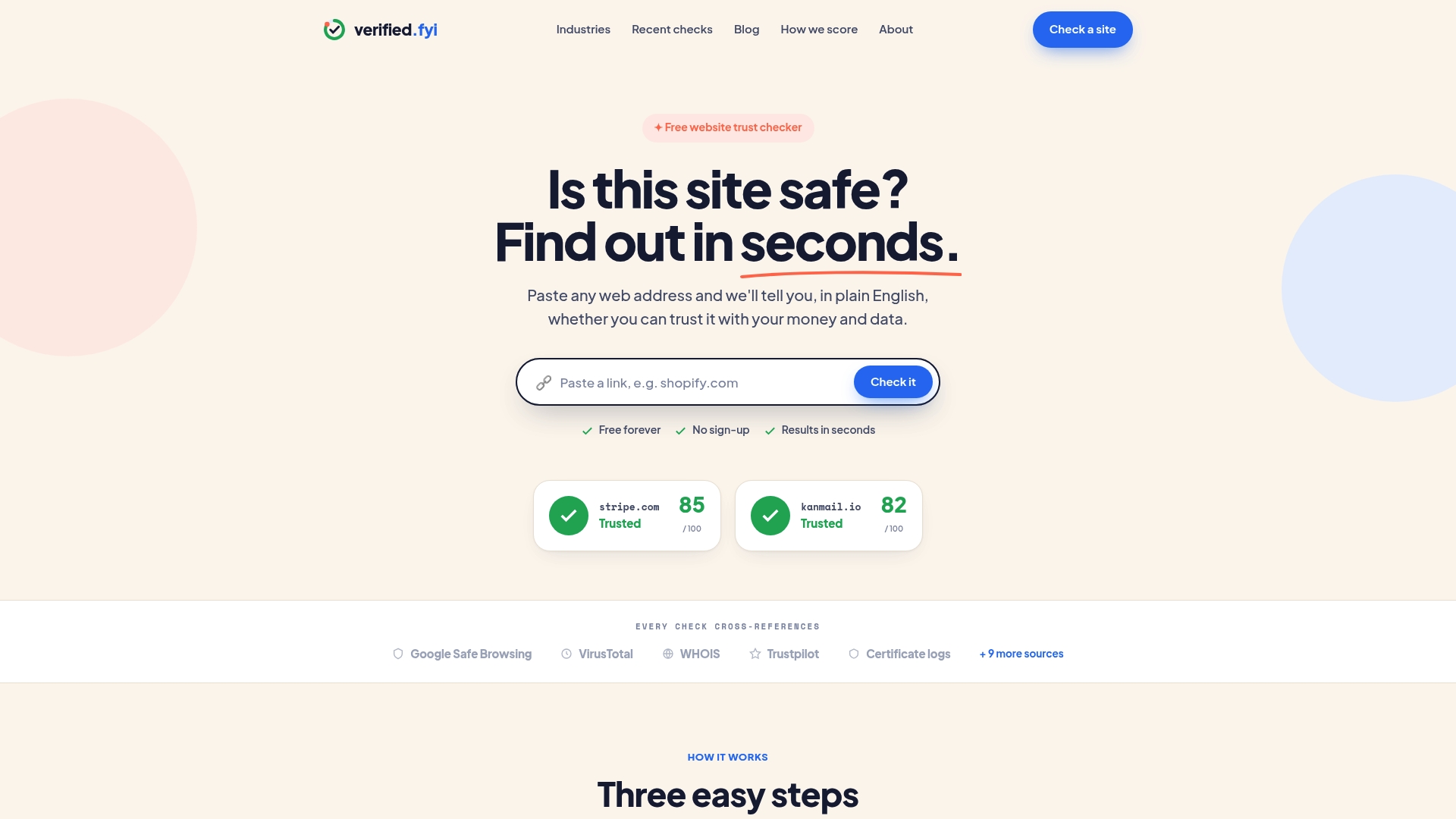
If a Mercari seller sends you off-site to "complete payment" or a text claims your account is suspended with a link attached, run that address through Verified fyi's recent site checks before you type in a single credential. It takes seconds, it costs nothing, and it catches exactly the kind of external scam that Mercari's own escrow system was never designed to see.
Sources
- Mercari profile — PitchBook
- Mercari Help Center — Payment and refunds policy (Article 235)
- Norton — Is Mercari legit? 8 Mercari scams to watch out for
FAQ
Is It Safe to Buy From Mercari?
Yes, buying on Mercari is generally safe because payments are held in escrow and released only after you rate the item, but you must report problems within the 72-hour window to stay protected.
How Do You Know if a Mercari Seller Is Legit?
Check their completed sales count, read their rating history, and look for consistent, detailed photos on past listings. A brand-new account with no sales history and prices far below market value is the clearest warning sign.
Is eBay or Mercari Safer?
Both platforms use escrow-style payment holds and seller ratings, and both face the same core risk: users bypassing protections through off-platform deals. Neither is inherently safer; the outcome depends on whether you follow each platform's in-app rules.
Is It Safe to Use a Credit Card on Mercari?
Yes, and it's the safer payment choice compared to a debit card, since credit cards give you a chargeback option if a transaction goes wrong and Mercari's own dispute process doesn't resolve it in your favor.
What Should You Do if a Mercari Seller Asks to Be Paid Off-Platform?
Decline immediately and report the listing. Mercari's prohibited conduct policy makes clear that transactions completed outside the app aren't covered by any of Mercari's protections.