TL;DR:
- A secure online shopping checklist verifies domain age, business registration, and contact details to avoid scams. Artificial intelligence allows scammers to create convincing fake sites that mimic legitimate retailers, making verification essential. Using reputable payment methods like credit cards and PayPal provides protection against fraud and unverified purchases.
A safe online shopping checklist is a step-by-step verification process that helps you protect your personal and financial information before, during, and after every purchase. Scam sites have grown more convincing, with AI now generating fake storefronts that look indistinguishable from legitimate retailers. Following a structured secure online shopping guide is no longer optional. It is the minimum standard for anyone spending money online.
1. Verify the store's domain age and registration
Domain age under 6 months is a primary red flag for scam sites. A store that launched last month and is already offering deep discounts deserves serious scrutiny. Use ICANN WHOIS to look up when the domain was registered and who owns it. Legitimate businesses build their web presence over time.
Suspicious domain names include hyphens, extra words, or unexpected country codes. "nike-outlet-deals.shop" is not Nike. These naming patterns are a deliberate attempt to confuse you. Read the full URL carefully before you click anything.
- Check the domain registration date at ICANN WHOIS (lookup.icann.org)
- Look for hyphens, misspellings, or extra words in the domain name
- Verify the country code extension matches the store's claimed location
- Search the domain name alongside the word "scam" or "review" in Google
Pro Tip: Paste any suspicious URL into Verified fyi before you buy. The platform analyzes over 200 security and reputation signals and returns a trust score from 0 to 100 in seconds.
2. Understand what HTTPS actually tells you

HTTPS indicates encrypted communication, not site legitimacy. Scammers routinely buy valid SSL certificates to display the padlock icon and fool shoppers into trusting their sites. The padlock means your data is encrypted in transit. It says nothing about who is receiving that data.
Check domain registration and government business registry listings as the real legitimacy test. In the United States, you can verify a business through your state's Secretary of State website. A registered business with a verifiable address is a much stronger signal than a padlock icon.
3. Evaluate deals and pricing with a skeptical eye
Prices 70–90% below standard retail values are hallmark indicators of scams. That $30 "designer" handbag is either counterfeit, nonexistent, or bait for a switch to a worse product. Compare any deal against the same item on established retailers before committing.
Watch for hidden shipping costs that inflate the final price after you have already entered your details. Some scam sites use artificially low product prices to hook you, then add $25 in "handling fees" at checkout. The real price only appears at the last step.
- Search the product name and model number on at least two established retailers
- Check whether the discount applies to a real retail price or an inflated "original" price
- Look for shipping cost disclosures before reaching the payment page
- Verify that the product description matches photos and specifications exactly
Pro Tip: Countdown timers and "only 2 left in stock" alerts are pressure tactics. Legitimate retailers rarely need to manufacture urgency. If a timer resets every time you reload the page, the scarcity is fake.
4. Use payment methods that protect you
Credit cards and PayPal are the safest payment options for online purchases. Both offer chargeback rights, meaning you can dispute a charge if the goods never arrive or are not as described. Debit cards offer weaker protections and expose your bank account directly.
Never pay via wire transfer, gift cards, or cryptocurrency. These payment methods are irreversible and untraceable. Any seller who insists on them is a red flag, regardless of how professional the site looks.
- Use a credit card or PayPal for every unfamiliar online purchase
- Virtual cards or single-use numbers limit fraud exposure on less-known sites
- Confirm the payment page URL stays consistent with the store's main domain
- Avoid saving card details on sites you have not used before
Payment page URL redirects to a different domain are a serious warning sign. If you are on "coolshop.com" and the checkout page suddenly shows "securepay-coolshop.net," stop immediately. Legitimate stores process payments within their own domain or through a clearly branded third-party processor like Stripe or PayPal.
Set a calendar reminder 14 days after purchase to check your order status. If nothing has arrived and the tracking number is invalid, initiate a chargeback before your card issuer's dispute window closes.
5. Validate seller contact information and policies
| Contact Check | What to Look For | Red Flag |
|---|---|---|
| Physical address | Matches a real business on Google Maps | Residential address or no address listed |
| Phone number | Connects to a real person or business line | Disconnected, generic voicemail, or no number |
| Email support | Responds within 48 hours with specific answers | Auto-reply only or no response |
| Return policy | Clear terms with a specific return window | Vague, missing, or copied from another site |
Verified business addresses and responsive support are strong trust signals. Fake sites often list invalid addresses or use virtual office services with no real staff behind them. Test the phone number before you buy, not after.
Fake return policies are often copied across multiple scam sites. Copy a sentence from the return policy and paste it into Google with quotation marks. If the same text appears on dozens of unrelated sites, the policy is a template, not a real commitment.
6. Check independent reviews across multiple platforms
Consistent independent reviews across platforms are more reliable than testimonials displayed on the store's own website. A site can fabricate five-star reviews on its homepage in minutes. It cannot as easily fabricate a consistent history on Google Reviews, Trustpilot, or the Better Business Bureau.
Look for review patterns, not just scores. A store with 500 reviews posted in a single week is suspicious. Established retailers with long-standing user bases build review histories gradually. A sudden spike in positive reviews often signals a purchased or fake review campaign.
Search the store name on Reddit as well. Shoppers frequently post warnings about scam sites in consumer communities, and those posts often appear before formal review platforms catch up.
Key Takeaways
A safe online shopping checklist works because it forces you to verify facts, not appearances. Every step targets a specific tactic scammers use to bypass your judgment.
| Point | Details |
|---|---|
| Domain age matters | Domains under 6 months old are a primary scam indicator; check via ICANN WHOIS. |
| HTTPS is not enough | SSL certificates prove encryption, not legitimacy; verify business registration separately. |
| Extreme discounts signal fraud | Prices 70–90% below retail almost always indicate bait-and-switch or non-delivery scams. |
| Use reversible payments | Credit cards and PayPal offer chargeback rights; wire transfers and gift cards do not. |
| Test contact details first | Call the phone number and email support before purchasing from any unfamiliar site. |
What I've learned watching scam sites get smarter
AI makes fake stores easier to create than ever before. I have reviewed sites that look more polished than many legitimate small businesses, complete with professional product photography, detailed size guides, and convincing "About Us" pages. The appearance of quality is no longer a reliable signal.
The most dangerous shift I have noticed is how scam sites now mimic the exact layout and branding of real retailers. Your eye glosses over the details. Your instincts do not fire because nothing looks obviously wrong. That is precisely when you need a checklist most.
My honest advice: treat every unfamiliar site as unverified until you have checked the domain age, confirmed the business registration, and tested the contact details. Convenience is real, but a $200 loss to a scam site costs far more than two minutes of verification. Tools like Verified fyi's scoring methodology exist precisely because manual checks take time and people skip them under pressure.
— Nick
Verified fyi makes the verification step effortless
Knowing what to check is half the battle. Actually running those checks on every unfamiliar site takes time most shoppers do not have.
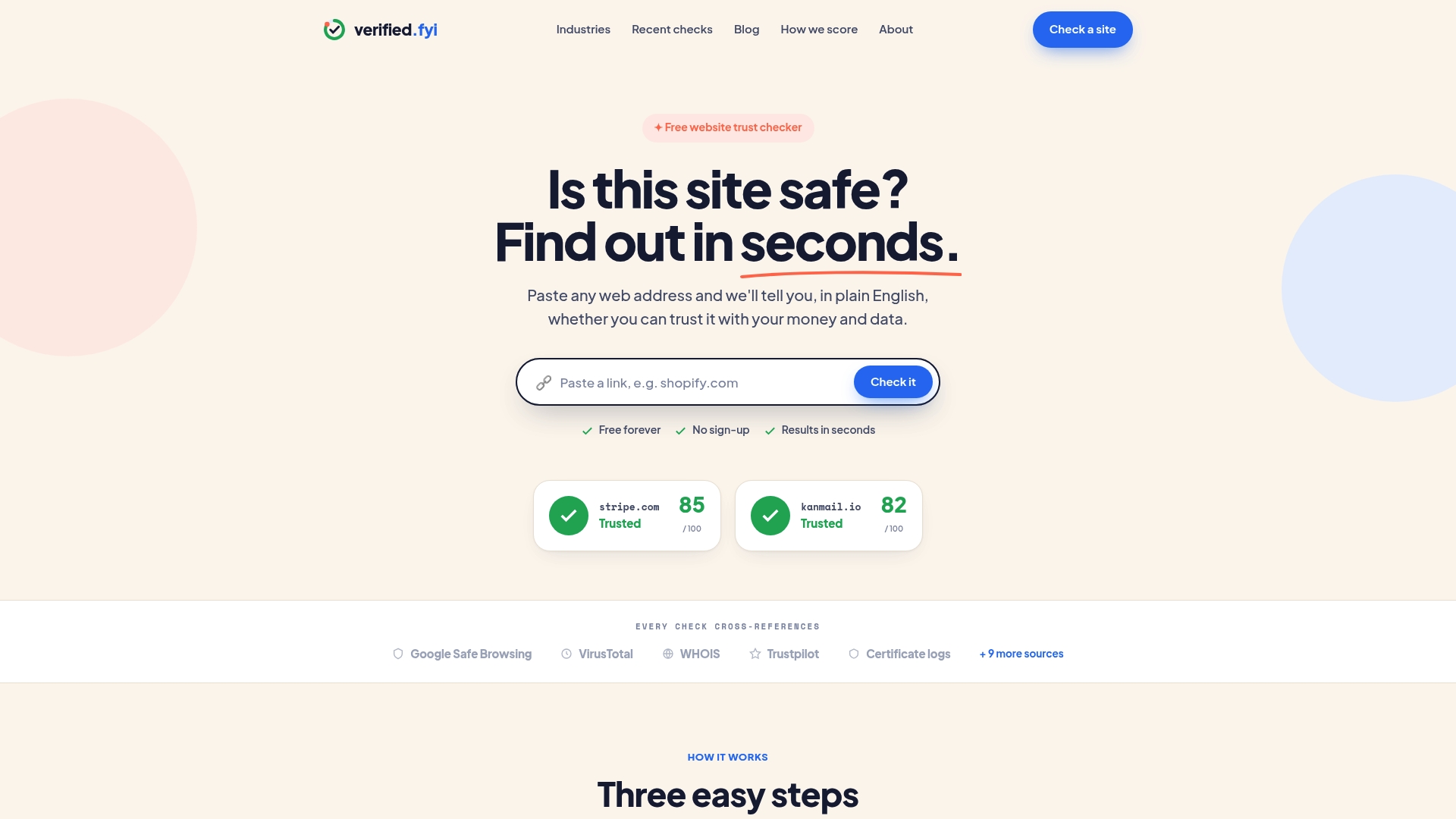
Verified fyi analyzes over 200 security and reputation signals for any website and returns a clear trust score from 0 to 100. You paste the URL, and the platform tells you whether the site is safe, risky, or a known scam. No technical knowledge required. See recently checked sites to browse real-time scam analyses, or go directly to verified.fyi to check any store before your next purchase.
FAQ
What is a safe online shopping checklist?
A safe online shopping checklist is a structured set of verification steps covering domain age, payment security, contact validation, and review credibility. Following it before each purchase reduces your risk of fraud significantly.
Does HTTPS mean a website is safe to buy from?
No. HTTPS confirms that your connection is encrypted, but scammers routinely obtain valid SSL certificates. Always verify business registration and domain age separately.
What payment method offers the best buyer protection?
Credit cards and PayPal both offer chargeback rights, making them the safest options for online purchases. Wire transfers, gift cards, and cryptocurrency are irreversible and offer no fraud protection.
How do I spot fake reviews on an online store?
Check review platforms like Google Reviews, Trustpilot, and the Better Business Bureau rather than the store's own testimonials. A sudden spike in five-star reviews posted within a short window is a strong indicator of fake or purchased feedback.
How can I quickly check if an online store is a scam?
Paste the store's URL into Verified fyi at verified.fyi. The platform scores the site across over 200 signals and delivers an instant verdict on its trustworthiness.