TL;DR:
- A website trust score is a numerical indicator of a site's credibility based on signals such as reviews, security, and transparency. It helps users assess safety and trustworthiness quickly, although scores are only directional and require manual verification. Ongoing monitoring and checking for red flags are essential for accurate evaluation and safe online interactions.
A website trust score is a numeric rating that measures how credible and safe a website appears based on multiple weighted signals. Think of it as a credit score for websites. It pulls together visual design quality, social proof, technical security, and identity transparency into a single number, giving you a fast read on whether a site deserves your time, money, or personal data. Understanding this score is the difference between clicking confidently and getting scammed.
The industry term for this concept is "website credibility score," and it applies to everyone from casual shoppers to freelancers vetting new clients to corporate buyers evaluating vendor platforms.
What is a website trust score and how is it calculated?
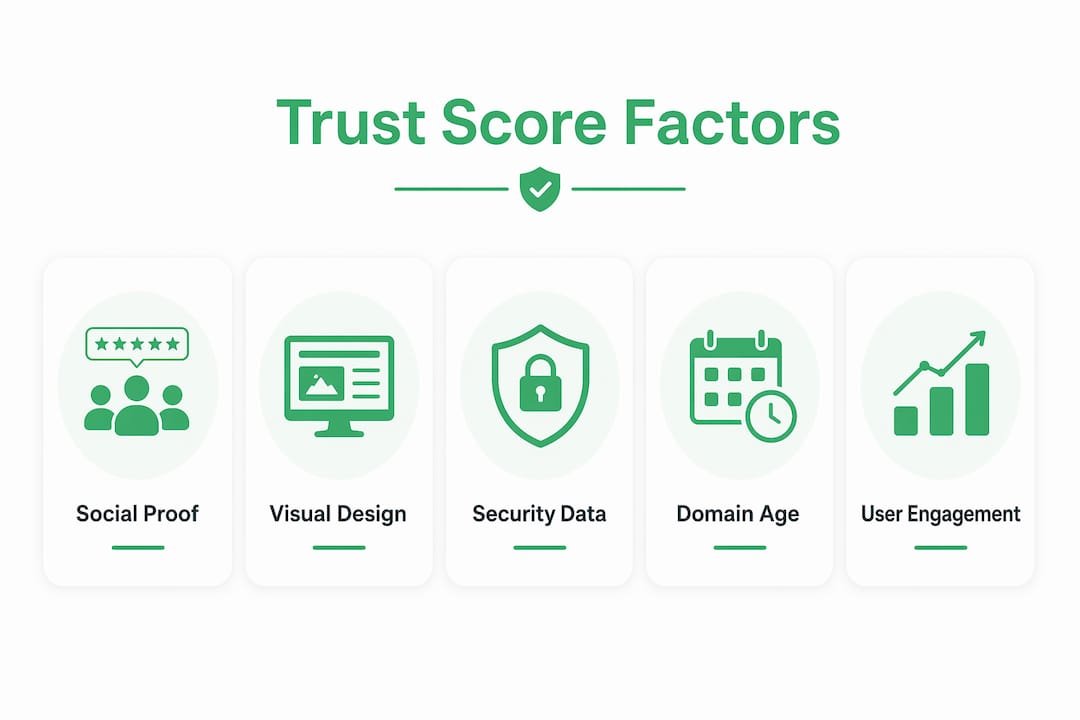
A website trust score is built from four core signal categories, each carrying a different weight in the final number. Trust scores combine visual credibility (roughly 30%), social proof and reviews (up to 40%), technical and security signals (20–25%), and identity transparency (10–15%). Social proof carries the heaviest weight because it reflects real human experience with the site.

Here is how each factor breaks down:
| Signal Category | Approximate Weight | What It Includes |
|---|---|---|
| Social proof and reviews | Up to 40% | Verified ratings on Trustpilot, Google Reviews, follower counts |
| Visual credibility | ~30% | Design quality, layout consistency, UX clarity |
| Technical and security signals | 20–25% | SSL certificate, encryption, uptime, WHOIS data |
| Identity transparency | 10–15% | Contact info, About page, privacy policy, terms of service |
One important caveat: no universal standard exists for how these signals are weighted. A score of 72 on one platform may not equal 72 on another. That means you should treat any single score as a directional signal, not a final verdict.
Pro Tip: When you check a site's score, also look at the methodology page of the tool you are using. Verified fyi publishes its scoring methodology so you know exactly what the number reflects.
How do you interpret trust score ranges?
Most scoring tools use either a 0–10 or 0–100 scale. On a 0–100 scale, scores above 70 generally indicate strong credibility. Scores between 40 and 70 suggest adequate but imperfect signals worth investigating. Scores below 40 are a clear warning to proceed with extreme caution or not at all.
Trust improvements can yield 20–30% conversion lifts by influencing every step of the user funnel. That stat tells you something important: trust is not just a safety concern. It directly shapes whether people buy, sign up, or walk away.
Scores are indicators, not guarantees. A site can score well and still have problems. Watch for these red flags regardless of the number:
- Fake trust badges. Non-interactive badges that do not link to a real verification page are cosmetic props, not proof of anything.
- Missing or vague policies. No privacy policy or terms of service is a non-negotiable red flag.
- No verifiable contact information. A real business has a real address, phone number, or support email.
- Aggressive psychological tactics. Countdown timers and artificial scarcity used excessively reduce credibility, even if the site is technically legitimate.
- No verified reviews. Platforms like Trustpilot's TrustScore are based on all reviews, verified by the platform. Generic star ratings without a verified source mean nothing.
Does website age actually affect credibility?
Domain age is a real trust signal, but it is widely misunderstood. Aged domains can bypass sandbox periods lasting 3–6 months that new sites typically face in search engines. That gives older domains a head start in both SEO authority and perceived credibility.
The misconception is that age alone equals trustworthiness. It does not. Content quality and user engagement often outweigh domain age in determining real-world trustworthiness. A new site with excellent, well-sourced content can outperform a decade-old domain that has gone stale.
There is also a darker side to domain age. Buying or inheriting an aged domain can mean inheriting toxic backlinks, manual penalties from Google, or a spam history that tanks your credibility before you publish a single page. Due diligence using backlink analysis tools is not optional when evaluating an aged domain.
Google's E-E-A-T framework (Experience, Expertise, Authoritativeness, Trustworthiness) reflects this reality. E-E-A-T factors increasingly matter in trust evaluations beyond technical metrics alone. Age contributes to authoritativeness, but only when paired with consistent, quality content and a clean history.
Pro Tip: Before trusting any site based on its age, run its domain through a WHOIS lookup and check its backlink profile. A long history with a toxic link profile is worse than a clean new domain.
How to check and improve a website's trust score
Whether you are evaluating a site before buying or trying to improve your own site's credibility, the process follows a clear sequence.
- Run a trust score check. Paste the URL into a dedicated tool. Verified fyi analyzes over 200 security and reputation signals and returns a score from 0 to 100 instantly, with no signup required.
- Verify the SSL certificate. Look for HTTPS in the address bar. A missing or expired SSL certificate is a hard stop.
- Check for verified reviews. Search the site name on Trustpilot or Google Reviews. Unverified testimonials on the site itself carry almost no weight.
- Click every trust badge. Interactive trust badges linked to the Better Business Bureau or recognized security services confirm authenticity. Badges that go nowhere are red flags.
- Read the About page and policies. Real organizations explain who they are. Vague or missing About pages signal a site that does not want to be held accountable.
Here is a comparison of tools commonly used to assess website credibility:
| Tool | Primary Focus | Unique Feature |
|---|---|---|
| Verified fyi | Overall trust and safety score | 200+ signals, AI-weighted, instant results |
| Trustpilot | Customer review aggregation | Verified reviewer identity |
| Google Safe Browsing | Malware and phishing detection | Integrated into Chrome browser |
| WHOIS Lookup | Domain registration and age | Reveals owner history and registration date |
To improve your own site's trust score, focus on authenticity over optics. Collect genuine reviews through Trustpilot or Google. Link your trust badges to real verification pages. Publish a detailed About page with real names and credentials. These changes build sustained credibility over time, which automated scores will eventually reflect.
Key takeaways
A website trust score is a directional credibility signal built from social proof, visual design, security data, and identity transparency, and no single score from any one tool is definitive.
| Point | Details |
|---|---|
| Trust scores use weighted signals | Social proof carries up to 40% of the score; technical security accounts for 20–25%. |
| No universal scoring standard | Scores differ between platforms, so always check the tool's methodology for context. |
| Domain age is not a trust guarantee | Aged domains with toxic backlink histories can harm credibility more than help it. |
| Red flags override high scores | Fake badges, missing policies, and aggressive tactics signal risk regardless of score. |
| Ongoing monitoring is required | A high score today does not guarantee safety tomorrow as algorithms and threats evolve. |
Trust scores are a starting point, not a finish line
I have spent years watching people treat a single trust score number like a green light. They see 80 out of 100 and stop thinking critically. That is exactly the wrong approach.
Automated trust scores require ongoing monitoring because the signals that feed them change constantly. A site that scored well six months ago may have since changed ownership, accumulated spam links, or removed its privacy policy. The score you saw last month is not the score that exists today.
What I have found actually matters is the combination of a solid score plus manual verification of the non-negotiables: real contact info, linked trust badges, and verifiable reviews. When those three align with a strong score, you can engage with reasonable confidence. When any one of them is missing, the score becomes irrelevant.
The sites that concern me most are the ones that look polished and score adequately but fail the manual check. Scammers have learned to game automated signals. Your own skepticism is the layer no algorithm can replace.
— Nick
Check any website's trust score in seconds
You should not have to guess whether a website is safe before you engage with it. Verified fyi removes that guesswork entirely.
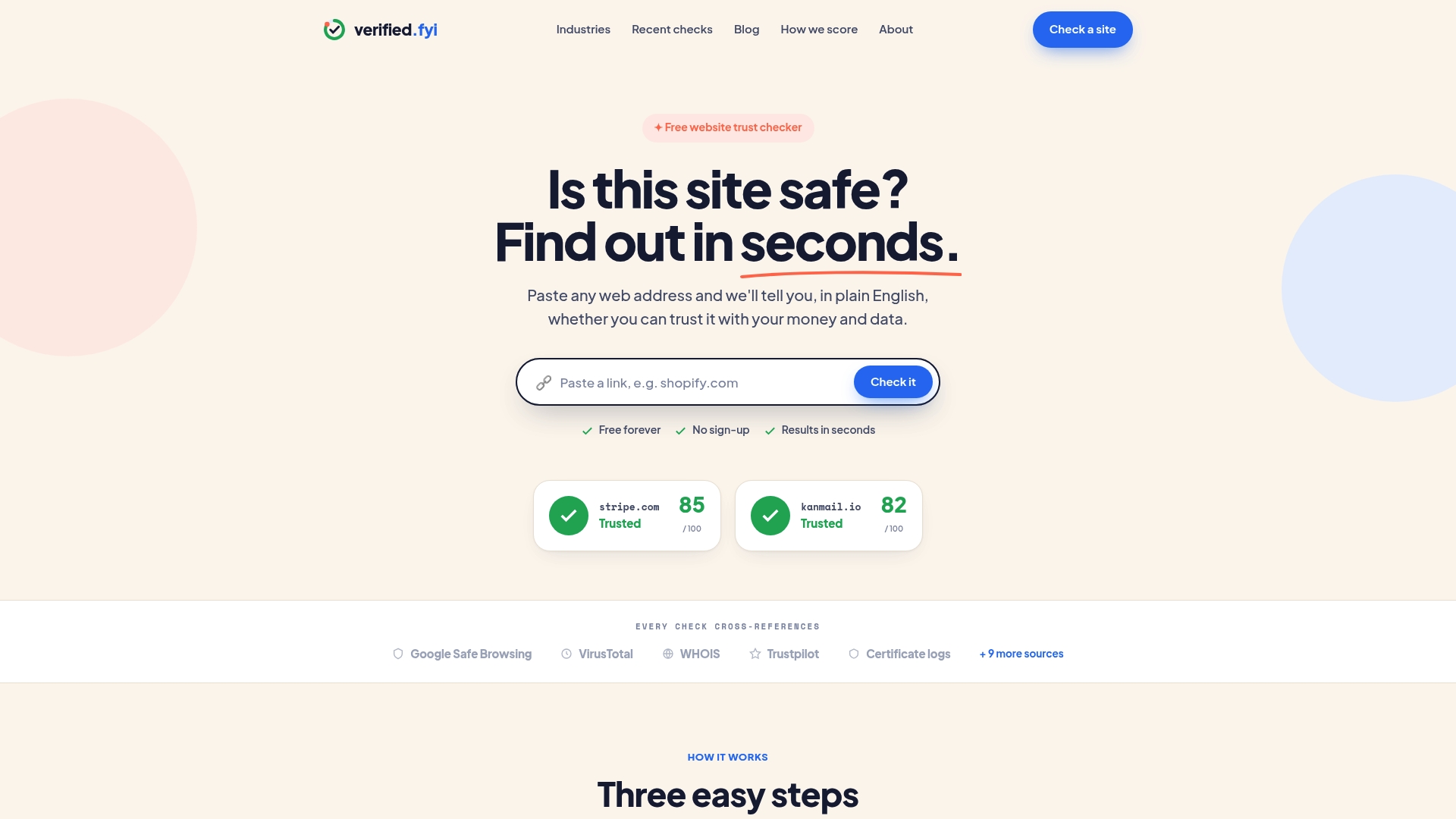
Paste any URL into Verified fyi and get an instant trust score backed by over 200 security and reputation signals, with no account required. The platform's AI weighs each signal and delivers a clear verdict on whether a site is safe, risky, or somewhere in between. You can also browse recently checked websites to see real-time safety reports on sites other users have already flagged or verified. Whether you are a freelancer vetting a new client's platform or a shopper checking an unfamiliar store, Verified fyi gives you the clarity to decide fast.
FAQ
What is a website trust score?
A website trust score is a numeric rating from 0 to 100 that reflects a site's credibility and safety based on signals like SSL certificates, verified reviews, domain age, and identity transparency. It helps users quickly assess whether a site is worth engaging with.
How do website trust score tools differ?
Trust score platforms use proprietary algorithms that weight signals differently, so scores can vary between tools. Always check the methodology of the tool you are using to understand what its number actually measures.
Does a high trust score mean a site is safe?
A high score is a strong positive signal but not a guarantee. Trust scores are triage tools that tell you where to look more closely, not absolute pass or fail verdicts. Always verify red flags manually.
How does domain age affect a website's trust score?
Domain age contributes to trust by providing an established backlink profile and history, but content quality and engagement often carry more weight than age alone. An old domain with a toxic history can actually lower credibility.
Can freelancers use trust scores to vet client sites?
Yes. Freelancers can use trust score tools to evaluate new website credibility before sharing personal information or accepting payment through an unfamiliar platform. A score below 40, combined with missing contact info or unverifiable reviews, is a clear reason to ask more questions before proceeding.