Offshore client scam risk is the danger that money you send to an offshore firm, broker, or "investment manager" disappears with little to no legal path to get it back. The core problem isn't geography. It's that many offshore setups skip the fund segregation, licensing, and compensation schemes that protect you domestically. If you're facing pressure to deposit, wire, or "upgrade" an account with an offshore entity right now, the first move is simple: stop, and verify the firm independently before you send another dollar.
TL;DR:
- Verifying the licensing status directly on the regulator's official register is crucial, as fake license numbers and virtual addresses are common scam indicators.
- Conducting a small deposit and withdrawal test can quickly confirm if the firm is legitimate, since scammers often release early withdrawals and then impose delays or fees.
- Most offshore scams operate from jurisdictions with minimal oversight, such as Saint Vincent or Seychelles, where regulation is lax and enforcement is limited.
- Red flags include pressure through urgent claims, guaranteed returns, pre-withdrawal fees, and insistence on crypto-only payments, especially when accompanied by no verifiable license.
- Using an online site authenticity check helps identify suspicious websites before investing, but should always be paired with regulator lookup and small withdrawal trials.
Table of Contents
- What Is Offshore Client Scam Risk, Exactly?
- Actionable Red Flags: A Fast Checklist to Spot a Likely Scam
- How Offshore Scams Operate: Jurisdictions and Tactics
- Why the Real Risk Is Money You Can't Get Back
- A Step-by-Step Due Diligence Checklist Before You Send Money
- Your Withdrawal Is Frozen: What to Do Right Now
- Where Automated Site Verification Fits Into Your Checks
- Common Types of Offshore Client Scams You'll Encounter
- Legal Implications and Risks for Clients Involved in Offshore Scams
- How Offshore Scams Target Specific Industries and Professions
- Editorial Perspective: Secrecy Is the Real Red Flag, Not "Offshore"
- Check Any Offshore Firm's Website Before You Deposit
- Primary Regulator Pages Worth Bookmarking
- Sources
- FAQ
What Is Offshore Client Scam Risk, Exactly?
The term describes a specific failure mode, not a general worry about foreign banks. It happens when a firm operating outside strong regulatory oversight takes your money and either delays withdrawals indefinitely or vanishes outright. You've probably seen versions of this pitched as "offshore trading accounts," "private wealth platforms," or "exclusive crypto funds" that promise access unavailable through your regular bank or broker.
Legitimate offshore finance exists. Licensed fiduciaries manage real estate, trusts, and investment accounts across borders every day, following reporting rules set by agencies like the IRS. What separates that world from the scam version is verification: a real firm has a checkable license, a named legal entity, and a paper trail. A scam operation has a story, a sense of urgency, and almost nothing you can independently confirm.
Actionable Red Flags: A Fast Checklist to Spot a Likely Scam
Scammers rely on a small, repeatable playbook. If you notice two or more of these at once, treat the offer as high risk.
- Urgency and pressure. You're told the opportunity, bonus rate, or "slot" closes within hours, or that hesitation will cost you the gains already showing on your dashboard.
- Guaranteed returns. Any offshore investment promising fixed, risk-free profits is misrepresenting how markets work, full stop.
- Fees before withdrawal. You're asked to pay a "tax," "AML clearance fee," or "liquidity release fee" before your own money can be released, a tactic the SEC has repeatedly warned investors about.
- Crypto-only or third-party payments. Legitimate firms rarely insist on crypto exclusively, and never ask you to wire funds to a personal account instead of a corporate one.
- No verifiable license. The firm claims registration but the license number doesn't match anything on the actual regulator's register, or the address is a virtual mailbox.
- Account manager pressure. A dedicated "advisor" pushes you toward larger deposits or bonus terms that lock your principal for a fixed period before any withdrawal is allowed.
Any single item here has an innocent explanation in rare cases. A cluster of them, especially urgency plus a pre-withdrawal fee, is the clearest pattern regulators associate with active fraud.
How Offshore Scams Operate: Jurisdictions and Tactics
Scam operations gravitate toward specific low-oversight jurisdictions for a reason: registration is cheap, fast, and requires almost no ongoing compliance. Saint Vincent and the Grenadines, Vanuatu, Belize, Seychelles, and similar jurisdictions show up repeatedly in complaint histories, partly because their financial services authorities impose lighter scrutiny than regulators like the SEC or the UK's FCA. Registering there doesn't automatically mean fraud, but it does mean you're getting far less protection if something goes wrong.
The mechanics beyond the jurisdiction are fairly consistent. Scammers build cloned versions of real broker websites, alter one letter in a domain name, and reuse a legitimate firm's license number on a fake entity. Some construct entire fake "trusts" with invented beneficiaries to make the offer look like sophisticated estate planning rather than a straightforward grab for your deposit.
Trading platforms add another layer. Offshore brokers often dangle very high leverage and deposit bonuses, terms that sound generous but come wrapped in fine print requiring a trading volume threshold before any withdrawal is permitted. That combination of high leverage and no client protections is what turns an aggressive sales pitch into a mechanism for trapping your funds.
The exit itself tends to follow a script. Early withdrawals process smoothly, sometimes even quickly, to build trust and encourage bigger deposits. Then a request for a larger sum triggers a "compliance hold," a new fee demand, or an account manager who stops responding altogether.
Why the Real Risk Is Money You Can't Get Back
The single biggest danger in offshore client scams isn't the scam itself. It's the near-total absence of a path to recovery afterward. Domestic brokerages and banks typically operate under fund segregation rules and compensation schemes like SIPC in the United States or the FSCS in the UK. Offshore, unregulated entities usually offer none of that protection, meaning if the firm disappears, there's no fund to file a claim against.
Cross-border litigation compounds the problem. Suing a shell company registered in a jurisdiction with minimal corporate transparency is expensive, slow, and often pointless if the principals used fake identification to register it. Even regulators with enforcement authority, like the SEC, can freeze domestic assets but have limited reach into foreign accounts.
The Treasury's national risk assessment specifically flags offshore opacity as a driver of enforcement gaps. That's the practical reality behind a frozen withdrawal: unresponsive support, expired chargeback windows, and a legal system that has no jurisdiction to help you.
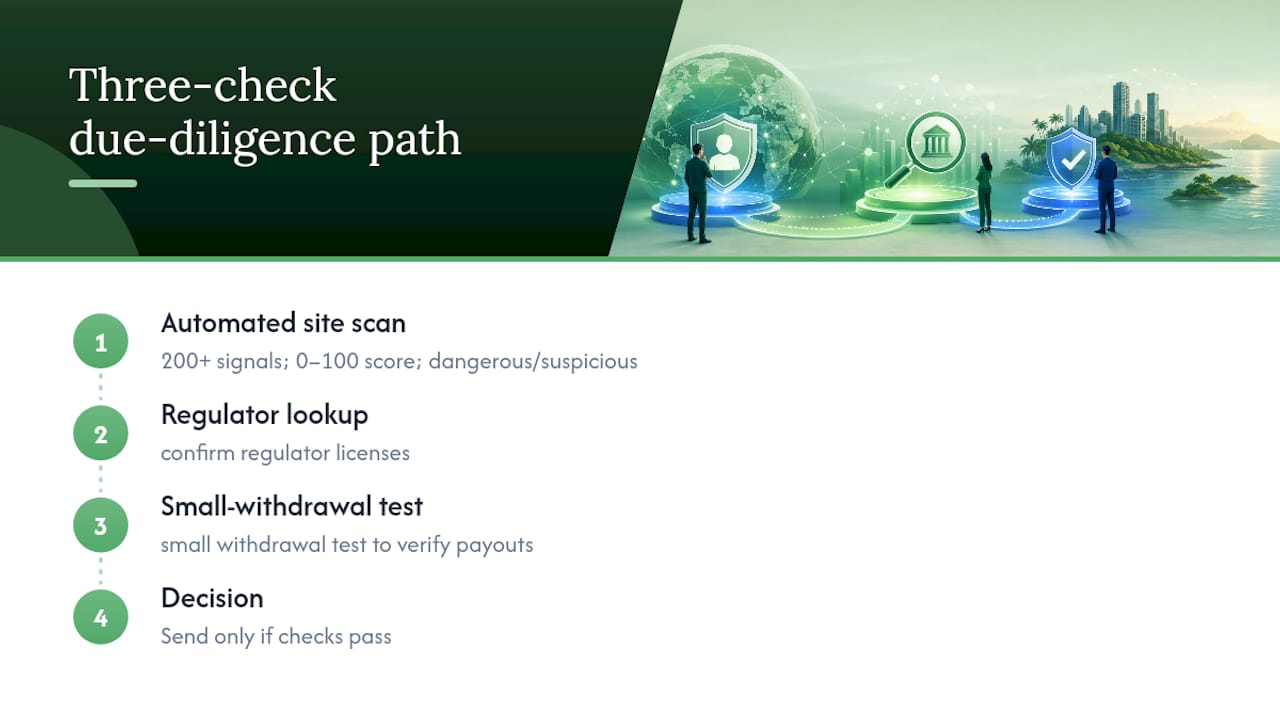
A Step-by-Step Due Diligence Checklist Before You Send Money
Verification takes twenty minutes. A scam takes your life savings. Here's the order that actually reduces risk, based on the checks regulators and consumer-protection guides consistently recommend.
- Verify the license directly on the regulator's register, not through a link the firm provides. Search the SEC's EDGAR system or the equivalent national regulator, and confirm the legal entity name and license number match exactly. Scammers frequently clone real license numbers onto fake entities, so the only reliable check uses contact details published on the regulator's own site, never the firm's.
- Confirm beneficial ownership and a real office address. Legitimate offshore fiduciaries are licensed individuals with public professional histories, not anonymous "wealth managers" reachable only through a messaging app.
- Run a small deposit and withdrawal test. Send a modest amount, then request a withdrawal back to your original funding source within the firm's stated business days. This single test exposes exit-scam behavior faster than any document review.
- Choose reversible payment rails. Cards and bank transfers give you dispute rights. Crypto and third-party account transfers give you almost none. If a firm insists on crypto only, that alone is reason enough to walk away.
- Search the principals' names alongside terms like "complaint," "lawsuit," or "sanction." A few minutes on a search engine often surfaces forum threads or regulator warnings that the firm's marketing conveniently omits.
Pro Tip: Do your small-withdrawal test before you're emotionally invested in the relationship. Scammers know that once you've built rapport with an "account manager," you're far less likely to walk away over a delayed payout.
Before wiring anything, it's also worth running the firm's domain through a business website authenticity check, which surfaces registration age, hosting anomalies, and ownership details that don't show up in a casual Google search.
Your Withdrawal Is Frozen: What to Do Right Now
Time matters here. Chargeback windows close, evidence disappears, and scammers count on victims freezing up instead of acting.
- Stop sending money immediately, even if you're told one more "fee" will unlock the frozen funds. It won't.
- Save every record: screenshots of your account balance, chat logs with the account manager, deposit receipts, and any emails referencing fees or bonus terms.
- Contact your bank or card issuer today to ask about a chargeback or dispute. Card networks typically enforce dispute deadlines measured in weeks, not months, so acting immediately preserves options that shrink quickly afterward.
- File a complaint with the relevant regulator (the SEC, CFTC, or your national equivalent) and a consumer-protection agency. These reports build case files even when individual recovery isn't possible.
- Watch for recovery-fee scams. A second wave of fraudsters targets victims by claiming to recover lost funds for an upfront fee. If someone contacts you unprompted offering recovery services, that's a second scam, not a rescue.
An independent consumer-protection lawyer, not the firm's own "legal department," is the only party whose advice you should trust at this stage.
Where Automated Site Verification Fits Into Your Checks
A trust score can't replace regulator verification, but it speeds up triage. Tools that scan 200+ signals, including WHOIS registration anomalies, Google Safe Browsing flags, and domain reputation history, catch structural warning signs before you've invested time confirming licenses manually. A site scoring in the "dangerous" or "suspicious" range on a 0 to 100 scale deserves the same skepticism as a cloned license number. Pair that scan with the small-withdrawal test and a regulator lookup, and you've covered the three checks that catch nearly every offshore scam pattern.
Common Types of Offshore Client Scams You'll Encounter
Most offshore fraud falls into three overlapping categories, and recognizing which one you're looking at helps you spot the specific tell.
Investment fraud is the broadest bucket: fake forex accounts, cloned trading platforms, and "private equity" pitches promising outsized offshore returns. These typically combine fabricated performance dashboards with real-looking account statements that never reflect actual trades.
Fake offshore bank or custody accounts target people specifically seeking privacy or asset protection. Scammers set up a shell entity claiming to hold funds in a jurisdiction with strong secrecy laws, then simply keep the money themselves. There's no real account behind the login screen you're shown.
Ponzi structures dressed up in offshore branding pay early investors with money from newer investors, creating the appearance of consistent returns. These collapse the moment new deposits slow down, which is why recruiters push so hard for you to bring in friends or family.
All three share the same underlying vulnerability: they depend on you never checking whether the underlying entity, license, or custodial relationship actually exists. That's precisely why the verification steps outlined earlier work across all three categories rather than needing a separate defense for each.
Legal Implications and Risks for Clients Involved in Offshore Scams
Losing money isn't always the only consequence. Depending on how the offshore structure was marketed to you, there can be tax and legal exposure on the client side too.
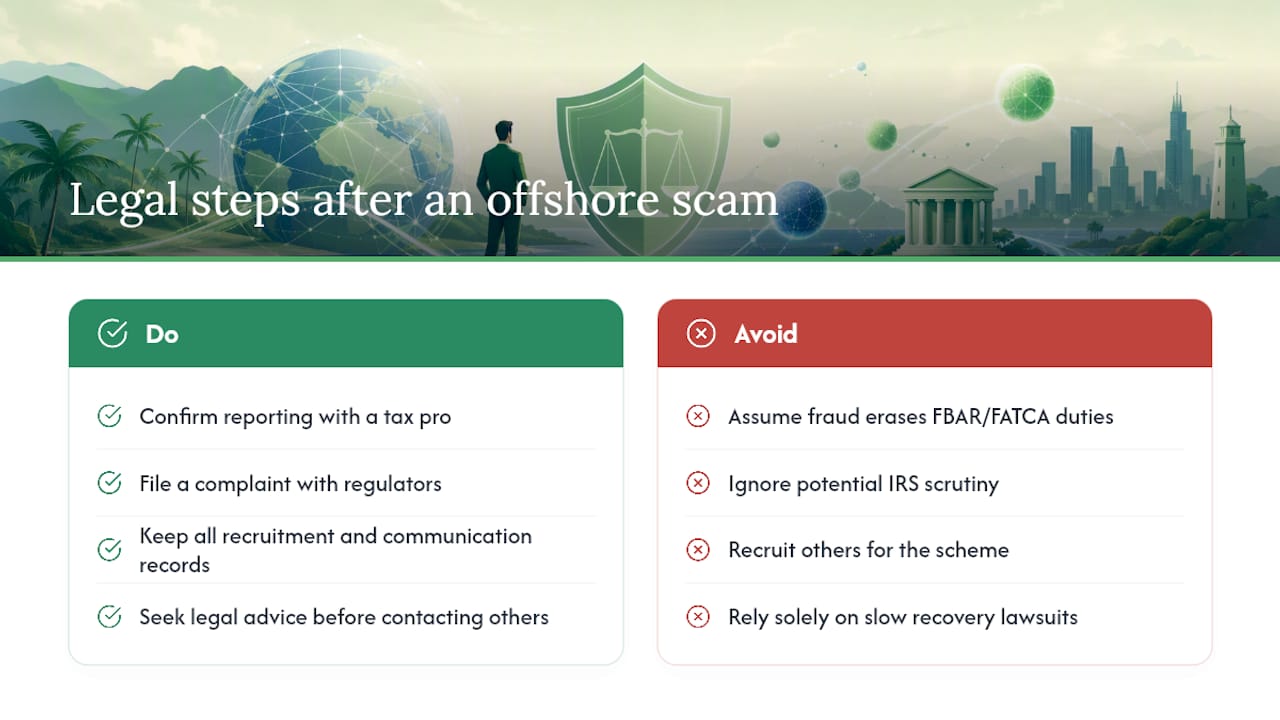
If a scam operation labeled its offering as an "offshore trust" or "tax-free account" and you reported it inaccurately (or not at all) on your tax filings, you could face separate scrutiny from the IRS even after losing the underlying funds. U.S. taxpayers with legitimate foreign accounts already face reporting obligations under FBAR and FATCA rules, and a scam doesn't erase that requirement. It's worth confirming with a tax professional whether any reporting is owed even for money you never actually recovered.
There's also a practical distinction between being a victim and being complicit. If you were recruited to bring in other investors, and the operation is later classified as a Ponzi scheme, recruiters sometimes face civil claims from downstream victims, even when they didn't know they were part of a fraud. Keep every record of what you were told and by whom.
Finally, recovery lawsuits against offshore entities are typically slow and expensive relative to the amount recovered, which is why regulators lean so heavily on prevention over litigation. Filing a complaint still matters, both for potential restitution funds and for building the case history that eventually shuts an operation down.
How Offshore Scams Target Specific Industries and Professions
Scammers tailor their pitch to whatever audience trusts them fastest, and certain groups get targeted with dedicated playbooks.
Retail forex and crypto traders see offshore brokers advertising leverage and bonus terms no regulated firm would offer, a combination the complete offshore broker risk guide documents in detail, and a pattern worth cross-checking against a forex broker comparison checklist before opening any account.
Retirees and pre-retirees get pitched offshore annuities or "asset protection trusts" that promise to shield savings from taxes or lawsuits, often through cold calls from someone posing as a financial planner.
Small business owners and freelancers with international clients are targeted through fake offshore payment processors that promise lower fees for cross-border invoicing, then simply hold the funds.
High-net-worth individuals and business owners face the most sophisticated version: bespoke "private banking" pitches complete with fabricated regulatory documentation. The tell across every version is the same. Real professionals in regulated industries welcome verification. Scammers discourage it.
Editorial Perspective: Secrecy Is the Real Red Flag, Not "Offshore"
The word "offshore" gets treated as inherently suspicious, and that's a mistake that actually helps scammers hide. Plenty of legitimate wealth planning happens through licensed offshore fiduciaries who file transparent reports. The danger isn't the jurisdiction. It's any offer that leans on secrecy as a selling point instead of verifiable credentials. Treat "no one will know about this account" as a bigger warning sign than any leverage ratio or bonus percentage.
— Nick
Check Any Offshore Firm's Website Before You Deposit
Online tools give you a faster first check than trying to manually piece together WHOIS records, hosting history, and blacklist status on your own. Paste any offshore firm's URL into the free site check and you'll get a trust score from 0 to 100 built from over 200 signals, including domain age, ownership transparency, and known scam-report overlaps, categorized into a plain verdict from "trusted" to "dangerous."
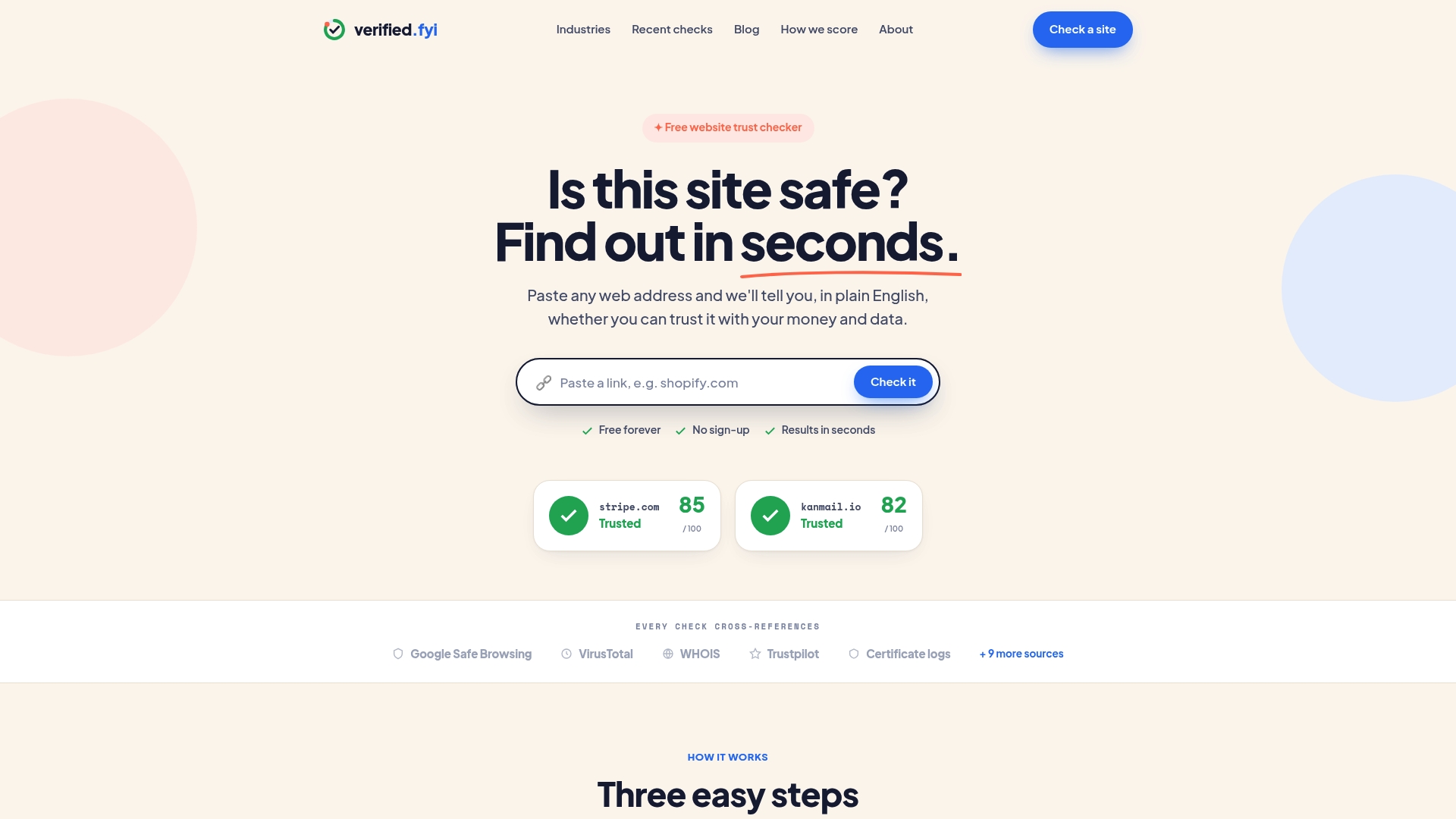
A poor score doesn't require further debate. Walk away and keep your deposit. A decent score doesn't replace the regulator lookup or the small-withdrawal test outlined earlier, but it does tell you whether the underlying website itself shows the technical fingerprints of a scam operation before you invest another minute of due diligence. Browse recently checked websites to see how the scoring plays out on real cases, then run your own check on the firm you're evaluating right now.
Primary Regulator Pages Worth Bookmarking
Start with the SEC's public warnings and press releases for enforcement actions and current scam patterns. Review the Treasury's national money-laundering risk assessment for context on which structures draw the most scrutiny. Most national regulators, including the SEC and CFTC, maintain searchable registries and dedicated complaint-filing pages worth locating before you need them urgently.
This article is general information, not a substitute for advice from a qualified financial advisor. Consult a qualified financial professional about your own circumstances before acting on anything here.
Sources
- SEC press release and warnings on offshore scams
- Notes on SEC protections and differences with unregulated entities — Columbia University
- 2024 National Money-Laundering Risk Assessment — U.S. Department of the Treasury
FAQ
What Does "Offshore Client" Mean?
An offshore client is a customer whose funds or account sit with a firm registered outside their home country, often in a jurisdiction chosen for lighter tax or regulatory requirements rather than for the client's benefit.
What Is Offshore Risk?
Offshore risk is the combination of weaker regulatory oversight, missing compensation schemes, and limited legal recourse that makes recovering lost funds far harder than with a domestically regulated firm.
Why Do Criminals Put Money in Offshore Accounts?
Criminals favor offshore jurisdictions because opaque ownership rules and limited cross-border enforcement make it easier to hide the source of funds, a pattern the Treasury's risk assessment specifically identifies as a money-laundering enabler.
How Safe Is an Offshore Account?
An offshore account's safety depends entirely on whether the firm is licensed with a verifiable regulator and offers fund segregation; without those two things, you have essentially no protection if the firm fails or disappears.
How Can I Check if an Offshore Firm's Website Is Legitimate?
Cross-reference the firm's license number directly on the regulator's official register, then run the domain through a site legitimacy check to catch hosting or ownership red flags before you deposit any money.