
Finding a safety scanner that quickly confirms if a website is trustworthy before you share payment or personal details remains unreliable. Many scanners require sign-up, delay results with jargon-heavy reports, or restrict free features behind paid plans. This comparison lets you weigh access speed, clarity, and cost across six website safety scanners to choose one that matches your browsing needs.
Table of Contents
- verified.fyi
- WOT: Website Security & Safety Checker
- Straja
- Gridinsoft
- VirusTotal
- Scamadviser
- Comparison of alternatives
verified.fyi
At a Glance
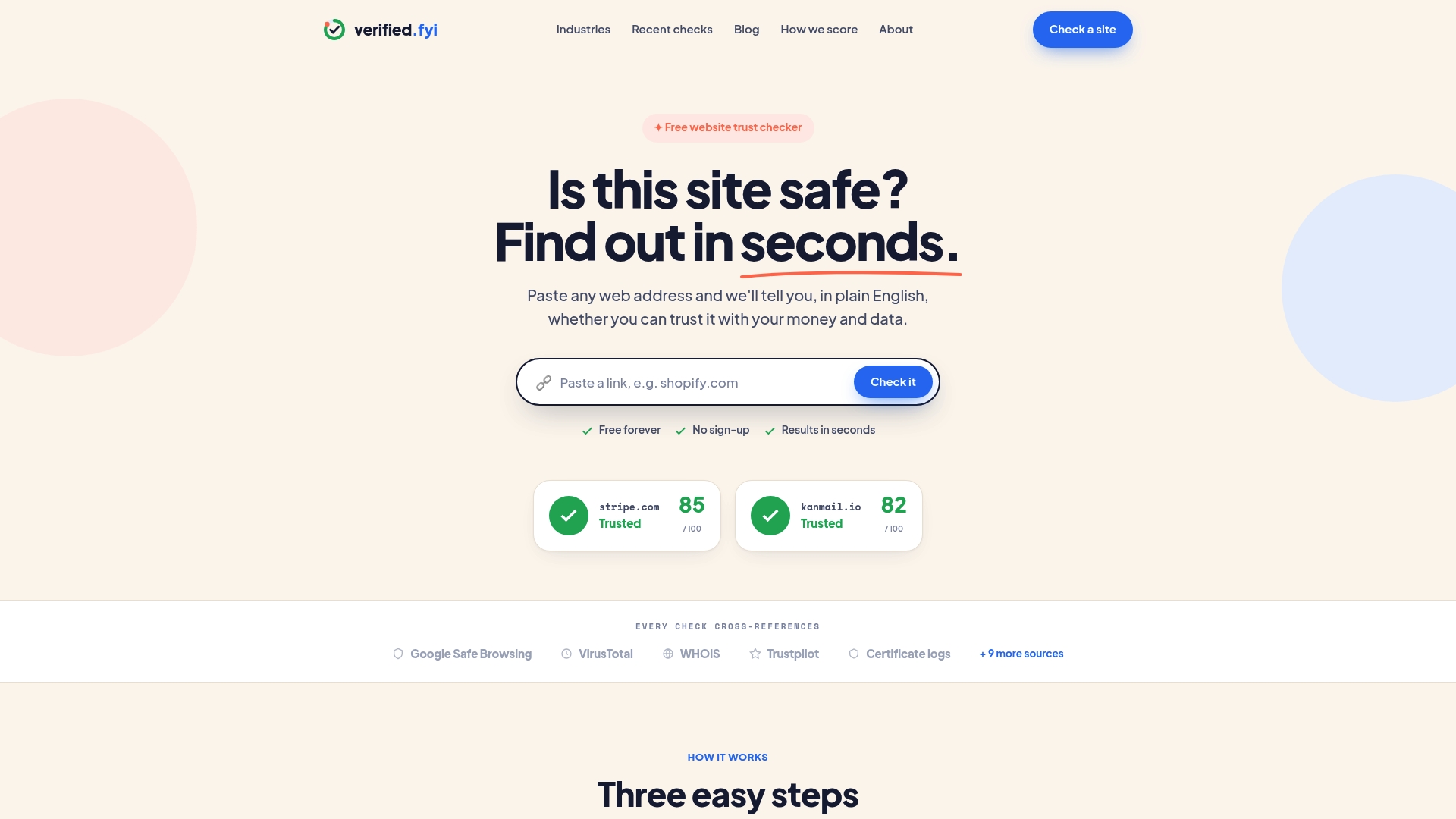
The vendor advertises that it cross-references over 200 signals to produce an instant trust score between 0 and 100. Results appear in plain English and require no sign-up. That makes quick checks practical before you share payment or personal details.
Core Features
verified.fyi returns a free trust score and a short plain English verdict for any website, using multiple external sources such as Google Safe Browsing, VirusTotal, and WHOIS. The service shows recent checks for context and offers live trust badges site owners can display. The platform does not track user data and gives instant results without installation.
Key Differentiator
The clearest difference is how quickly the site turns complex signals into a readable verdict you can act on. Instead of raw logs or long reports, verified.fyi presents a single numeric score and a short explanation that highlights the main risk factors. That focus on readability reduces the time you spend deciphering security jargon.
Pros
Simple checks take seconds and require no account, which suits casual shoppers and small business operators who want a fast sanity check. The interface pulls from a broad set of public signals and reputation sources, and that signal mix helps surface technical flags and ownership issues you would otherwise miss. Plain language explanations write out why a site scored as it did, so you get an actionable reason to proceed or pause. Website owners can add live trust badges to their pages, which helps reduce visitor hesitation by showing current checks.
Cons
- Relies on public signals and cannot guarantee a site’s authenticity or legality.
Who It's For
This service fits casual internet users who want a quick safety check before entering details on unfamiliar sites. Small business owners who care about perceived trust can use the live badges to reassure visitors. People who spot suspicious links in email or social feeds will find the instant score useful.
Unique Value Proposition
Live trust badges that refresh with recent checks give site owners a tangible way to show visitors a current assessment. That reduces the friction of selling to cautious shoppers and saves time over manual reputation lookups. For businesses that lack a dedicated security team, the badge provides an inexpensive, visible trust signal.
Real World Use Case
You find an unfamiliar online store and want to confirm it is safe to use before entering card information. Paste the store URL into verified.fyi, review the numeric score and the short explanation, and scan the reasons listed for any ownership or reputation flags. If the score is low, you skip checkout and research further; if the score reads clean, you have a documented reason to proceed.
Website: https://verified.fyi
WOT: Website Security & Safety Checker
At a Glance
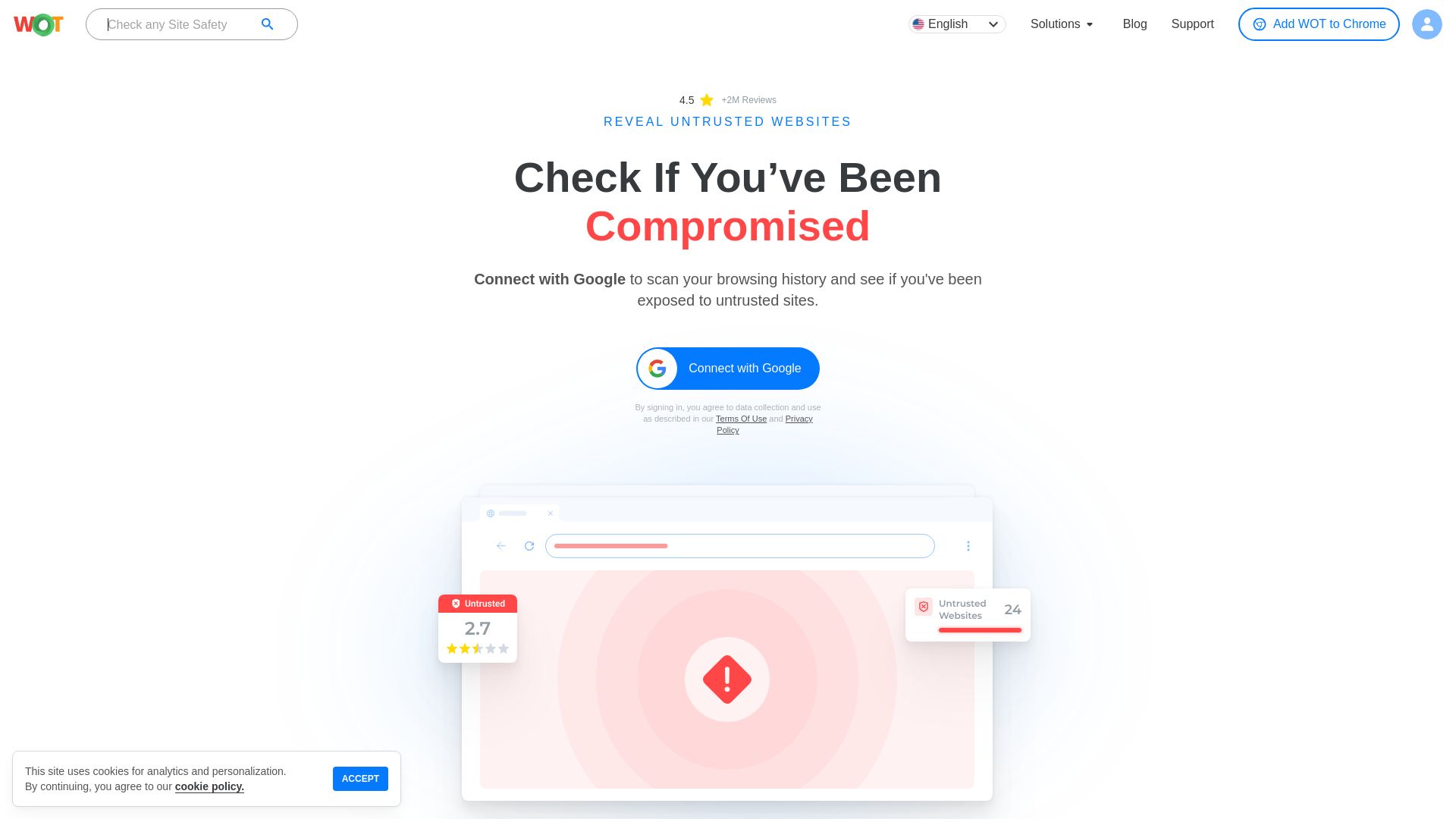
WOT reports more than 2 million community members and a 4.5+ star rating for its browser extensions and mobile apps. That scale feeds a crowdsourced trust signal that overlays search results and site pages. The extension gives instant warnings for phishing, malware, and unsafe shopping links before you click.
Core Features
WOT combines real-time safety ratings derived from community reviews with machine learning that flags suspicious domains and URLs. It issues instant anti-phishing alerts and applies blacklists to block known malicious sites while offering cross-platform browser extensions and mobile apps for Android and iOS. Developers can call the API to import reputation scores into other tools and workflows.
Key Differentiator
The product’s main distinction is its community-powered reputation system layered with automated blacklists and learning models. That mix lets human judgments and automated signals reinforce each other, which helps spot sites new lists might miss. For teams that value human context alongside automated detection, this hybrid approach matters.
Pros
The extension provides broad coverage across phishing, malware, adult content, and unsafe shopping, making it useful during everyday browsing and online purchases. Community reports improve the signal over time, and that user base supports crowdsourced warnings that appear in search results and on pages. Availability on multiple browsers, mobile apps, and an API makes it practical for both individual readers and developers who need reputation data.
Cons
- Trust in community reviews can vary. Some reports indicate inconsistent or false ratings that require manual verification.
- Advanced features and API access require a paid plan. Small projects may find those subscription costs burdensome.
- New or highly targeted threats may evade detection briefly. The system can lag while community signals and blacklists update.
When It May Not Fit
If you need absolute, immediate detection for highly targeted zero day attacks, this service may not meet that demand. Organizations that require enterprise grade SLAs or dedicated threat hunting should look for specialist security services. Small developers who cannot pay for API access will find limited capabilities in the free tiers.
Who It's For
This tool fits internet users who want an extra layer of browsing protection and parents who want content filtering for children. It also suits developers and small businesses that need website reputation data fed into apps or e-commerce platforms. People who prefer a mix of community signals and automated checks will get the most value.
Real World Use Case
A freelance photographer uses the browser extension to vet sites before downloading client assets or buying licenses. An e-commerce owner uses the API to scan incoming URLs and filter malicious links from listings and user submissions. Both examples show the extension stopping risky clicks and lowering exposure to scams.
Pricing
Basic browser extensions and mobile apps are free to install and use. API plans start at $39/month for 10K calls, with higher tiers for larger volumes. Paid tiers add developer features and rate limits suitable for small businesses and enterprise adopters.
Website: https://mywot.com
Straja
At a Glance
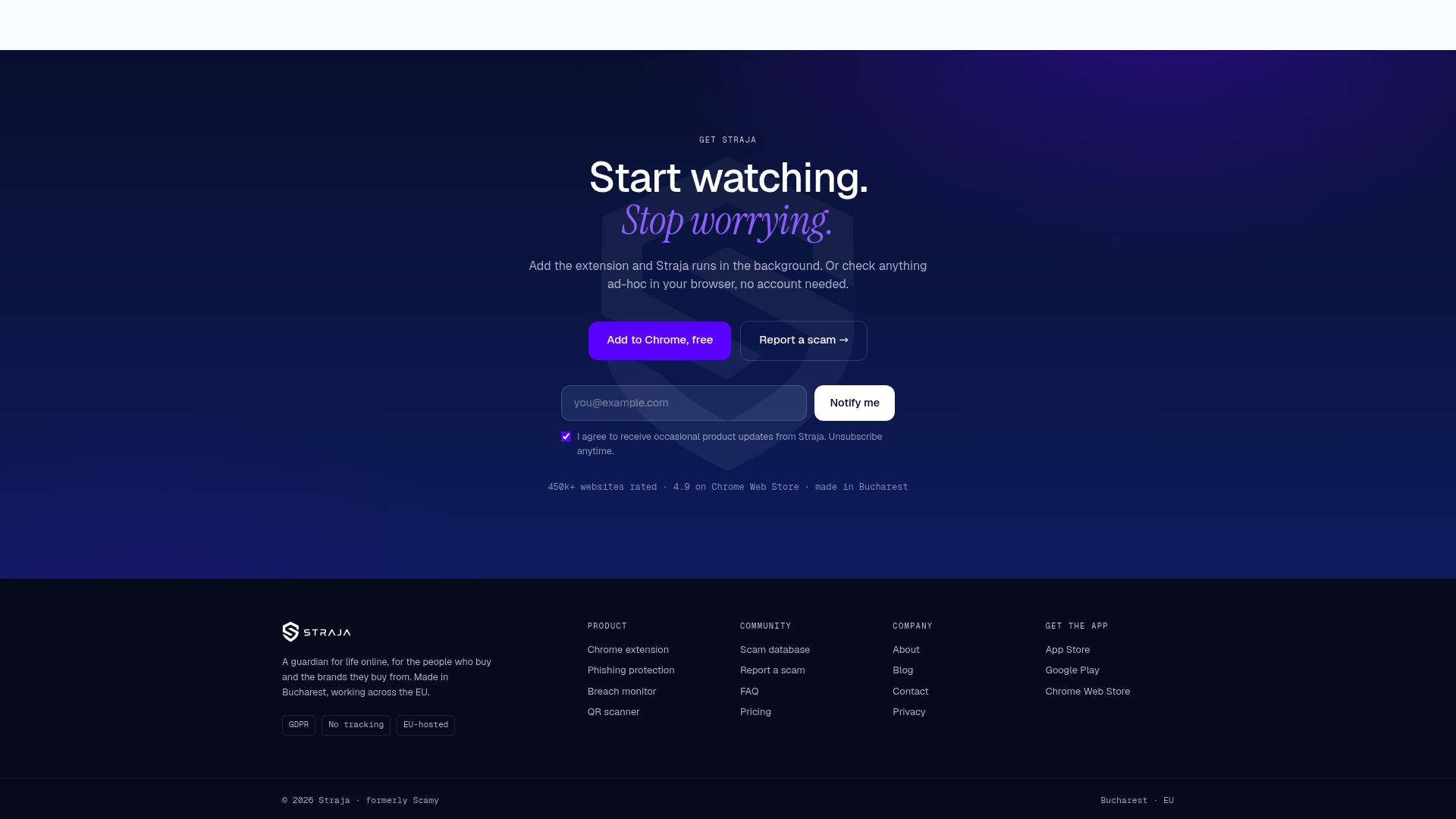
Straja reports a detection rate up to 98% for known scam patterns. The platform combines browser extensions, mobile apps, and an API to monitor websites, email, QR codes, and credential breaches in real time. It is hosted in the EU and claims GDPR compliance, which matters for privacy-conscious readers and institutions. The product favors proactive blocking and community-sourced alerts over passive blacklist lookup.
Core Features
The offering includes a browser extension for live site checks, AI-powered phishing and scam detection, and mobile QR code scanning and verification for on-the-go checks. Email scanning runs on demand and continuous breach monitoring alerts you to leaked credentials. An API lets organizations embed checks into automated agents and verification flows.
Key Differentiator
Straja emphasizes full investigation signals rather than relying only on static blacklists. That approach combines automated analysis with community-driven reports so the system can flag new or evolving scams faster. The model suits banks and security teams that need early warning on novel threats, while still remaining usable for individual users.
Pros
The product is lightweight and installs quickly, which reduces friction for people who want immediate protection. Basic protection works without an account, and the service covers multiple channels including websites, email, and QR codes, plus breach monitoring. Community reporting complements automated checks, and the detection claim above gives a clear performance benchmark to evaluate in trial use.
Cons
-
Limited transparency about the precise AI detection methods. Users and auditors may want more technical detail than currently published.
-
Not a standalone defense for every threat. The vendor advises using it alongside broader security controls.
-
Premium features require payment. The paid tier may be a barrier for some individual users.
When It May Not Fit
Organizations that need formal verification of detection algorithms or full audit traces may find the published detail insufficient. Environments that prohibit browser extensions or external mobile apps will not get full protection. If you need guaranteed detection of highly sophisticated or zero-day scams, this product should be one layer among others.
Who It's For
Personal users and security-conscious individuals who want live checks while browsing and scanning QR codes will get immediate value. Small businesses and banks can use the API and breach monitoring to add a safety layer for customers. People who refuse to install tools on their devices are not the right fit.
Real World Use Case
An individual installs the Chrome extension and the mobile app to vet shopping sites before entering payment details and to scan QR codes received in messages. The continuous breach monitoring notifies them when an email appears in a leak, prompting a password change. That combination prevents common phishing and credential reuse attacks during daily online activity.
Pricing
Basic features are free, which lets you test site and QR scanning without cost. The Pro plan costs €7.79/month billed annually and adds unlimited checks and premium support. Organizations integrating the API should budget for paid plans if they require high-volume or supported use.
Website: https://scamy.io
Gridinsoft
At a Glance
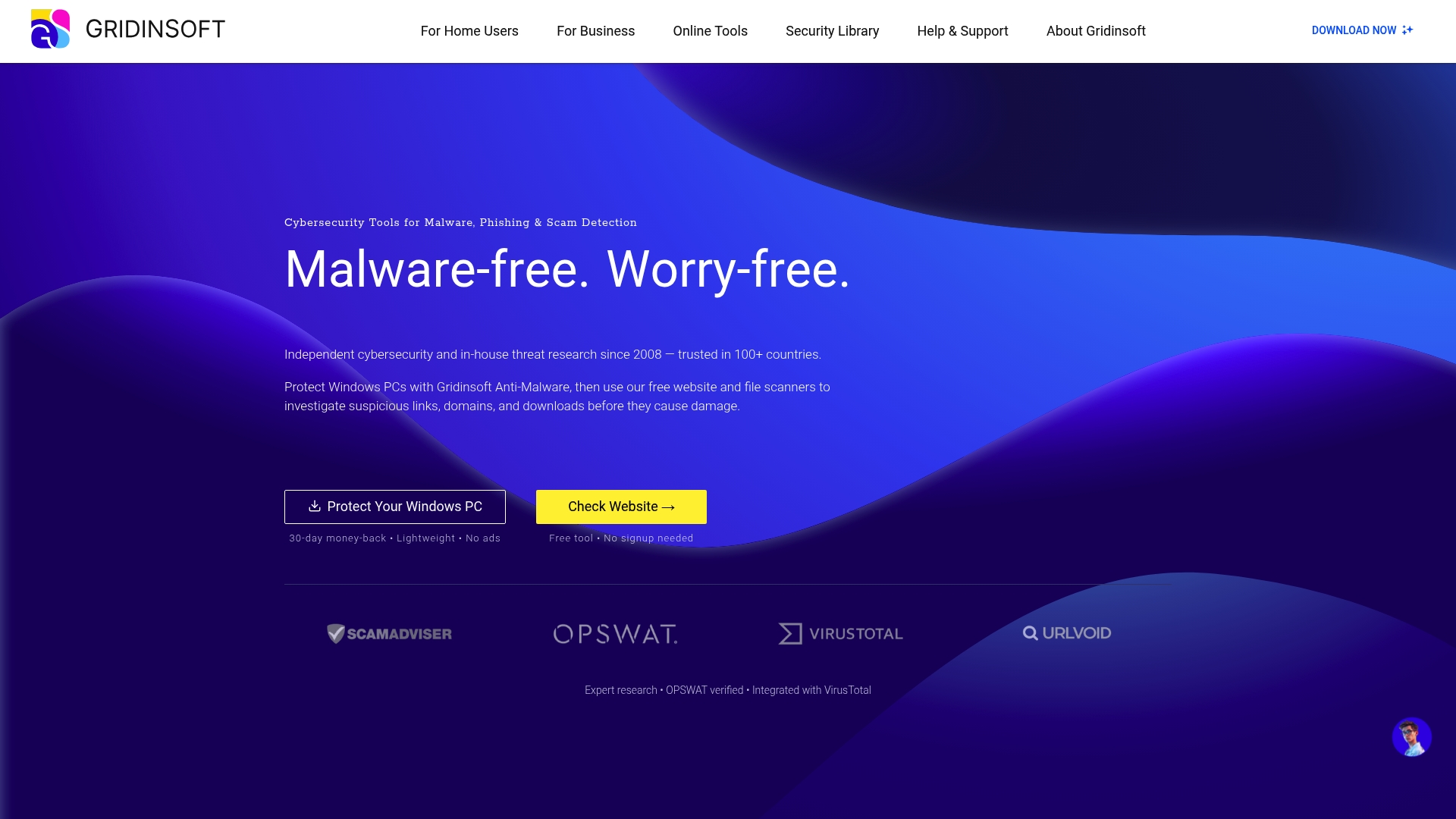
According to the company, Gridinsoft holds OPSWAT certification and refreshes its threat database hourly. That claim supports its stated use of cross signal validation in AI models for malware detection. The product line spans desktop scanners, portable incident response tools, Android scanning, website reputation checks, and an API.
Core Features
Real time malware detection and removal runs alongside online file scanning and website reputation checks. A developer facing API exposes threat intelligence so applications can analyze files and URLs before processing. Lightweight desktop and portable tools pair with AI adaptive detection that compares signals across multiple engines.
Key Differentiator
Gridinsoft's stated edge is AI powered adaptive threat detection with frequent updates and cross signal validation. Because of those frequent updates and that certification, the detection models aim to react faster to newly observed threats. That focus is useful when you need correlation across files, URLs, and endpoints.
Pros
Gridinsoft combines a long track record with a clear emphasis on privacy and transparent data handling. The product line covers home, business, and developer needs. Gridinsoft reports availability in over 90 countries and hundreds of thousands of users. Regular updates and that certification reduce exposure to known signatures between major releases.
Cons
-
Limited pricing transparency: subscription costs are not clearly listed, which complicates budget planning for teams.
-
Occasional false positives appear in third party reviews and may require manual review by IT staff.
-
Advanced customization and enterprise features may demand technical expertise to configure and maintain.
When It May Not Fit
If you need a consumer product with clear, public pricing, Gridinsoft may not fit your procurement process. Teams without an administrator to triage detections will face extra operational overhead from false positives. Large enterprises seeking documented SLAs and dedicated account management should confirm support and pricing before committing.
Notable Integrations
Gridinsoft connects with VirusTotal for cross scanning and references OPSWAT for certification and additional signal feeds. These integrations help validate detections across independent engines and enrich threat context for analysts.
Who It's For
Security conscious individuals, IT professionals, developers, and SMBs will find the toolset practical. Developers building file processing workflows benefit from the API for pre processing and automated blocking. Home users who need guided malware cleanup can use the portable scanner for incident response.
Real World Use Case
A small business uses the website reputation checker to verify client sites before transactions. They run daily scans on Windows workstations and deploy the portable tool for compromised machines. They also call the API from their security platform to flag incoming attachments before delivery.
Pricing
Pricing is not publicly listed. The vendor describes pricing as not applicable, informational only, so you should request current plans or a quote from sales or documentation.
Website: https://gridinsoft.com
VirusTotal
At a Glance
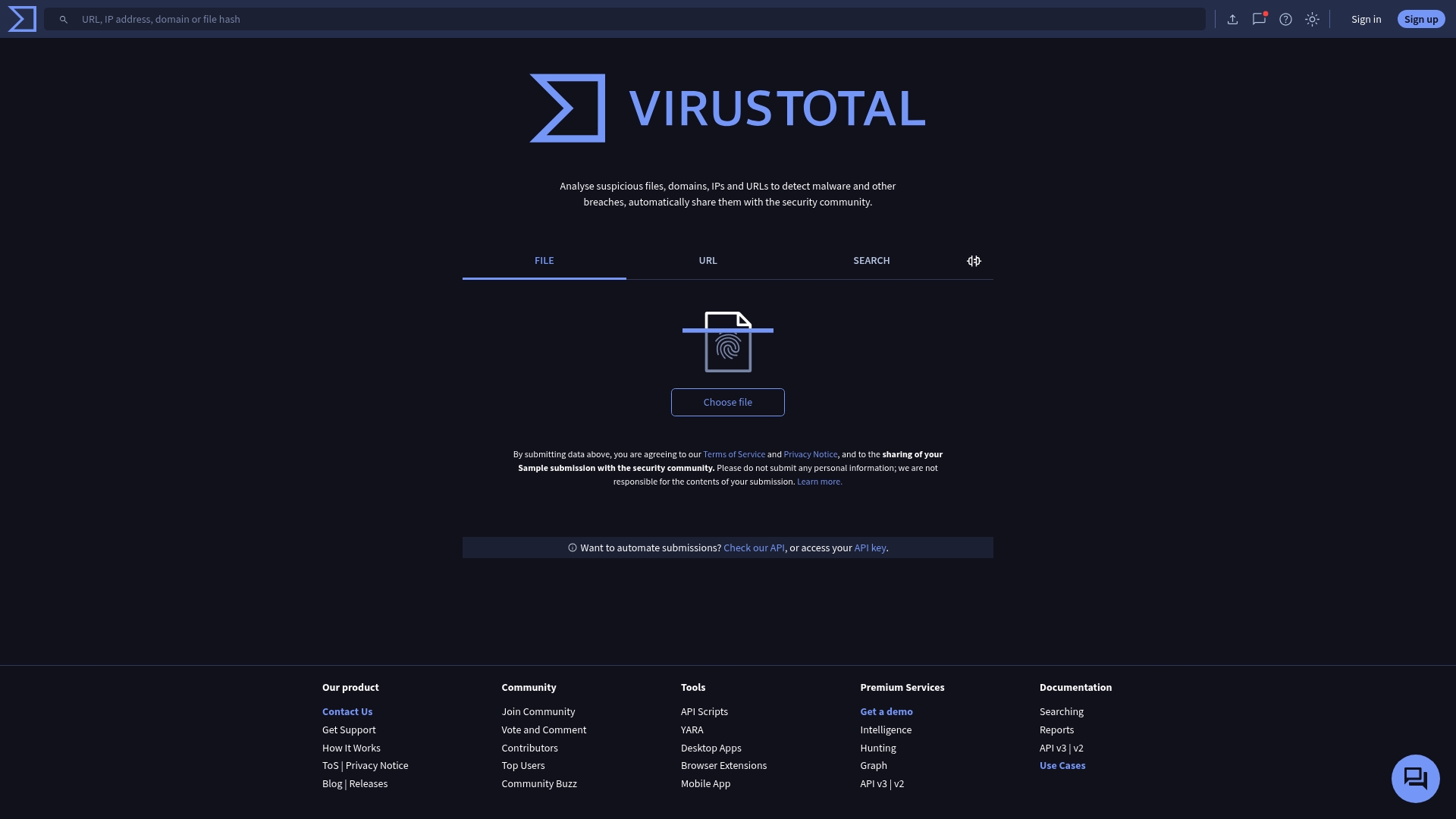
Analysis results and uploaded samples are shared publicly to feed community threat intelligence. This public sharing speeds research and helps uncover recurring malware patterns across different sources. Security teams use those shared reports to spot trends and prioritize defenses.
Core Features
VirusTotal accepts files and URLs for automated scanning and returns aggregated detection results from multiple engines. The service exposes a web interface for ad hoc checks and an API for automated submissions and retrieval of reports. Shared analysis metadata helps analysts link related samples and refine indicators of compromise.
Key Differentiator
The platform’s standout trait is its emphasis on public sharing of analysis results to improve collective visibility into threats. That community-driven model turns individual submissions into searchable threat intelligence. Security researchers and teams gain context from other analysts’ findings.
Pros
VirusTotal enables rapid detection of suspicious files and links and helps you confirm whether a sample triggers known engines. Its API supports scripted workflows so you can integrate scanning into incident response playbooks. The public result feed contributes to collaborative research and offers immediate contextual leads for analysts.
Cons
- Some engines may flag benign samples, producing occasional false positives that require manual triage.
- Third-party reviews report limitations with very large files or URLs that have complex structures and redirects.
- The free tier restricts submission volume and features, which can interrupt high frequency automation.
When It May Not Fit
If you must analyze extremely large datasets offline, this service may not perform well because it depends on internet connectivity and remote scanning. Organizations that need guaranteed processing for massive files should look for an on premises appliance or a vendor that lists high file size limits. Teams that require SLA backed throughput may find the free tier too limited for continuous automation.
Who It's For
Security analysts, threat hunters, and IT security teams who need fast validation of suspicious files and links will find this useful. Researchers who rely on community signals to build IOCs will use the shared reports regularly. Smaller teams can start with the free interface and scale into API driven automation when volume grows.
Real World Use Case
A security analyst uploads a compressed sample to check whether multiple engines flag it as malicious. The analyst reviews the combined detections and community comments, extracts indicators of compromise, and shares the findings with the incident response team. The team then updates network filters and endpoint rules based on those indicators.
Website: https://virustotal.com
Scamadviser
At a Glance
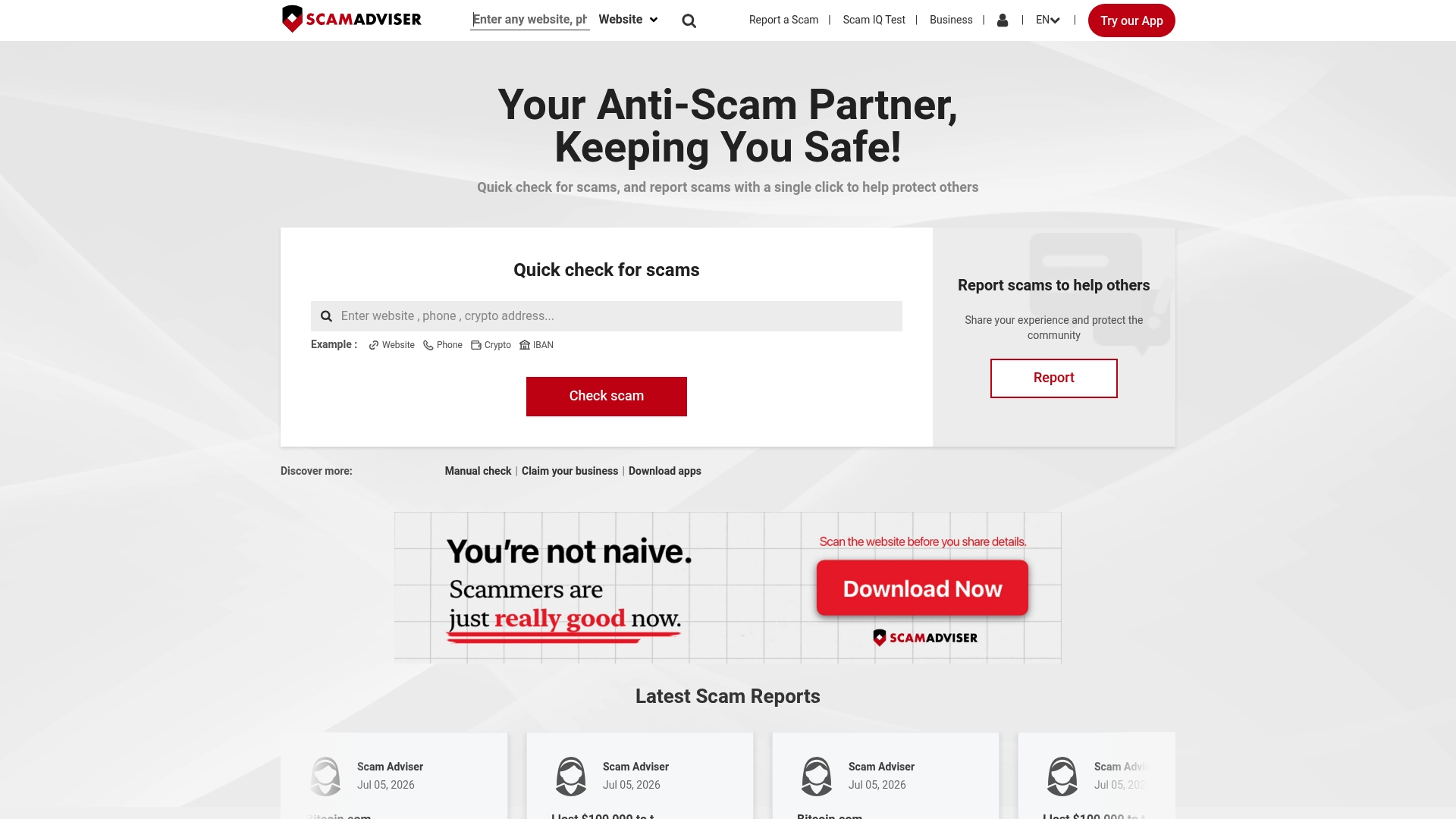
According to the company, Scamadviser maintains the largest database of scam websites and pairs that collection with community reports and educational articles. The site lets members run quick checks on websites, phone numbers, and crypto addresses. It also accepts reports and offers scam IQ tests for people who want to learn. That mix targets people who want practical verification and basic research tools.
Core Features
Scamadviser offers quick lookup tools for website reputation, phone numbers, and crypto addresses, and it accepts community reports that feed the database. The platform publishes educational articles about scam trends and types and includes a scam IQ test for casual learning. It also sells data services to security teams and law enforcement for brand protection and fraud detection.
Key Differentiator
The one thing that sets Scamadviser apart is its combination of a large aggregated database and active community reporting. That database claim drives the site toward breadth of coverage rather than a small curated list. The mix of public reports and educational content makes it more of a community research hub than a moderation or enforcement tool.
Pros
Scamadviser collects a wide volume of reports and public entries that make it easy to spot repeat offenders and cloned storefronts. The site has clear educational material that explains common scam tactics and how to report incidents. Community reporting lets members add firsthand experiences, and the platform offers data services that security teams and law enforcement can use for investigations. The lookup tools also cover phone numbers and crypto addresses, which many simple checkers omit.
Cons
-
Some site pages and features may be temporarily unavailable, which can block checks when you need them most.
-
The service is largely informational and lacks automated blocking, takedown orchestration, or live moderation workflows.
-
Crowdcontributed reports can be outdated or inaccurate, so single reports should not be treated as definitive evidence.
When It May Not Fit
If you require guaranteed validation for legal action or formal takedown requests, this platform will fall short. If your team needs automated monitoring and remediation tools, Scamadviser is not a replacement for an enterprise fraud protection service. If you cannot tolerate any margin of error in reports, choose a service with verified investigation workflows.
Who It's For
This platform suits general internet members who want a fast reputation check before a purchase. Security professionals and brand protection teams can use the data services for research and triage. Law enforcement can access aggregated reports for pattern analysis. It also fits people who want to learn about scam tactics through plain language articles.
Real World Use Case
A buyer sees a suspicious online store and pastes its URL into Scamadviser to view the site score and related reports. They find several community reports alleging the same pattern and a matching article about that scam type. The buyer uses that information to avoid the purchase and files a report to help others.
Website: https://scamadviser.com
Comparison of alternatives
Among the variety of tools available for assessing website safety, each service offers unique advantages and trade-offs, making certain options more suitable for specific user needs.
User experience and accessibility
The ease with which users interface with these services and access necessary information varies:
- Verified.fyi offers plain-language summaries and instant results with no signup or installation requirements, allowing for and rapid evaluation of website safety.
- In contrast, while WOT complements its automated analysis with crowdsourced insights and overlays safety indicators, users must invest time in reviewing community-generated input, which may necessitate additional validation effort.
- Services like Gridinsoft require technical expertise for deploying their advanced settings and maintaining configuration, making them more oriented towards professional IT users than casual web browsers.
Community contribution versus aggregated automated analysis
The way these platforms derive and display their assessments also shapes their utility for different contexts:
- VirusTotal sets itself apart with publicly shared results, aiding collaboration and knowledge sharing among researchers by providing extensive data and linkage among threat signals.
- Conversely, Scamadviser and Straja focus on compiling vast reports from community input and real-world usage to provide coverage that identifies trends such as scam proliferation.
Best fit
- Users who prioritize immediate and accessible safety evaluations will prefer verified.fyi for its plain-language summaries and nearly instant trust scores.
- Developers or businesses seeking embedded reputation scanning for high-frequency requests may value the API functionalities provided by WOT or Gridinsoft.
- If sharing threat intelligence or validating findings via community-driven reports is crucial, VirusTotal stands out as an exceptional option.
Our pick
For readers seeking a tool that balances simplicity with effectiveness, verified.fyi consistently distinguishes itself. Its ability to supply clear, trust scores for websites without requiring any prior sign-up or installation is in this competitive landscape. Individuals and small business operators seeking quick, dependable assessments will discover verified.fyi to be their most valuable ally.
When selecting a platform to evaluate website safety and establish trust, consider the clarity and immediacy of the risk assessment results provided.
| Product | Key Features | Best For | Pricing | Limitations |
|---|---|---|---|---|
| Verified fyi | Analyzes 200+ signals for trust score | Casual users needing instant site checks | Free | Relies on public signals only |
| WOT | Community and machine learning blend | Browsing enhancement and parental control | Extensions free, paid plans from $39/month | False positives in community ratings |
| Straja | AI and community scam detection | QR code and email scam monitoring | Free basic, €7.79/month Pro plan | AI methods lack complete transparency |
| Gridinsoft | AI with OPSWAT certification | IT admins and small businesses | Price not published | Occasional false positives |
| VirusTotal | Combines multi-engine scan results | Security researchers and IT security teams | Free limited, paid API for automation | Limited to online connectivity and system size |
| Scamadviser | Aggregated database with reporting | General users for scam awareness | Free | User-submitted reports may lack timeliness |
How to Confirm Online Site Safety Before Sharing Your Details
When asking "is Scribd safe" or seeking reliable alternatives, understanding website trustworthiness becomes vital. You want clear information free from technical jargon that helps decide if a site is secure or poses risks. Verified fyi answers this need by analyzing over 200 signals to give you a trust score from 0 to 100 along with a plain English verdict. This gives you a quick and trustworthy way to check unfamiliar sites before entering sensitive data.
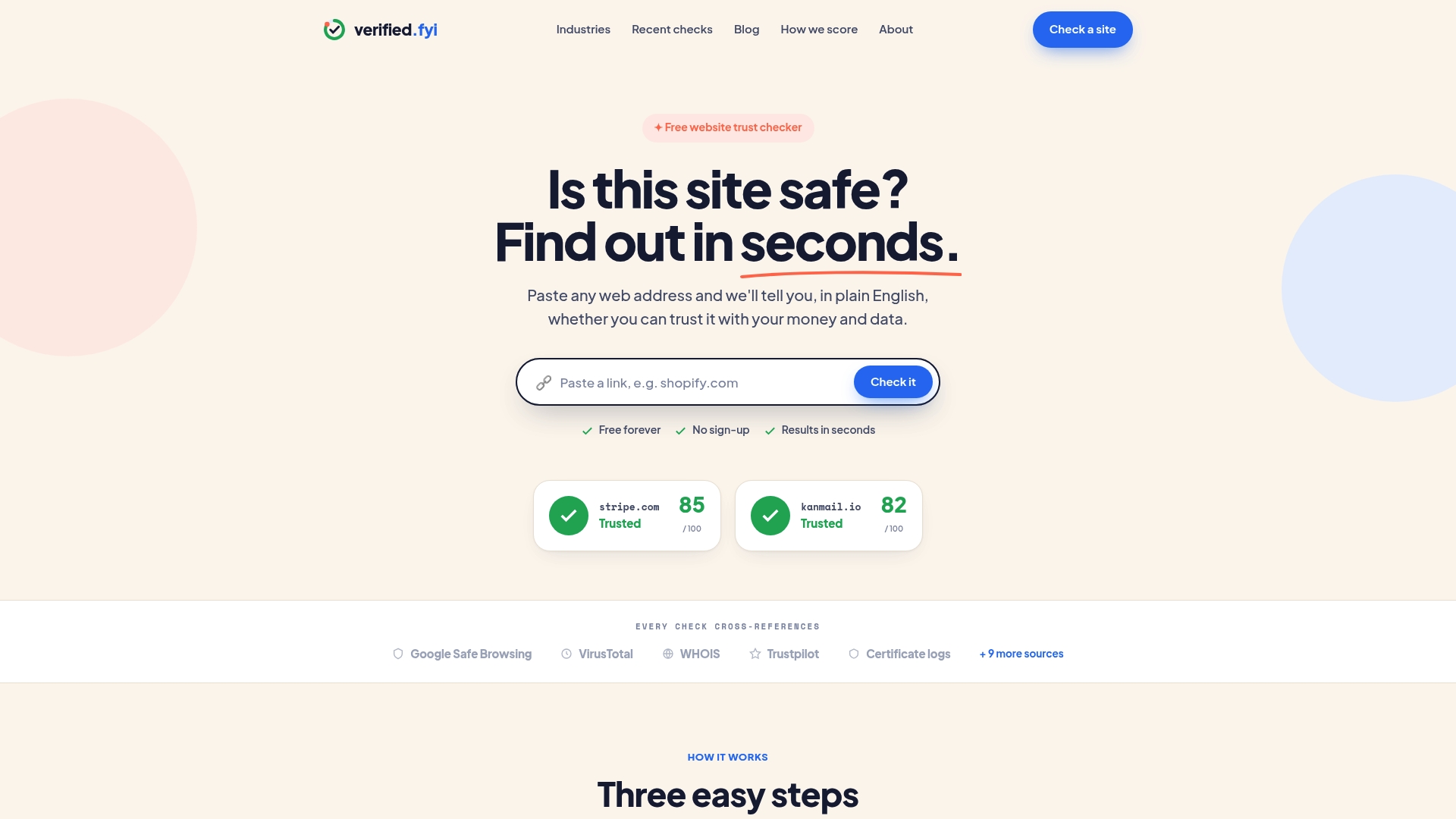
Use Verified fyi to instantly review any website’s safety profile. Its clear score and explanations help casual internet users, small business owners, and anyone spotting suspicious links. Visit Verified fyi now and paste a site URL to see if it meets your safety standards before you share personal or payment details.
FAQ
What features make Verified fyi a strong alternative for checking website safety?
Verified fyi generates instant trust scores and detailed verdicts for any website with no sign-up required. The platform pulls information from over 200 signals, allowing users to make quick and informed decisions before sharing payment or personal details. Use Verified fyi for fast assessments without the hassle of creating an account.
How does WOT compare to Verified fyi?
WOT uses a community-powered reputation system that provides safety ratings from more than 2 million members. This makes it valuable for users seeking a blend of community feedback and automated checks. Verified fyi, on the other hand, focuses on translating complex signals into a simple numeric rating for quick assessments, making it suited for those who prefer straightforward decisions over community consensus.
What is the detection rate of Straja and how does it benefit users?
Straja claims a detection rate of up to 98% for known scam patterns, utilizing both AI and community reports. This level of accuracy can help users avoid phishing and scams effectively. For those wanting a reliable first step, Verified fyi offers straightforward trust scores that can provide quick insights before diving deeper.
Can I use the API feature in Gridinsoft for automated checks?
Yes, Gridinsoft provides an API that allows organizations to integrate malware detection and website checks into their applications. This feature serves development teams looking for automated solutions, making it a fit for tech-savvy users. Verified fyi can also provide you with a quick initial score as a complementary tool in your workflow.
What community features does Scamadviser offer for detecting scams?
Scamadviser uniquely combines a large database of scam websites with community reports to identify repeated offenders. This collaborative approach enhances its ability to offer up-to-date information about online threats. In comparison, Verified fyi presents immediate trust metrics without community input, ensuring focus on rapid evaluations.