
A web-of-trust score is an AI-driven 0 to 60 rating that screens a website using more than 200 security, ownership, reputation, infrastructure, transparency, and compliance signals. It helps you decide whether a site is safe to visit, shop on, or share information with before you commit. Treat it as a screening aid, not proof of legitimacy: a high score lowers your risk, but it does not guarantee a clean outcome.
TL;DR:
- A website's trust score assesses security, ownership, reputation, infrastructure, and compliance through over 200 signals, but it is not an absolute proof of legitimacy.
- Quick rechecks before purchasing are essential because scores update daily and may lag after a site's issues are resolved or new problems emerge.
- A low score raises suspicion but does not confirm fraud; it should trigger a detailed review of specific flagged reasons and better payment methods.
- For trusted sites, verify domain spelling, check for HTTPS, and pay with a credit card to maximize protection against potential disputes.
- When a site is flagged as dangerous, never share personal information, retain evidence, and report suspected fraud to authorities.
Table of Contents
- What a site-trust score actually measures
- How to check a website's safety score in a few steps
- What the score categories mean and where they fall short
- A practical checklist based on your score
- Why scores change quickly and when to recheck
- Where the idea of a web of trust came from
- Web of trust versus certificate authority verification
- Real-world platforms that apply this layered approach
- How a score gets calculated behind the scenes
- Why this quick habit matters more than people assume
- Try the free trust checker before your next purchase
- Primary sources behind this guide
- Sources
- FAQ
What a site-trust score actually measures
A trust score is only as useful as the evidence behind it. Rather than relying on one clue, like a padlock icon or a polished homepage, a well-built score pulls from several categories of evidence and weighs them together.
- Security: malware and phishing indicators, often drawn from Google Safe Browsing, which flags social engineering, malware, and unwanted software, along with scan results from tools like VirusTotal.
- Ownership: WHOIS records showing domain age, registrant history, and whether ownership details are hidden behind privacy services.
- Infrastructure: hosting provider reputation and IP address history, since scam networks often reuse the same server blocks.
- Reputation: public reviews, complaint boards, and patterns in customer feedback across multiple sources.
- Transparency and compliance: whether a site publishes real contact information, a clear refund policy, and standard legal pages.
Google notes that its Safe Browsing lists come from automated algorithms and user feedback, and it is upfront that no single database is definitive. That is exactly why combining signal types matters. A site could pass a malware scan and still be a fresh scam domain with no ownership history, or it could have an old domain but a wave of recent complaints. Looking at several categories at once catches problems that any one check would miss, and it cuts down on false alarms when one signal looks bad but the rest of the picture is clean.
How to check a website's safety score in a few steps
Checking a site before you buy, sign up, or enter payment details takes less time than reading the reviews section. Here is the quick version.
- Paste the full URL into a checker, including the exact subdomain and path, since scammers often mimic real brands with small spelling variations.
- Read the score and its category rather than stopping at the number alone.
- Expand the listed reasons to see what actually drove the result, whether it is a young domain, a flagged host, or missing contact information.
- Double-check the spelling of the domain and confirm the connection uses HTTPS, keeping in mind that encryption alone does not confirm the business behind it is legitimate.
- Look for a working contact page, a phone number or address, and a clearly written refund policy.
Before you pay, the FTC recommends using a credit card rather than a debit card, gift card, or wire transfer, since credit cards carry stronger dispute protections if something goes wrong. If a seller insists on an untraceable payment method, treat that as a reason to stop. Unsolicited links, an unusually low score, or pressure to "act now" are all signals to slow down and dig deeper before entering any information.
Pro Tip: If a deal arrived through a social media ad or a text message you did not expect, verify the seller's website independently before clicking through, since attackers frequently advertise real brand names at fake discounts.
What the score categories mean and where they fall short
Most checkers sort results into categories like trusted, mostly safe, caution, suspicious, and dangerous. The category gives you a quick read, but the specific reasons behind it matter more than the label itself.
- Trusted or mostly safe: few or no red flags across the signal categories, though it is still worth skimming the reasons for anything unusual.
- Caution: mixed signals, such as a legitimate-looking site with a very new domain or thin reviews.
- Suspicious or dangerous: multiple serious flags, often including security warnings or a pattern of complaints.
A trust score is a risk summary, not a guarantee. Google Safe Browsing focuses primarily on social engineering, malware, and unwanted software, and its own documentation acknowledges that lists can miss dangerous sites or flag safe ones in error. HTTPS is another area where people assume more than the technology promises: it encrypts the connection between your browser and the site, but it says nothing about who is running that site or whether they intend to deliver what they sell. A clean score also does not guarantee you can recover your money if something goes wrong, which is why payment method still matters even when a site looks trustworthy on paper.
A practical checklist based on your score
Once you have a score, the next move depends on which category the site landed in.
If the site comes back trusted or mostly safe, confirm the domain spelling matches the brand exactly, read the refund policy before you check out, and pay with a credit card so you have recourse if the order goes wrong.
If the result is caution or suspicious, search the business name alongside words like "review" or "complaint" to see what other buyers have experienced, avoid gift cards or wire transfers if the seller pushes for them, and reach out to the seller directly to confirm order and shipping details before paying.
If the site is flagged as dangerous, do not enter login credentials, card numbers, or personal information under any circumstances. Close the tab, block the domain in your browser if possible, and report it.
- Save screenshots of the site, the listing, and any communication with the seller.
- Collect any contact information the seller gave you, including email addresses and phone numbers.
- Report suspected fraud to ReportFraud.ftc.gov so the pattern gets tracked.
Pro Tip: A quick reverse image search on product photos can reveal whether a "too good to be true" listing is copied from another retailer, a common sign of a cloned scam storefront.
Why scores change quickly and when to recheck
Trust scores are not static, because the underlying signals are not static either. Google's guidance on Safe Browsing notes that its index scans sites daily, and once a compromised site is cleaned up, removal from warning lists typically takes about 24 hours to fully propagate. That lag means a freshly fixed site might still show a warning for a short window, and a site that looked clean yesterday could be compromised today.
- Scans run on a recurring schedule, not continuously, so very recent changes may not show up yet.
- A cleaned site can still carry a stale warning for a short period after remediation.
- A previously trusted site can be compromised later, so a good score from last month says little about today.
The practical habit worth building is simple: recheck a site right before you pay or share credentials, not just the first time you visited it.
Where the idea of a web of trust came from
The phrase "web of trust" has roots in decentralized identity verification, where individuals vouched for each other's credentials without a single central authority making the call. Over time, the same underlying idea, that trust is stronger when it draws on multiple independent confirmations rather than one source, migrated into consumer-facing website safety tools.
Early web-safety efforts leaned heavily on blocklists: a single organization would maintain a list of known-bad domains, and browsers would check against it. That approach works reasonably well for known threats but struggles with new scam sites that have not been reported yet. Google Safe Browsing itself acknowledges this limitation, noting that its lists come from a mix of automated detection and user feedback rather than a single definitive source.
Modern trust-scoring tools extend that original idea by aggregating far more than a blocklist. Instead of asking "is this domain on a bad list," they ask "what does the full picture, security, ownership, reputation, infrastructure, and compliance, say about this site." That shift from a single yes-or-no list to a weighted combination of many independent signals is the direct descendant of the original web-of-trust concept, just applied to modern shopping and browsing decisions rather than identity credentials.
Web of trust versus certificate authority verification
Certificate authorities, or CAs, verify one narrow thing: that a website controls the domain it claims to and that the connection to it is encrypted. When your browser shows a padlock, a CA has issued a certificate confirming that technical fact. It says nothing about whether the business behind the site is honest, delivers what it sells, or handles your data responsibly.
A web-of-trust style score works differently by design. Rather than confirming one technical fact, it combines many kinds of evidence, security scan results, how long the domain has existed, hosting reputation, public complaints, and whether the site is transparent about who runs it, into a single risk picture. The CA model answers "is this connection encrypted." A trust score tries to answer the broader question a shopper actually cares about: "should I trust this site with my money or my information."
Neither approach replaces the other. HTTPS and CA-issued certificates remain a baseline expectation for any legitimate site, and their absence is itself a red flag. But as the FTC points out, HTTPS does not prove legitimacy on its own, since scam sites can and do obtain valid certificates. A trust score is meant to pick up where certificate verification leaves off, by layering in the reputation and ownership signals that a certificate simply was never designed to check.
Real-world platforms that apply this layered approach
The layered, multi-signal approach behind a modern web-of-trust score shows up across several parts of the safety ecosystem you likely already use without noticing. Browsers rely on Google Safe Browsing to warn you before you land on a page flagged for malware or phishing, drawing on both automated detection and user reports rather than a single fixed list. Malware-scanning aggregators like VirusTotal combine results from dozens of independent engines rather than trusting any one antivirus vendor's verdict alone, which mirrors the same "many signals beat one signal" logic.
Domain registration lookups through WHOIS give another layer, surfacing how long a domain has existed and whether ownership is disclosed or hidden, information that on its own means little but adds useful context alongside a security scan. Public complaint databases and review aggregation add a human layer that automated scans cannot capture, since a site can be technically clean while still generating a pattern of unresolved customer complaints.
Some website trust checkers pull categories such as security, ownership, reputation, infrastructure, transparency, and compliance into a single score so you do not have to check each source separately. Instead of opening a WHOIS lookup, a Safe Browsing check, and a review search in three separate tabs, you get the combined read in one pass, which is the practical, everyday version of the layered verification model these platforms use individually.

How a score gets calculated behind the scenes
Aggregating more than 200 signals into one number is not a matter of averaging them equally. A meaningful score weighs each signal by how strongly it predicts risk and by how relevant it is to the type of site being checked, since the signals that matter for an e-commerce storefront differ from the ones that matter for a content blog or a financial service.

Security signals, such as a malware flag from Google Safe Browsing, tend to carry heavy weight because they represent a confirmed technical threat rather than an inference. Ownership and infrastructure signals, like a domain registered days ago and hosted alongside known scam sites, carry moderate weight individually but compound quickly when several of them point the same direction. Reputation signals, like a cluster of recent complaints, add context that purely technical scans cannot see on their own.
Google's own documentation on its Safe Browsing Advisory is candid that automated systems and user feedback are effective but incomplete, which is the core reason context-aware weighting matters more than a simple checklist. A rigid checklist treats every flag the same regardless of context; a weighted model adjusts for the fact that a missing refund policy on a five-year-old retailer with thousands of reviews means something different than the same gap on a domain registered last week. That contextual weighting, rather than any single signal, is what turns raw data points into a score you can actually act on.
Why this quick habit matters more than people assume
Most people learn about unsafe websites the hard way, after a charge they do not recognize or a product that never arrives. The signals that separate a legitimate storefront from a convincing fake, domain age, hosting reputation, a pattern of complaints, rarely show up if you are just scrolling past a checkout page on your phone. Your eye glosses over these details; a system built to check all of them at once does not.
This approach reflects that gap directly: the checker analyzes numerous signals across security, ownership, reputation, infrastructure, transparency, and compliance, and returns a clear verdict rather than a pile of raw data you would need a background in web security to interpret. The value is not in replacing your judgment. A shopper who pastes a suspicious link before checking out, instead of after a disputed charge, is the entire point of building this kind of tool for everyday use rather than for security professionals.
— Nick
Try the free trust checker before your next purchase
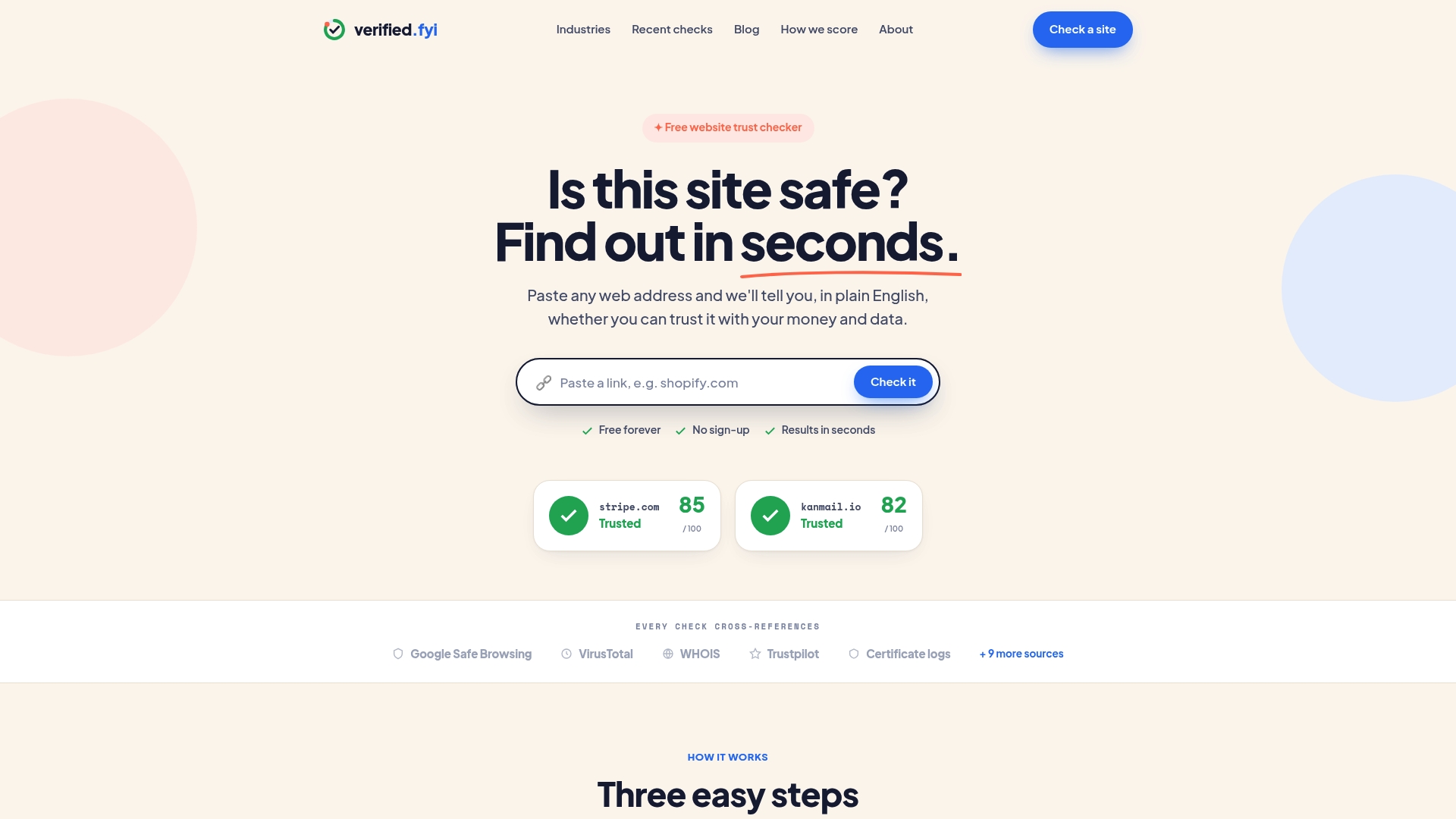
Running a check should not require creating an account or reading a technical report. Some free website trust checkers let you paste any URL and get an instant score with a plain-language breakdown of what drove the result, at no cost and with no sign-up required.
If you run a site yourself, whether as a freelancer, a small shop, or a growing business, a trust badge can give customers a visible signal that your site has been checked, which can help during a purchase decision when a stranger is deciding whether to trust you with their card details.
- Paste a URL and get a score with reasons, not just a number.
- Browse recently checked websites to see how the scoring plays out on real examples.
- Check the most trusted security and VPN sites if you are comparing providers in that category.
Check a website now before you enter any payment details on a site you are not sure about.
Primary sources behind this guide
The guidance above draws on Google's Safe Browsing Advisory for how automated threat detection works, FTC online shopping guidance for payment safety, and CISA's holiday shopping safety guidance for vendor verification. For a deeper technical read on how HTTPS affects credibility, see this guide to SSL and website trust.
Sources
- Safe Browsing Advisory | Safe Browsing APIs (v4) | Google for Developers
- Google: Safe Browsing and site-cleaning guidance
- Online shopping | Consumer advice — FTC
- #SecureTheSeason: Holiday online shopping safety — CISA
FAQ
What does a web-of-trust score actually tell you?
It tells you how a website scores from 0 to 60 across security, ownership, reputation, infrastructure, transparency, and compliance signals, giving you a fast read on risk before you visit or buy. It works as a screening aid rather than a legal or financial guarantee, so pair it with basic checks like verifying the domain spelling and payment method.
Is a low score proof that a site is a scam?
Not necessarily. Google itself notes that no single database is definitive, so a low score should prompt closer review of the specific flagged reasons rather than an automatic assumption of fraud.
How often do trust scores update?
Security scans like Google Safe Browsing typically run on a daily schedule, and cleaned sites are usually cleared from warning lists within about 24 hours, though updates can lag briefly. Recheck a site shortly before paying or sharing sensitive information, since a score from days ago may not reflect the site's current state.
What is the safest way to pay if a site's score is uncertain?
The FTC recommends credit cards over debit cards, gift cards, or wire transfers, since credit cards offer stronger dispute protections if the purchase turns out to be fraudulent. Avoid any seller who insists on an untraceable payment method, regardless of how legitimate their site appears.
Does Verified.fyi charge for a website check?
No. Verified.fyi's core website trust checker is free with no registration required, and it returns an instant 0 to 60 score with a breakdown of the signals behind it.