
Site trust verification gives parents a fast, evidence-based safety signal they can check before allowing or sharing a link with their family. Tools like Verified scan a site and return a score from 0 to 100, breaking down exactly which signals raised or lowered it. That score doesn't replace a conversation with your kids about scams, but it gives that conversation something concrete to point to.
TL;DR:
- Site trust verification tools highlight suspicious signals such as new domains, lack of contact information, and no HTTPS to help parents assess site safety quickly.
- Automated scores can misjudge legitimate new businesses as risky or overlook sophisticated scams that use valid certificates and hosting, so manual checks remain important.
- Urgency tactics, like countdown timers and pressure messages, are common in phishing attempts and should trigger extra caution before clicking or sharing links.
- Recognizing red flags such as misspelled domains and unusual personal data requests can prevent financial loss, identity theft, and malware infections.
- Combining a site’s trust score with manual review and household routines, like the "Take 9" rule, strengthens family safety without reliance on restrictive controls alone.
Table of Contents
- Why verification matters for families: the scale of scams and what it prevents
- How modern site trust verification works
- A practical verification checklist you can use right now
- Limits of automated verification and when it gets things wrong
- Building verification into family routines
- How SSL certificates, seals, and browser indicators differ
- Setting up parental controls that include trust verification
- What trust verification means for your child's privacy and data
- Teaching your kids to recognize a trustworthy site themselves
- What this looks like in practice for families
- Why Verified.fyi focuses on family-friendly verification
- Try the free checker before you click or share
- Sources
- FAQ
Why verification matters for families: the scale of scams and what it prevents
Scams aren't a rare encounter anymore. About three-quarters of adults under 50 in the United States report having experienced an online scam or attack, according to the Pew Research Center. That figure spans fake shopping sites, impersonated delivery notices, and phishing links sent through text or social media, the exact categories a family is likely to run into while browsing together.
A very high number of phishing attacks were recorded in Q2 2025, according to the APWG, a volume that keeps climbing year over year. Most of these attacks rely on the same tricks: a storefront that looks real but ships nothing, a login page copying a familiar brand, or a message pretending to be a streaming service or school portal.
What verification catches before it becomes a problem for your household:
- Financial loss from fake storefronts or payment pages designed to collect card details.
- Identity theft from forms that ask for more personal information than a legitimate site would need.
- Malware delivered through downloads disguised as games, homework tools, or media players.
A quick check before a click turns a guess into a decision backed by data.
How modern site trust verification works
A trust verification tool doesn't rely on one signal. It pulls from several categories at once and summarizes them so you don't have to read a technical report to understand the verdict.
- Technical security: whether the site uses HTTPS and a valid TLS certificate, which encrypts data passed between the browser and the server.
- Domain and infrastructure: how old the domain is, who registered it (via WHOIS), and where it's hosted, since many scam sites are brand new and hosted cheaply.
- Reputation and blocklists: cross-referencing databases like Google Safe Browsing and VirusTotal for known malware or phishing associations.
- Content and transparency cues: the presence of real contact information, clear terms of service, and a physical business address.
- User reports: patterns from people who have already flagged a site as suspicious or confirmed it as safe.
Verified weighs more than 200 of these signals with AI, adjusting how much each one matters depending on the type of site. A small local bakery's new domain shouldn't be judged the same way as a checkout page asking for a credit card. The result is a single score from 0 to 100, with a plain-language verdict ranging from dangerous to trusted, and a breakdown of exactly which signals pulled the score down. The full breakdown of how that weighting works is public on the methodology page.
Pro Tip: Don't just read the score. Check the top two or three flagged signals, since they usually tell you the actual reason a site is risky.
A practical verification checklist you can use right now
Checking a site before letting your kid click through or before sharing a link in a family group chat takes less than a minute once it's a habit.
- Paste the URL into a verification tool and read the score along with the top flagged signals.
- Scan the page yourself: look for HTTPS, check the domain spelling against the real brand, and note whether there's a real contact page or return policy.
- If the site pressures you to act fast, pause. Urgency is one of the most common tactics in phishing attempts, designed specifically to short-circuit careful thinking.
- If something still feels off, stop before entering any payment or login details, and verify the business through an independently sourced phone number rather than one listed on the suspicious page itself.
Red flags worth recognizing on sight:
- A domain that swaps letters or adds extra words to a familiar brand name (amaz0n-deals.com, for example).
- Countdown timers or "only 2 left" banners paired with no verifiable seller history.
- Checkout pages that ask for a Social Security number, full birth date, or security question answers.
If a site turns out to be a scam, the FTC recommends reporting it through ReportFraud.ftc.gov and using payment methods like credit cards, which offer dispute protections that debit cards and gift cards don't. Afterward, talk through what happened with your child so the red flags stick for next time.
Limits of automated verification and when it gets things wrong
No scoring system catches everything, and understanding where it falls short matters as much as knowing what it catches. A brand-new local business or a small nonprofit might score lower simply because its domain is young and it hasn't built up reputation signals yet, a false positive that penalizes legitimacy rather than risk. On the other side, well-funded scam operations sometimes rent legitimate hosting and buy valid certificates, producing a false negative that looks clean on the surface.
- Favor known marketplaces over standalone storefronts when the option exists.
- Use payment methods with built-in dispute protections rather than wire transfers or gift cards.
- Verify a seller's identity through an independent search rather than trusting only what's on their page.
Pro Tip: When a score and your gut disagree, trust the combination. A clean score with a pushy, too-good-to-be-true offer is still worth a second look.
If something slips through, report it, block the domain in your browser, and contact your bank or the platform involved if money or personal data has already been shared.
Building verification into family routines
Checking a site together, rather than just blocking or allowing it silently, teaches judgment instead of just enforcing rules. Common Sense Media notes that this kind of active mediation tends to work better than restrictive controls alone, partly because kids start to recognize patterns themselves instead of just hitting a wall.
A simple household system makes this easier to sustain:
- Adopt the "Take 9" rule: pause for nine seconds before clicking a link or finishing a purchase, long enough to break the urgency trick scammers rely on.
- Create a family scam plan with a safe word kids can use if a message or call feels wrong, an approach cybersecurity outreach programs like UTHSC's recommend for reducing panicked decisions.
- Bookmark trusted sellers so there's less temptation to click an unfamiliar ad link under time pressure.
- Set a household rule that purchases over a certain amount get a second set of eyes before checkout.
How SSL certificates, seals, and browser indicators differ
These three signals get lumped together often, but they check different things. An SSL (or more precisely, TLS) certificate confirms that data moving between your browser and the site is encrypted. It says nothing about whether the business behind that site is honest. Plenty of scam sites have a valid padlock icon.
Third-party trust seals, the badges some sites display claiming "verified" or "secure," vary widely in rigor. Some represent a genuine review process; others can be copied and pasted onto any page with no verification behind them at all. A seal is only as trustworthy as the organization issuing it, and consumer guidance generally recommends confirming a seal directly with its issuer rather than taking it at face value.
Browser indicators, like warning banners for known malicious sites, rely on blocklists that take time to update. A brand-new scam site can operate for days before it's flagged, which is why browser warnings catch known threats but miss fresh ones. A verification score that pulls from multiple categories at once, rather than one single check, tends to close that gap better than any single indicator on its own, though none of these methods is a guarantee.

Setting up parental controls that include trust verification
Most modern parental control tools now build in some form of site reputation checking, usually layered on top of the content filtering and screen time limits you'd expect. When setting one up, start by deciding what you actually need: a filter for content categories, a time limit, or real-time warnings when a site scores poorly on security.
Enable browser-level protections first, since most major browsers include a free safe browsing feature that blocks known malicious domains automatically. From there, add a parental control app if your family needs more granular rules, like restricting purchases without approval or getting notified when a new, unfamiliar site is visited.
Pair whatever tool you choose with manual spot checks. Run a questionable link through a free checker like Verified before approving it permanently, rather than relying only on whatever category the parental control software assigned it. Automated filters are good at blocking known bad actors; they're slower to catch something brand new. Combining a parental control setup with an independent site check closes that gap without adding much extra effort to your routine.
What trust verification means for your child's privacy and data
Checking a site before your child enters any information on it isn't only about avoiding scams. It's also about limiting how much personal data gets collected in the first place. A site that fails a trust check often shares a pattern: it asks for more information than its stated purpose requires, a game site asking for a home address, or a quiz asking for a birth date and school name.
Verification doesn't access or store your child's personal information. It evaluates the site itself, its security setup, ownership history, and reputation, before any data ever gets typed in. That distinction matters because it means you're reducing risk at the point of decision, rather than after something has already been submitted.
Common Sense Media specifically flags caution around AI-marketed services and data privacy aimed at kids, noting that many lack consistent regulatory oversight. A trust check adds one more layer of scrutiny before your child interacts with a new app or website that asks for personal details, on top of whatever privacy settings you've already configured.
Teaching your kids to recognize a trustworthy site themselves
The goal isn't to run every link through a checker forever. It's to help your kids build the instincts to notice warning signs on their own, so the habit holds up even when you're not standing over their shoulder.
Start with the basics they can check in seconds: does the URL match the real brand name exactly, is there a padlock icon in the address bar, and does the site have a working contact page. Walk through a few examples together, a legitimate retailer alongside a copycat site, so they see the difference firsthand rather than just hearing a rule.
Teach them to notice pressure tactics specifically. CISA's phishing guidance points to urgency as one of the most common tricks: "you've won," "act now," "your account will be suspended." Explain that legitimate companies rarely create artificial deadlines for routine purchases or account updates.
Make checking a site before clicking a normal step rather than a punishment or a sign they did something wrong. Kids who feel safe coming to a parent after clicking something suspicious report it faster, which matters more than preventing every single mistake.
What this looks like in practice for families
A parent scrolling through social media spots an ad for a limited-run sneaker drop at a steep discount. The domain looks close to the real brand, but not quite right. Running it through a checker flags a domain registered only a few weeks earlier and no verifiable contact information, two signals that would be easy to miss scrolling quickly on a phone.
In another common scenario, a teenager gets a text claiming their streaming account has been suspended, with a link to "verify" payment information. The link goes to a page that looks identical to the real login screen. A quick check shows no HTTPS certificate and a domain unrelated to the actual company, details a verification score surfaces immediately even when the visual design fools the eye.
A third case involves a small, legitimate local shop with a brand-new website that scores lower than expected simply because the domain is young and hasn't built up reputation yet. Here, the score alone isn't the full answer. A quick manual check, a real phone number, a working return policy, social media presence predating the site, fills in the gap that a pure number can't.
Each of these cases shows the same pattern: verification narrows down where to look closer, and a short manual check finishes the job.

Why Verified.fyi focuses on family-friendly verification
Parents don't need more technical noise. They need a fast, evidence-based answer to one question: is this safe enough to click? That's the thinking behind building a score from over 200 signals into one free, plain-language verdict, so a parent can decide in seconds rather than digging through a WHOIS record themselves.
— Nick
Try the free checker before you click or share
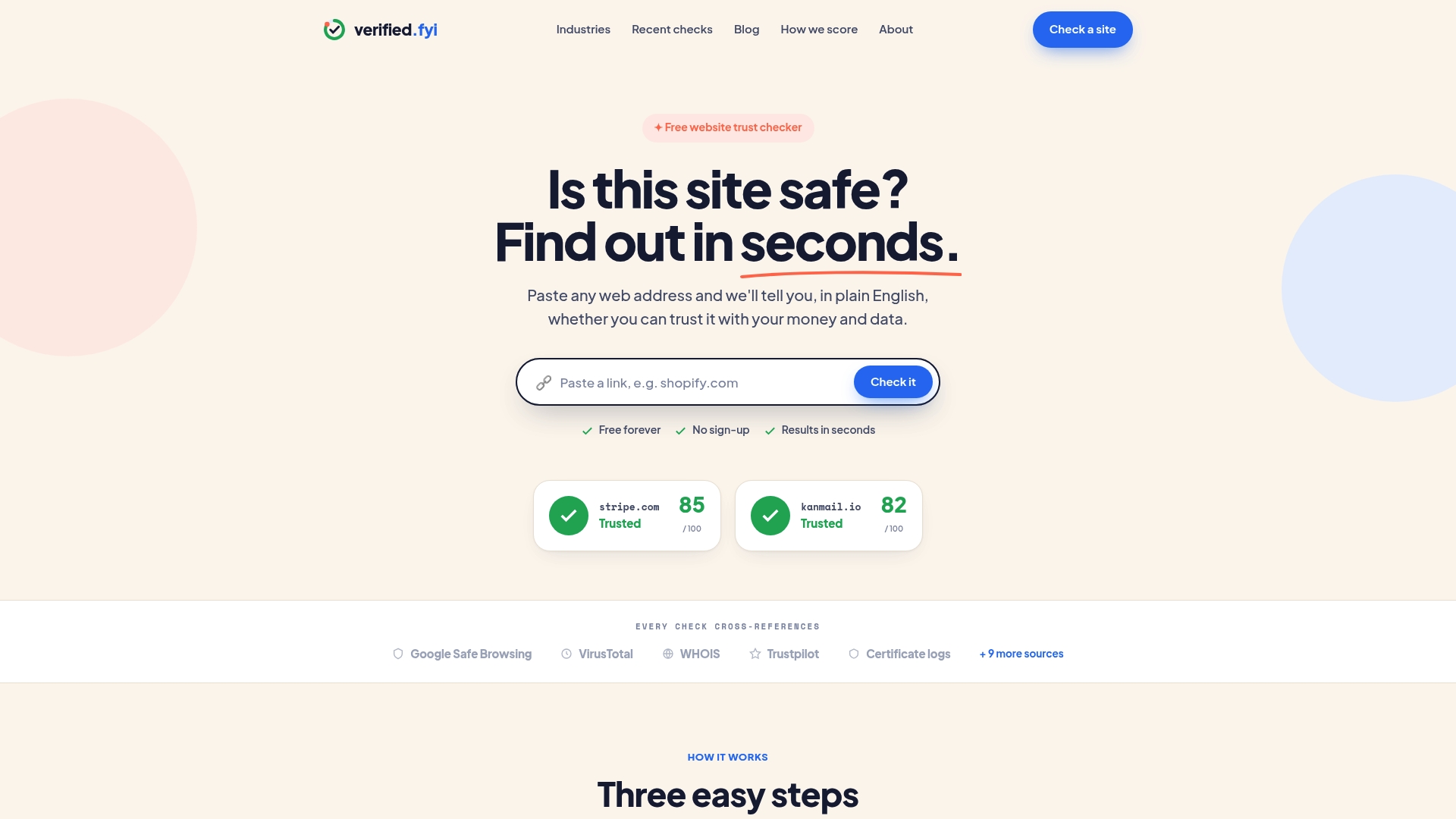
- Paste any URL and get a score along with the specific signals driving it.
- Review the methodology to see exactly how the 200+ signals and AI weighting work.
- Browse recently checked websites to see examples of both safe and risky verdicts in action.
Run your family's next unfamiliar link through the checker before anyone clicks, and keep this article's checklist handy for the manual checks a score alone can't cover.
Sources
- Online scams and attacks in America today | Pew Research Center
- APWG trends report Q2 2025
- How to avoid an online shopping scam this holiday season | FTC
- Recognize and report phishing | CISA
- Common Sense Media — AI resources
FAQ
What does a website trust score actually measure?
A trust score summarizes signals like HTTPS encryption, domain age, hosting reputation, and known blocklist matches into one number, usually from 0 to 100. Verified weighs more than 200 such signals with AI to produce that score and a plain-language verdict.
How common are scams that target families online?
Scams are widespread rather than rare: about three-quarters of adults under 50 report experiencing an online scam or attack, according to Pew Research. Phishing specifically remains high in volume, with APWG recording 1,130,393 attacks in Q2 2025.
Can a trust verification tool ever be wrong?
Yes. New legitimate sites can score lower simply because they lack reputation history, a false positive, while sophisticated scams using legitimate hosting and valid certificates can sometimes score better than they should, a false negative. Pairing an automated score with a quick manual check, like confirming contact details and watching for urgency tactics, closes most of that gap.
What should I do if my family already entered information on a bad site?
Stop using that site immediately, change any reused passwords, and contact your bank if payment details were involved. Report the site through ReportFraud.ftc.gov so others are warned.
Is checking every link really necessary, or just for big purchases?
It's most useful for new, unfamiliar, or urgent-feeling links rather than every single click. Sites you already know well and have used safely before rarely need a fresh check unless something about the link looks different from usual.