
You can tell if a startup site is likely safe by running eight quick checks, and if you want an instant multi-signal verdict, run a free website trustworthiness check. Start with the domain spelling, a search for the company name plus "scam," and a fast URL scan. A padlock icon alone tells you nothing about legitimacy, so treat it as one small clue, rather than proof.
TL;DR:
- A mismatched domain registration or URL scan, combined with negative search results for scams or complaints, signals high risk.
- Payment requests for gift cards, wire transfers, or cryptocurrencies are nearly always signs of illegitimacy, especially if other red flags are present.
- A low trust score from the free website trust checker indicates the site may be untrustworthy, with fewer verified signals passing basic checks.
- Lack of clear contact info, poor website design, or absent business registration and licensing further increase the likelihood of fraud or instability.
- Combining multiple signals such as review patterns, security features, and domain history provides a more accurate risk assessment than single checks alone.
Table of Contents
- Quick checklist: eight checks to run in under five minutes
- Deeper signals and tools: how to interpret WHOIS, SSL, scanners, and reviews
- If you suspect fraud: exact next steps to limit harm and report the site
- Assess financial stability and funding sources
- Evaluate the startup's leadership and team background
- Check business registration and licensing status
- Analyze the startup's market position and competition
- Understand the legal and compliance risks
- Why combining many signals beats single-check heuristics
- Verify it now: use the free website trust checker and trust badge
- Authoritative resources and scanners to consult next
- Sources
- FAQ
Quick checklist: eight checks to run in under five minutes
Before you hand over payment details or create an account, work through these checks in order. Each one takes under a minute, and together they catch most obvious problems.
- Check the exact domain and subdomain. Look for swapped letters, extra hyphens, or an unfamiliar suffix. A company that should be at "startupname.com" showing up at "startupname-support.net" is a warning sign worth taking seriously.
- Search the company name plus "scam" or "complaint." The FTC recommends pairing a business name or URL with words like "scam," "complaint," or "review" to surface what other people have already reported.
- Confirm contact info and readable policies. A legitimate startup lists a real address or support email and has plain-language privacy, return, and terms pages, not a single vague paragraph.
- Watch for payment red flags. Requests for gift cards, wire transfers, or crypto-only payment are a near-certain sign of trouble, since the FTC warns these methods are hard to reverse.
- Run a fast URL scan. Tools like VirusTotal, Google Safe Browsing, or Verified.fyi check a link against known threat data in seconds.
- Inspect the design and test a contact method. Broken links, stock photos everywhere, and an unanswered support email all suggest the site was thrown together quickly.
- Prefer credit cards, or wait. Credit cards give you dispute rights that debit cards and instant transfers do not.
- Save your checklist. Keep it somewhere you can reuse for the next unfamiliar site, since new startups appear constantly.
Pro Tip: Bookmark your checklist as a note on your phone. When you're rushed at checkout, you're least likely to notice red flags, and a saved list keeps you from skipping steps.
For a closer look at spotting fakes by name and branding, see our guide on how to spot fake company websites.
Deeper signals and tools: how to interpret WHOIS, SSL, scanners, and reviews
Once you've run the quick checks, a few technical signals deserve a closer look. None of them proves a site is safe on its own, but together they build a clearer picture.
- WHOIS and domain age: A domain registered days ago paired with a brand claiming years of history is a mismatch worth questioning, though privacy registration by itself is common and not automatically suspicious.
- SSL and certificates: A padlock only confirms an encrypted connection. BBB guidance notes that scammers can obtain certificates just as easily as legitimate businesses, so check the certificate issuer and watch for redirects to a different domain than the one you typed.
- Scanner results: VirusTotal sorts engine findings into categories such as harmless, suspicious, and malicious. One engine flagging a site differs a lot from a dozen independent engines agreeing, so read the count, not just the label.
- Review patterns: Reviews posted in tight clusters, written in generic language, or tied to accounts with no other activity often signal manufactured feedback rather than real customers.
- BBB profiles: An accredited BBB profile with a real complaint history and business response pattern carries more weight than a bare, unclaimed listing.
- Account security features: A startup offering multifactor authentication on user accounts signals it takes basic account protection seriously, an increasingly expected baseline.
A padlock and a five-star rating can both be faked, and BBB and FTC guidance both point out that visual trust cues do not substitute for independent verification.
A simple heuristic helps here: give a site one point for each check it passes cleanly (domain match, clean scan, visible contact info, credible reviews, valid registration, working support, reasonable payment options, MFA availability). A higher score suggests you're likely dealing with a legitimate operation; a lower score indicates the need for real caution before you proceed. For a broader look at how businesses build these signals deliberately, this overview of online trust strategies is a useful outside perspective.
If you suspect fraud: exact next steps to limit harm and report the site
If something feels wrong partway through a purchase or sign-up, stop immediately and follow these steps.
- Stop and document. Screenshot the site, save the URL, and record any transaction IDs before the page changes or disappears.
- Contact your card issuer right away. The FTC recommends reaching your bank or card provider immediately after suspected fraud to dispute charges and freeze further activity.
- File reports. Submit a report to the FTC's ReportFraud site, flag phishing to CISA, and file a complaint with BBB, including the URL, dates, and any communication you kept.
- Run a malware scan and update passwords. Scan the device you used, change reused passwords, and turn on multi-factor authentication anywhere it's available.
- If you're a business, pause vendor onboarding. Log every piece of evidence you gathered on the vendor and hold off resuming contact until basic vetting is redone.
Escalate to law enforcement when money was transferred or personal identification was shared. Keep your evidence packet organized by date so it's ready to hand over.
Assess financial stability and funding sources
A startup's financial footing matters most when you're a client committing to a longer engagement, not just a one-time purchase. Look for a funding announcement, an investor list, or a public statement about revenue that you can independently confirm rather than take on faith from the site itself. A startup that's vague about who backs it, or that pressures you into an unusually large upfront payment, is worth extra scrutiny.
Cross-reference any funding claim against a press release, a filing, or third-party business news coverage rather than a screenshot posted on the company's own page. Startups that are pre-revenue or early-stage aren't automatically risky, but they carry more uncertainty about whether they'll still be operating in a year, which matters if you're relying on ongoing service or support.
If a startup can't or won't answer a direct question about how it's funded, that's information too. Legitimate early-stage companies are usually comfortable explaining their runway in general terms, even without disclosing exact figures.

Evaluate the startup's leadership and team background
Check who's actually running the company. A real leadership team has a traceable history: a LinkedIn profile with consistent work experience, mentions in industry coverage, or a prior company you can verify existed. Founders who are anonymous, use only first names, or have profiles created within the last few weeks are a signal to slow down.
Look for a pattern across the team, not just the founder. If none of the listed executives have any public footprint before the startup's launch, or if the "team" page uses stock photography instead of real people, treat that as a meaningful gap rather than a minor oversight.
A credible leadership history doesn't guarantee good service, but its absence is a reliable early warning. Startups building something legitimate generally want their team's credentials visible, since that history is part of what earns client trust.

Check business registration and licensing status
A registered business has a paper trail. Depending on the industry, that might mean a state business registration, a professional license, or a tax ID the company can produce if asked. If a startup handles money, health information, or regulated services and can't point to the licensing that applies to it, treat that as a serious gap rather than a technicality.
You can often verify basic registration through your state's business filing search, which is free and takes a few minutes. A startup that resists sharing its registered business name or entity type when asked directly is behaving differently from one that's simply new and small.
Registration status doesn't confirm quality of service, but its absence removes your recourse if something goes wrong. An unregistered business is harder to hold accountable and harder to locate if a dispute needs resolving.
Analyze the startup's market position and competition
Understanding where a startup sits relative to others in its space helps you judge whether its claims are realistic. A startup promising to do something no one else can, at a fraction of the usual cost, deserves a second look rather than automatic trust. Extraordinary claims without a clear explanation of how they're achieved are a common thread in weaker offers.
Search for how the startup describes itself versus how independent sources or industry coverage describe the same space. If a company claims to be the only option solving a widespread problem, but a quick search turns up several established competitors doing similar work, that gap between the pitch and reality is worth noting.
A startup's honesty about where it fits, including admitting it's newer or smaller than established players, is often a better trust signal than an inflated claim of market dominance.
Understand the legal and compliance risks
Different industries carry different compliance obligations, and a startup operating in a regulated space (finance, health, data handling) should be able to speak plainly about how it meets them. If a company handles payment information, look for basic signals like clear terms of service and a stated data handling policy, and treat vague or missing language as a real risk rather than a formality.
Jurisdiction matters too. A startup's terms should specify which laws govern a dispute, and a company that's deliberately unclear about where it's legally based makes it harder to pursue a complaint if something goes wrong.
Compliance gaps don't always mean fraud. Sometimes they mean a young company hasn't caught up to what its growth requires. Either way, the risk lands on you as the client, so it's worth weighing before you commit money or data to an unproven startup.
Why combining many signals beats single-check heuristics
A padlock icon can be faked. A five-star rating can be bought. Relying on any single signal to judge a startup's site puts you at the mercy of whichever one that startup happened to game. The more reliable approach weighs many signals together: domain history, scanner results, review patterns, contact transparency, and account security, so that one manipulated data point doesn't decide the whole verdict.
That's the logic behind an approach that cross-references many security, ownership, and reputation signals and uses AI to weigh them contextually rather than applying one rigid rule to every site. A newer domain might be perfectly normal for one type of business and a red flag for another, and a system that accounts for that context produces fewer false alarms and fewer missed warnings than checking one thing and calling it done.
For readers who want to go deeper, our guide on business website authenticity walks through the reasoning behind multi-signal checks step by step.
— Nick
Verify it now: use the free website trust checker and trust badge
Running through eight checks manually takes a few minutes. Pasting a URL into Verified takes a few seconds and returns a trust score from 0 to 100 based on the security, ownership, and reputation signals covered above, categorized clearly so you know whether a site looks trusted, mostly safe, or worth avoiding.
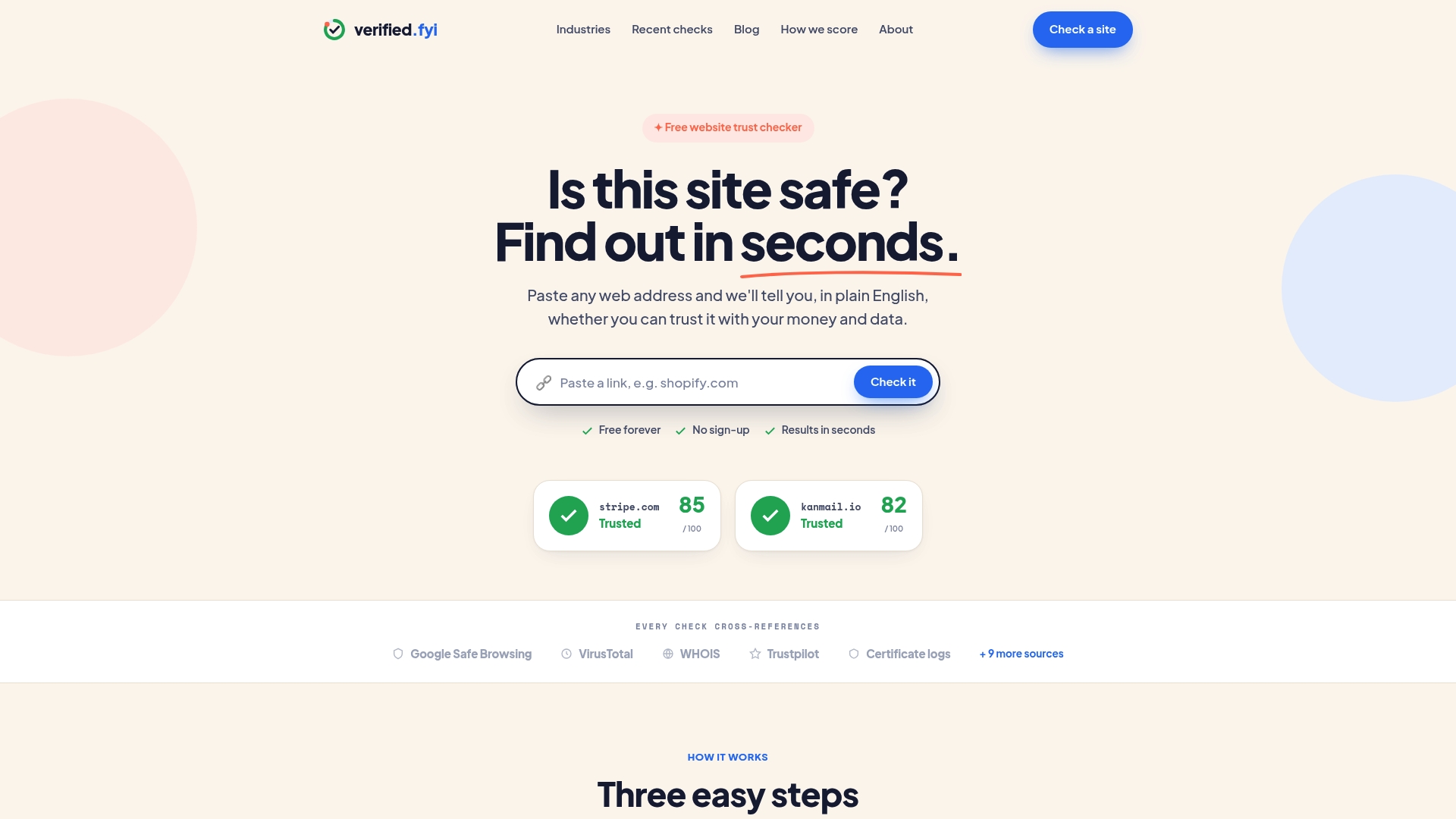
Run it any time you're about to buy from an unfamiliar startup, sign up for a new account, or enter payment or personal details on a site you haven't used before.
- Instant results: paste any URL and get a score with no registration required.
- Trust badge: startups can display a Verified on their own site once verified, giving you an at-a-glance signal before you dig deeper.
- Recent checks: browse recently checked websites to see how similar sites scored.
If a site is giving you a bad feeling but you can't pinpoint why, that instinct is worth acting on. Check it before you check out.
Authoritative resources and scanners to consult next
For deeper reading beyond this checklist, consult the FTC's online shopping guidance, CISA's phishing guidance, NIST's phishing resources, and BBB's guide to fake websites. VirusTotal's documentation explains how its scan categories work.
Sources
Ask for names you can actually contact, not just quotes pasted on a testimonials page. A startup with real client history should be able to connect you with at least one past or current client willing to answer a short question or two about their experience.
Be skeptical of testimonials that read like marketing copy, use only first names and initials, or all appear within the same short window. Genuine references usually vary in tone and detail because they're written by different people at different times, not by one copywriter.
If the startup is too new to have references, ask instead about the founder's or team's prior project history elsewhere. A track record built at a previous company still tells you something about how they handle client work, even if this particular venture is brand new.
- Online shopping | Consumer Advice
- Recognize and report phishing | CISA
- Wire transfer scams | FTC
- How to identify a fake website | BBB
- URL object | VirusTotal API documentation
- Phishing | NIST
FAQ
How can I tell if a startup's website is fake?
Check the exact domain spelling for lookalike tricks, search the company name alongside "scam" or "complaint," and run the URL through a scanner like VirusTotal or Verified. No single check is definitive, so weigh several together before deciding.
Does a padlock icon mean a website is safe?
No. A padlock only confirms the connection is encrypted, not that the business behind it is legitimate, since BBB guidance notes that scammers can obtain valid certificates just as easily as real companies. Always check additional signals like contact transparency and reputation history.
What payment methods should I avoid with an unfamiliar startup?
Avoid gift cards, wire transfers, and crypto-only payment requests, since the FTC warns these are difficult or impossible to reverse. Credit cards offer stronger dispute protections if something goes wrong.
What should I do if I already paid a suspicious startup?
Contact your card issuer immediately to dispute the charge, and document the site, transaction details, and any communication before they disappear. Then report the incident through the FTC's ReportFraud site and, if it involved phishing, to CISA as well.
How does Verified.fyi decide if a site is trustworthy?
Verified.fyi cross-references multiple security, ownership, and reputation signals and uses AI to weigh them contextually, producing a trust score from 0 to 100 with a clear verdict category. It's designed for instant, free checks with no registration required.