A verify app is an AI-powered checker that scans a website's URL against 200-plus security and reputation signals and returns a trust score from 0 to 100, along with a plain-language verdict ranging from "dangerous" to "trusted." The fastest thing you can do right now: paste any URL into a verifier like Verified before you type in a card number or your address.
Two habits make this even safer:
- Pay with a credit card, never a debit card, wire transfer, or crypto wallet, since card issuers can reverse fraudulent charges.
- Skip checkout on public Wi-Fi. Unsecured networks make it easier for someone to intercept what you type.
If the verdict comes back anything short of "mostly safe" or "trusted," close the tab. You lose nothing by waiting thirty seconds. You could lose a lot by not.
Key Takeaways
A trust score built from 200-plus signals, checked before checkout, is a stronger safeguard than any single manual check on its own.
| Point | Details |
|---|---|
| Verify before you pay | Paste the URL into a verifier and wait for a "mostly safe" or "trusted" verdict before entering card details. |
| HTTPS isn't proof | The padlock confirms encryption only; scammers can obtain valid SSL certificates for fraudulent domains. |
| Pick reversible payments | Use a credit card or PayPal instead of wire transfers, gift cards, or crypto for unfamiliar sellers. |
| Act fast if scammed | Dispute charges with your card issuer and report the incident at ReportFraud.ftc.gov right away. |
| Verified.fyi centralizes the check | It scores security, ownership, reputation, and transparency signals together instead of requiring separate manual lookups. |
Where to Report Scams and Learn More
- Report fraud and get FTC guidance on disputing unauthorized credit card charges.
- Review Wells Fargo's shopping scam checklist for bank-recommended payment safety tips.
- Read why HTTPS alone doesn't prove legitimacy from Columbia University's IT security team.
- For a broader look at what a shady site collects and shares behind the scenes, this privacy guide on data-selling apps covers the same red flags from a different angle.
Table of Contents
- How to Verify a Website in Under Two Minutes
- What Do Trust Scores and Flags Actually Mean?
- What to Do if You Already Entered Your Information
- Checking Links From Emails and Texts, Not Just Browser URLs
- Try Verified.fyi Before Your Next Checkout
- Sources
- FAQ
How to Verify a Website in Under Two Minutes
You don't need to be technical to run a solid check on an unfamiliar site. You need a sequence, and about ninety seconds.
- Paste the URL into a verifier. A tool like Verified reads the domain, pulls signals from sources like Google Safe Browsing and VirusTotal, and hands you a score and a short list of flagged issues. Read the flags first. They tell you exactly what tripped the score, whether it's a missing privacy policy or an active malware match.
- Click the padlock in your address bar. This shows you the certificate details, who issued it, and whether it's current. It confirms the connection is encrypted. It does not confirm the person running the site is honest.
- Reread the actual domain, character by character. Scammers love near-matches: "arnaz0n-deals.com," "paypal.secure-billing.net," or a real brand name with an extra word bolted onto a strange top-level domain. If anything about the spelling feels off, trust that instinct.
- Look for a privacy policy, a physical contact address, and a return policy. Legitimate retailers spell out how returns work and how to reach a human. A site that skips all three is telling you something.
- Run a quick domain-age check. A WHOIS lookup shows when a domain was registered. A storefront that launched three weeks ago and is already running an unusually deep discount deserves extra scrutiny.
- Choose a reversible payment method. Wells Fargo's fraud guidance recommends credit cards or PayPal over wire transfers, gift cards, or cryptocurrency, precisely because those methods can't be clawed back once the money moves.
- Search the site's name alongside the word "scam." Then cross-check it against a scanner like VirusTotal or Google's Transparency Report. If dozens of people are asking the same question you are, that's your answer.
This sequence works whether you're buying a jacket from an Instagram ad, hiring a freelancer's invoice portal, or checking a vendor site for your small business. The order matters: verdict first, then manual spot-checks, so you're not wasting time inspecting a site the score already flagged as dangerous.
Pro Tip: Bookmark the verifier on your phone's home screen. The moment you land on an ad-driven storefront you've never heard of, checking it takes the same effort as checking the weather.
For a deeper look at how impersonation sites dress themselves up to look legitimate, how fake company websites operate is worth a read before your next big purchase.
What Do Trust Scores and Flags Actually Mean?
A trust score isn't one measurement. It's a weighted blend of several categories, and understanding what each one covers helps you read a verdict instead of just trusting a number blindly.
- Security signals check for malware, phishing kits, and blacklist matches from services like Google Safe Browsing and VirusTotal.
- Ownership signals look at WHOIS records and domain age. A domain registered last week, hiding its owner behind privacy protection, scores differently than one that's been active for a decade.
- Reputation signals pull in complaint patterns and review consistency.
- Infrastructure signals examine hosting quality, server location, and how many times a link redirects before landing you on the actual checkout page.
- Transparency signals check for a real contact address, working policy pages, and consistent branding.
- Behavioral signals flag suspicious form fields, hidden scripts, or pop-ups engineered to rush a purchase.
Here's the part most people get wrong: HTTPS and the little padlock icon confirm your connection is encrypted, nothing more. Columbia University's IT security guidance is blunt about this: scammers can and do obtain valid SSL certificates for fraudulent domains. The padlock tells you no one's eavesdropping on the data in transit. It says nothing about who's on the other end.
That distinction matters more than most shoppers realize, especially given how many scams start outside a search engine entirely. FTC data shows online shopping scams were the most frequently reported scam type in 2025, with a large share originating from social media ads and messages rather than organic search.
A malware flag or active phishing match means exit immediately and don't look back. A mismatched checkout domain (you started on "brandname.com" but the payment page is on some unrelated URL) is a hard stop too. A fake trust badge is trickier: click it. A real validation badge links to the provider's own verification page. An image that does nothing when clicked, or links somewhere unrelated, is decoration, not proof. Borderline scores, where a site isn't flagged as dangerous but isn't clean either, call for the manual checks above before you commit any payment information.
What to Do if You Already Entered Your Information
If you've already typed in a card number or clicked something you shouldn't have, speed matters more than panic. Work through this in order.
- Call your card issuer immediately. FTC guidance on disputing charges confirms you can dispute charges for merchandise never received or for transactions you didn't authorize, and acting fast preserves your dispute window.
- Disconnect from the internet if you downloaded anything or clicked a suspicious link, then run a malware scan before reconnecting.
- Change your passwords, starting with email and banking, and turn on two-factor authentication anywhere you haven't already.
- Report the incident at ReportFraud.ftc.gov and to your bank's fraud department.
- Save your evidence: screenshots of the site, order confirmation emails, and transaction IDs. You'll need them for both the dispute and the report.
If sensitive information like a Social Security number or a photo ID got typed into a fake form, consider a credit freeze or an identity-recovery service on top of the steps above. The safe shopping checklist covers a related set of warning signs worth reviewing after the fact, so you can spot the next one faster.
Checking Links From Emails and Texts, Not Just Browser URLs
Direct URL checks assume you're already sitting on a website. A lot of scams never give you that chance; they arrive as a link in a text, a DM, or an email that looks like it's from your bank or a delivery service.
The rule here is simple: never tap first. On a phone, hold your finger on the link (long-press) to preview the actual destination URL before it opens. On desktop, hover your mouse over the link and check the address shown in the corner of your browser. If the preview shows a domain that doesn't match the sender's actual company, that's the scam, right there, before you've clicked anything.
Copy the link instead of tapping it, and drop it into a verifier or a scanner to see where it actually leads. Copying suspicious links into a scanner rather than clicking them directly is one of the more reliable habits for catching redirect chains that hide the real destination behind two or three hops.
Be especially wary of messages that create urgency: "your package couldn't be delivered," "your account will be suspended," "confirm this purchase within 24 hours." Legitimate companies rarely gate information behind a countdown clock. If a text or email pushes you toward a link with that kind of pressure, verify the destination separately rather than trusting the message's own claims about it.
A Note From Nick on the Mistakes That Keep Repeating
The two misconceptions I see trip people up most are the padlock myth and the badge myth: shoppers assume HTTPS means "safe" and that a trust badge on a checkout page is automatically real. Neither holds up. What actually reduces risk is layering an automated check with two or three manual glances at the domain and policies. Verifiers catch what your eye skips past; your eye catches the weird phrasing a scanner can't judge. Use both.
— Nick
Try Verified.fyi Before Your Next Checkout
Verified.fyi is built specifically for the moment you're staring at an unfamiliar checkout page wondering if it's safe to type in your card number. Paste any URL and you'll get a trust score from 0 to 100 within seconds, built by weighing over 200 security, ownership, reputation, infrastructure, and transparency signals, including data pulled from Google Safe Browsing and VirusTotal.
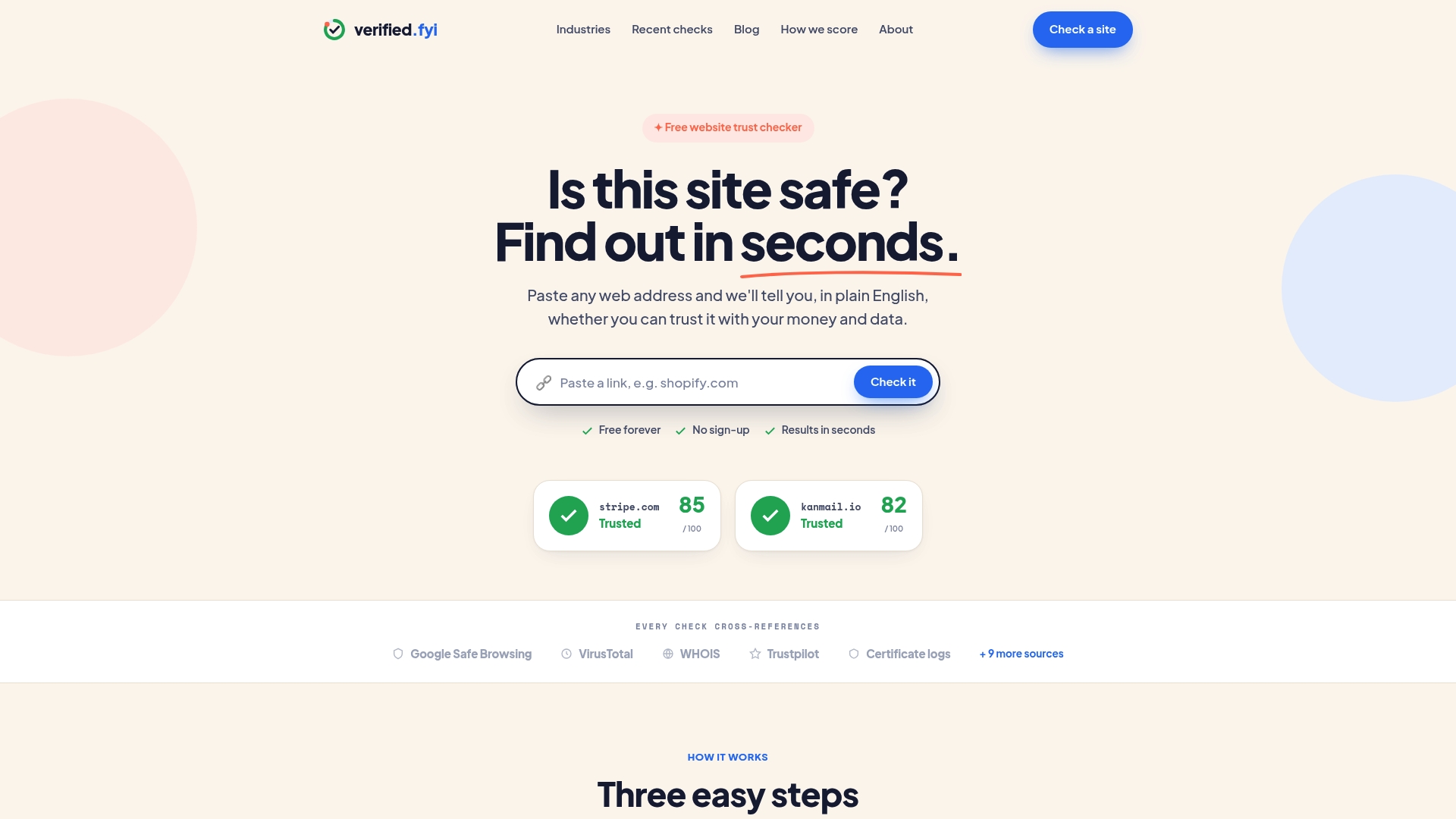
The result isn't a vague score with no explanation. You'll see a clear verdict (dangerous, suspicious, caution, mostly safe, or trusted) plus the specific flags that shaped it, so you know exactly what to fix or avoid before entering payment information. If you want to see it in action first, browse recently checked websites to see real scores on real sites, or read through how the scoring actually works if you want the full breakdown behind the number. Next time an unfamiliar link lands in your inbox or a new storefront shows up in your feed, paste it into Verified before you buy anything.
Sources
- New FTC data: people have lost billions to social media scams — FTC press release
- Using credit cards and disputing charges — Consumer FTC
- 10 Tips to Identify Online Shopping Scams — Wells Fargo
- Why HTTPS doesn't prove legitimacy — CUIT (Columbia University)
FAQ
Is a Verify App the Same as an Antivirus Scanner?
No. An antivirus scanner protects your device from malware already present; a verify app like Verified.fyi checks a website's trustworthiness before you visit or pay, using signals like domain age, SSL details, and reputation data.
Does a High Trust Score Guarantee a Site Is Safe?
No score guarantees anything with certainty, but a high score from a verifier weighing 200-plus signals is a strong indicator, and it should still be paired with a quick manual glance at the domain spelling and policies.
What Should I Do if a Verifier Flags a Site as Suspicious?
Stop the checkout process immediately, read the specific flags listed, and if the flag involves malware or phishing, close the tab and don't return; for lower-severity flags, run the manual checks covered above before deciding.
Can Scammers Really Get a Valid SSL Certificate?
Yes. Certificate authorities verify domain ownership, not business legitimacy, so a fraudulent site can display the same padlock icon as a trusted retailer.
How Do I Verify a Link Sent in a Text Message?
Long-press the link on your phone to preview the actual destination without opening it, then paste that URL into a verifier if anything about the domain looks off.