
Website safety verdicts come from cross-checking a URL and its site against threat databases, then layering in technical and reputation signals before normalizing all of that into a short label or score. Authorities like Google Safe Browsing, VirusTotal, and CISA each play a role in this pipeline. Below, we break down the signals, the matching mechanics, the normalization logic, where accuracy breaks down, and what you can check yourself in under a minute.
TL;DR:
- Cross-check multiple signals like reputation scores, domain age, and SSL details, since a single label might not capture recent threats or evasion tactics.
- Use several independent tools, such as Safe Browsing, VirusTotal, and WHOIS checks, before trusting a website when personal or financial data is involved.
- Be aware that false positives can temporarily flag legitimate sites, especially when infrastructure is shared or domains are compromised briefly.
- Recognize that quickly showing a site as unsafe does not guarantee malicious intent if signals are conflicting or slow to update.
- Always treat suspicious or borderline verdicts as warnings and verify with manual checks or direct contact when high stakes are involved.
Table of Contents
- How URLs get checked: canonicalization, hashing, and lookups
- How platforms turn raw signals into a single verdict
- Why safety tools sometimes get it wrong
- How to check a website safely right now
- What our checker measures and how it complements public lists
- Treating automated verdicts as signals, not guarantees
- Check any URL with our free trust checker
- FAQ
- Sources
How URLs get checked: canonicalization, hashing, and lookups
Before any comparison happens, a URL has to be put into a standard shape, because two addresses that look identical to you can be technically different to a matching engine. Trailing slashes, capitalization, and encoded characters all get normalized first.
- Canonicalization: the system strips unnecessary parameters, resolves encoding, and standardizes the format so lookalike URLs match consistently.
- Hash-prefix matching: rather than sending a full URL to a server, many systems compute a SHA256 hash and compare only a prefix, a privacy-preserving method documented in Safe Browsing's list specification.
- Local cache versus real-time lookup: a downloaded list of hash prefixes lets a browser check locally without network calls, while a real-time API query trades a bit of latency for fresher coverage.
- Cache expiration: lists and lookups carry a defined caching window, so a verdict that was accurate an hour ago can shift once the cache expires and fresh data loads.
This is why the same site can show different verdicts on different devices for a short stretch: one is running on a slightly older local list.
How platforms turn raw signals into a single verdict
Once signals are collected, they still need to become something readable: a label, a score, a color. That normalization step is where most of the real engineering happens.
Platforms map each engine's raw output, whether that is a flag, a count, or a probability, into shared categories such as harmless, suspicious, or malicious. VirusTotal's URL object exposes exactly this kind of consolidated report, with last-analysis statistics tallying how many engines landed in each category.
- Weighted scoring: not every signal counts equally; a confirmed blocklist hit typically outweighs a single low-confidence heuristic flag.
- Confidence thresholds: a site needs to cross a defined threshold before it moves from "suspicious" to "malicious," which keeps borderline cases from triggering full warnings prematurely.
- Heuristics and sandboxing: lookalike-domain detection and redirect-chain analysis catch threats that no static blocklist has recorded yet.
- Human review: analysts can override an automated verdict, document the reasoning, and in some cases reverse a flag once a false positive is confirmed.
Pro Tip: A "suspicious" label usually means a site crossed a lower confidence threshold than "malicious," not that the evidence is weaker, just less conclusive.
Why safety tools sometimes get it wrong
No verdict system is infallible, and understanding the common failure modes helps you read a result with the right amount of skepticism.
- False positives happen when a legitimate site gets compromised temporarily or shares infrastructure with a flagged domain.
- False negatives occur with short-lived phishing domains that vanish before they are indexed.
- Evasion techniques like homograph attacks (swapping lookalike characters), URL obfuscation, and fast-flux domains that rotate IPs are built specifically to dodge list-based detection.
- Propagation lag means a freshly confirmed threat takes time to reach every cache, so a verdict can be stale by minutes or hours depending on the cacheDuration value services publish.
- Scope gaps matter too: some services focus narrowly on malware and phishing, leaving low-quality or scammy-but-not-malicious content unflagged.
Because no single signal is definitive, cross-checking multiple sources and layering manual review on top of automated results meaningfully reduces your exposure.
How to check a website safely right now
You can run a meaningful safety check in under a minute, and a deeper one when money or personal data is on the line.
- Look at the padlock and certificate, then confirm the domain is spelled exactly as expected, since CISA notes that HTTPS confirms encryption, not legitimacy.
- Check the URL scheme for
https://and watch for extra subdomains or characters that don't belong. - Cross-check the domain against Safe Browsing's site status, a VirusTotal report, or a WHOIS lookup for domain age.
- Watch for behavioral red flags: unexpected downloads, auto-redirects, or a login prompt appearing somewhere it shouldn't.
- Leave immediately if something feels wrong, and report confirmed threats through Safe Browsing or CISA's reporting channels.
Pro Tip: Before entering payment or identity information anywhere unfamiliar, run the domain through at least two independent checks, since no single tool catches everything.
For transactions involving money transfers, tax documents, or identity verification, treat any uncertainty as a reason to stop and confirm through a second channel, like calling the organization directly.

What our checker measures and how it complements public lists
We built our checker to go beyond list-matching alone. The system analyzes multiple security, ownership, reputation, infrastructure, and compliance signals, then produces a trust score from 0 to 100 alongside a plain-language verdict.
- A 0-100 trust score gives you a quick read without requiring you to interpret raw technical data yourself.
- A categorized verdict, from dangerous to trusted, sits alongside a breakdown of which signals pushed the score up or down.
- Signal transparency means you see contributing factors like domain age or certificate details, not just a pass or fail.
This kind of multi-signal weighting is meant to sit alongside public threat lists and manual checks, not replace them, which we explore further in how AI analyzes website safety.
Treating automated verdicts as signals, not guarantees

Automated verdicts are genuinely useful, but they're probability estimates built from available evidence at a given moment, not courtroom-grade proof. We'd encourage you to use the checklist above before any transaction involving money or personal data, and to escalate to a manual call or second opinion when the stakes rise.
Defense-in-depth, meaning browser protections plus independent lookups plus a healthy dose of caution, consistently beats trusting any single tool's output, a point echoed in independent comparisons of privacy and security tools.
— Nick
Check any URL with our free trust checker
We make it simple to turn everything above into one instant check: paste a URL into our free website trust checker and get a score, a verdict, and the signals behind it in seconds, no registration required.
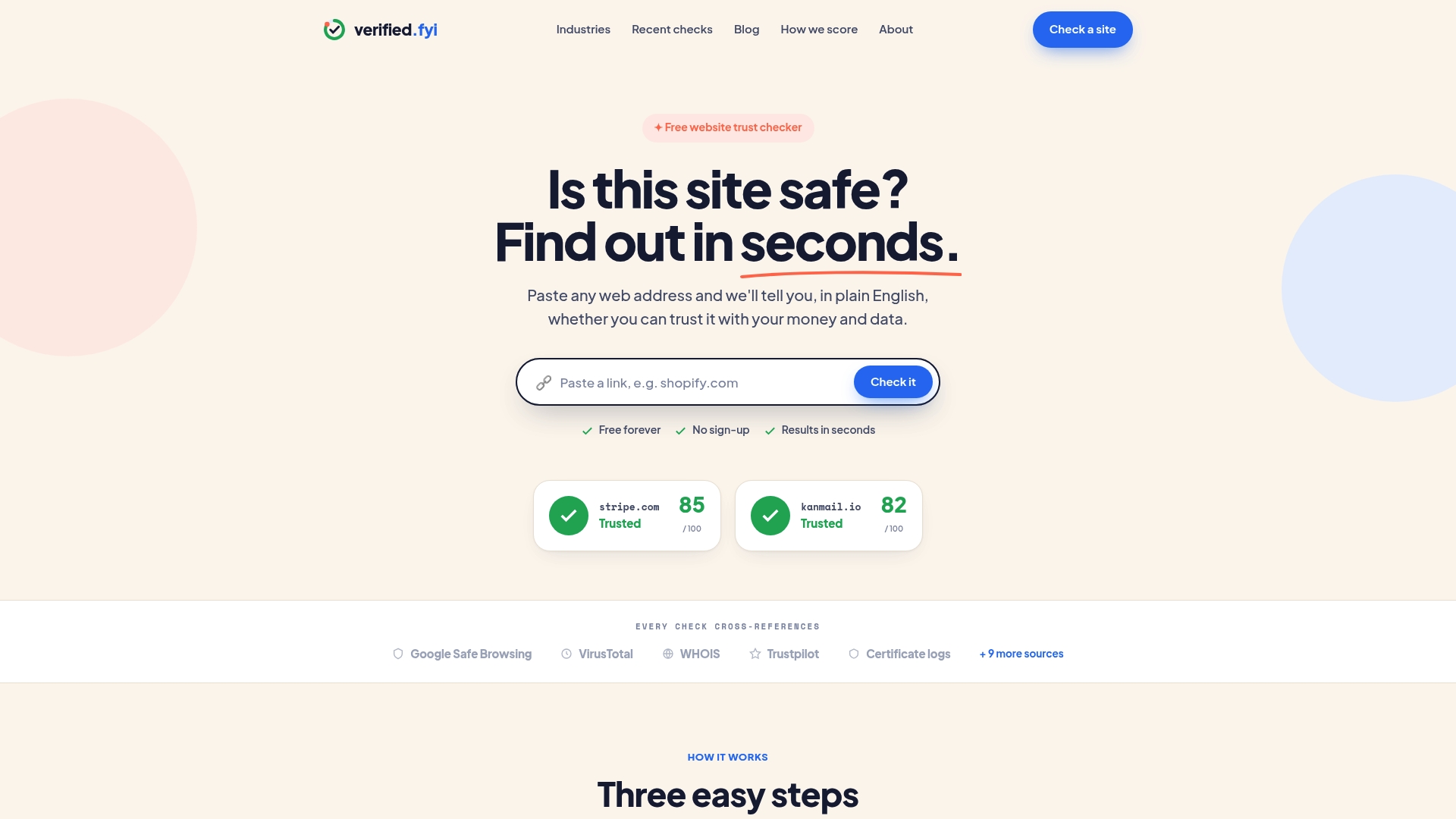
Pair that score with the quick checks in this guide, then browse recently checked websites to see how the scoring plays out across real examples. If you run a site yourself, our trust badge lets you display a verified result for visitors who want that reassurance before they buy.
FAQ
How to safely check a website?
Look for a valid padlock and correct domain spelling first, then cross-check the URL against a tool like Safe Browsing or VirusTotal for a second opinion. Avoid entering any personal or payment information until at least two independent checks agree the site looks legitimate.
What are the 5 online safety rules?
Common guidance groups around verifying the connection (HTTPS and certificate details), confirming exact domain spelling, cross-checking against threat databases, watching for unexpected redirects or downloads, and never entering sensitive data on an unverified site. CISA's guidance covers the certificate and URL verification pieces in detail.
How accurate are link checkers?
No single link checker is completely accurate, since each tool draws from different threat lists and scanning engines that can disagree with one another. Combining multiple sources, such as a blocklist check alongside a multi-engine scanner like VirusTotal, gives a more reliable picture than relying on one result alone.
How do I know if I'm on a safe website?
Check that the connection uses https://, confirm the domain matches exactly what you expected to visit, and watch for unexpected pop-ups, downloads, or login prompts. Running the domain through a threat-list checker or a multi-signal tool adds a second layer of confirmation beyond what you can see visually.
What does a "suspicious" verdict actually mean?
A "suspicious" label typically means a site crossed a lower confidence threshold than a full "malicious" flag, based on signals like scanner detections or heuristic matches rather than a confirmed blocklist hit. It's a caution signal worth taking seriously, not necessarily proof of active harm.
Sources
A safety verdict rarely rests on one data point. Instead, it blends several independent signal types, each revealing a different angle of risk.
- Google Safe Browsing
- Safe Browsing lists | Safe Browsing APIs (v4) | Google Developers
- URL object | VirusTotal Documentation
- Tips to stay safe while surfing the web, Part 2: Accessing websites securely | CISA
Safe Browsing protects billions of devices daily by flagging unsafe sites and triggering warnings before you load them, which shows the scale at which threat-list matching now operates across browsers worldwide (Google Safe Browsing).