TL;DR:
- Verifying payment site security involves checking HTTPS, dynamic trust seals, and business identity to prevent fraud.
- Using real-time tools like Confirm of Payee and independent scoring enhances online transaction confidence for shoppers and merchants.
Secure payment site verification is the process of confirming that a website uses strong protections and trusted protocols to keep your payment data safe during online transactions. The industry term for this practice is payment site authentication, and it draws on standards like PCI-DSS 4.0 and NIST 800-63-4 to define what "secure" actually means. Skipping this step is a real risk. Cloned storefronts, fake trust seals, and lookalike domains are common enough that both shoppers and business owners need a repeatable process before entering card details anywhere online.
What signs and tools indicate a secure payment site?

The non-negotiables start with HTTPS. Every legitimate payment page encrypts data in transit using SSL/TLS, which shows up as a padlock icon in your browser's address bar and an "https://" URL prefix. No padlock means no encryption. That is a hard stop.
Beyond HTTPS, look for these indicators:
- Dynamic trust seals. A genuine seal pulls real-time scanner data and removes itself if a problem is detected. A static image that never changes is a decoration, not a security signal.
- Tokenization. Legitimate payment pages replace your raw card number with a token before transmitting any data. Tokenized transactions show around 30% lower fraud rates and 3–4% better approval rates compared to raw PAN transmission. That gap is significant.
- Confirmation of Payee (CoP). This real-time service checks account name, BSB, and account number against the recipient's bank records before a payment clears. It is the clearest defense against invoice redirection scams.
- Domain-entity binding. A trustworthy site ties its domain ownership to a verified legal entity. This cryptographic link is something an impersonator cannot fake.
Pro Tip: Click the padlock icon in your browser and select "Certificate." Check that the organization name on the SSL certificate matches the business you expect to be paying.
How do you verify a payment site before making a payment?
Follow these steps in order. Each one adds a layer of confidence.
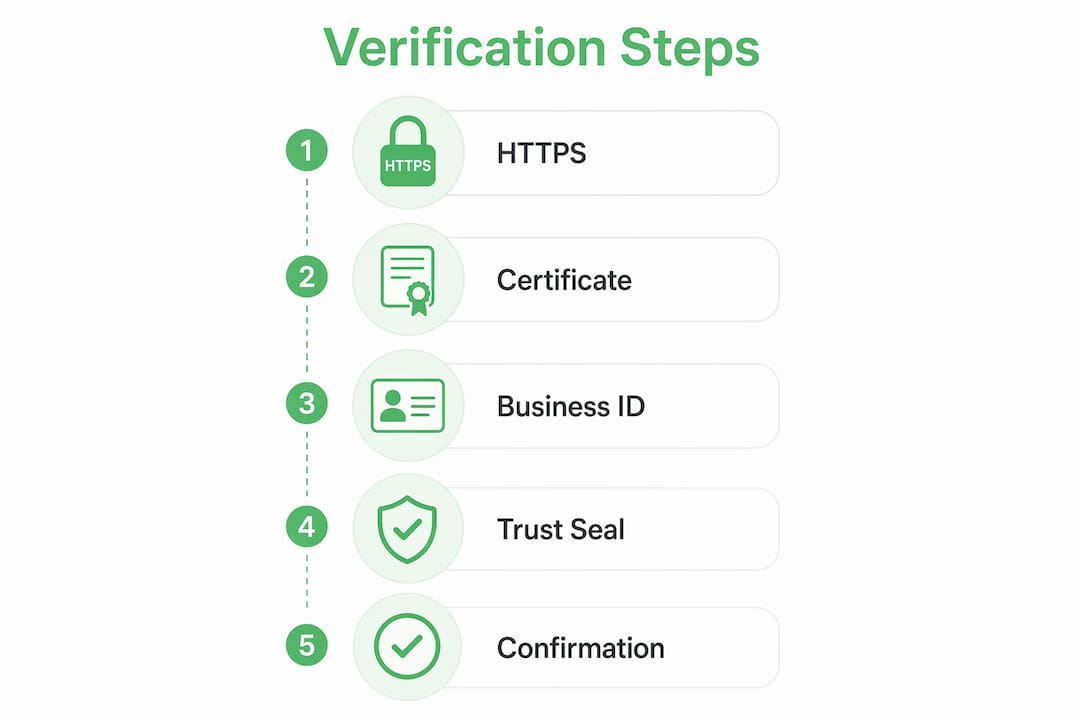
- Check for HTTPS and examine the SSL certificate. Open the certificate details and confirm the issuing authority and the organization name. A mismatch is a red flag.
- Verify the trust seal is live. Click the seal directly. A genuine dynamic seal opens a verification page hosted by the security provider. A static image does nothing when clicked.
- Confirm domain-entity binding. Use a WHOIS lookup tool to check who registered the domain and when. A domain registered days ago for a site claiming years of history is suspicious.
- Validate the payment method. Look for 3-D Secure (3DS2) prompts during checkout. PCI-DSS 4.0 requires encryption in transit, tokenization, and strong customer authentication including 3DS2.
- Use a Confirmation of Payee service. For bank transfers, CoP verifies account details in real time against bank records, stopping misdirected payments before they happen.
- Cross-check compliance signals. Look for PCI-DSS compliance statements and Strong Customer Authentication (SCA) prompts. Their absence does not confirm fraud, but their presence confirms the merchant takes compliance seriously.
- Run an independent site check. Paste the URL into a verification platform like Verified fyi to get an instant trust score based on over 200 security and reputation signals.
Here is a quick reference for what each check catches:
| Verification step | What it detects |
|---|---|
| HTTPS and SSL certificate | Encryption gaps, certificate mismatches |
| Dynamic trust seal click-through | Fake or expired security seals |
| WHOIS domain lookup | Newly registered or anonymized domains |
| 3DS2 and SCA prompts | Missing strong authentication |
| Confirmation of Payee | Misdirected bank transfers |
| Independent site score | Aggregated reputation and security signals |
Common pitfalls when checking payment site security
HTTPS alone does not mean a site is safe. Scammers obtain valid SSL certificates for fraudulent domains in minutes. The padlock confirms encryption. It does not confirm the business behind the site is legitimate.
- Fake trust seals. A copied badge image looks identical to a real one at a glance. Only clicking through to a live verification page confirms authenticity.
- Lookalike domains. Cloned storefronts copy real company names, logos, and product pages. Sophisticated clones pass content checks because they use real company data. The one thing they cannot replicate is cryptographic domain-entity binding.
- Outdated malware scans. Some security seals reflect scan results from days or weeks ago. A site can be compromised between scans. Dynamic seals that update continuously are the only reliable option.
- Ignoring business identity. Technical checks confirm encryption. They do not confirm the business is real. Verifying that a domain is legally bound to a registered entity is just as critical as checking the padlock.
"A site can pass every visual security check and still be a scam. The gap between 'looks secure' and 'is secure' closes only when you verify the business identity behind the domain, not just the encryption layer in front of it."
How does payment site verification benefit shoppers and businesses?
For shoppers, the direct benefit is fraud prevention. Phishing-resistant authentication methods like passkeys and biometrics, recommended under NIST 800-63-4, block account takeover attacks that SMS one-time passwords cannot stop. Knowing a site uses these methods before you pay is a meaningful assurance.
For businesses, verified identity at checkout directly affects revenue. Independent identity verification at the point of decision builds buyer confidence and reduces cart abandonment. Shoppers who trust the checkout complete their purchase. Those who do not, leave.
Compliance is also a business benefit, not just a legal obligation. Meeting PCI-DSS 4.0 and SCA requirements reduces fraud liability and protects the merchant from chargeback losses. Understanding how payment gateway integration handles authorization codes and decline responses also helps merchants troubleshoot false declines, which frustrate legitimate customers and cost sales.
Pro Tip: If you run an online store, display your PCI-DSS compliance status and link to your dynamic trust seal on every checkout page. Shoppers notice these signals even when they do not consciously read them.
Key Takeaways
Secure payment site verification requires checking encryption, business identity, and real-time trust signals together, not any single indicator alone.
| Point | Details |
|---|---|
| HTTPS is necessary but not sufficient | Always examine the SSL certificate details and confirm the organization name matches. |
| Dynamic seals outperform static ones | Click every trust seal to confirm it links to a live, real-time verification page. |
| Domain-entity binding is the hardest to fake | Verify that the domain is cryptographically tied to a registered legal entity. |
| CoP stops misdirected payments | Use Confirmation of Payee for bank transfers to verify account details in real time. |
| Independent scoring adds a final layer | A platform like Verified fyi aggregates 200+ signals into one trust score for fast decisions. |
Why visual checks alone are no longer enough
I have watched the sophistication of payment scams increase sharply over the past few years, and the pattern is consistent. Fraudsters stopped trying to look obviously fake. They now invest in looking exactly right. A cloned storefront today will have the correct logo, the correct SSL certificate, and a copied trust badge. Your eye glosses over these. Your instinct does not always catch them either.
The shift I find most significant is the move toward real-time identity confirmation. CoP services and domain-entity binding checks are not optional extras for cautious people. They are the verification layer that actually separates a legitimate site from a convincing copy. I have seen shoppers lose money on sites that passed every visual check because nobody confirmed the domain was tied to a real, registered business.
My advice to shoppers: build a two-second habit. Before you enter card details anywhere unfamiliar, paste the URL into a site verification tool and check the score. It takes less time than reading the return policy. For business owners, the investment in dynamic trust seals, 3DS2, and a verified business identity is not just about compliance. It is about the checkout confidence that converts browsers into buyers.
— Nick
Verified fyi makes site safety checks fast and reliable
Knowing what to check is half the battle. Having a tool that does the checking in seconds is the other half.
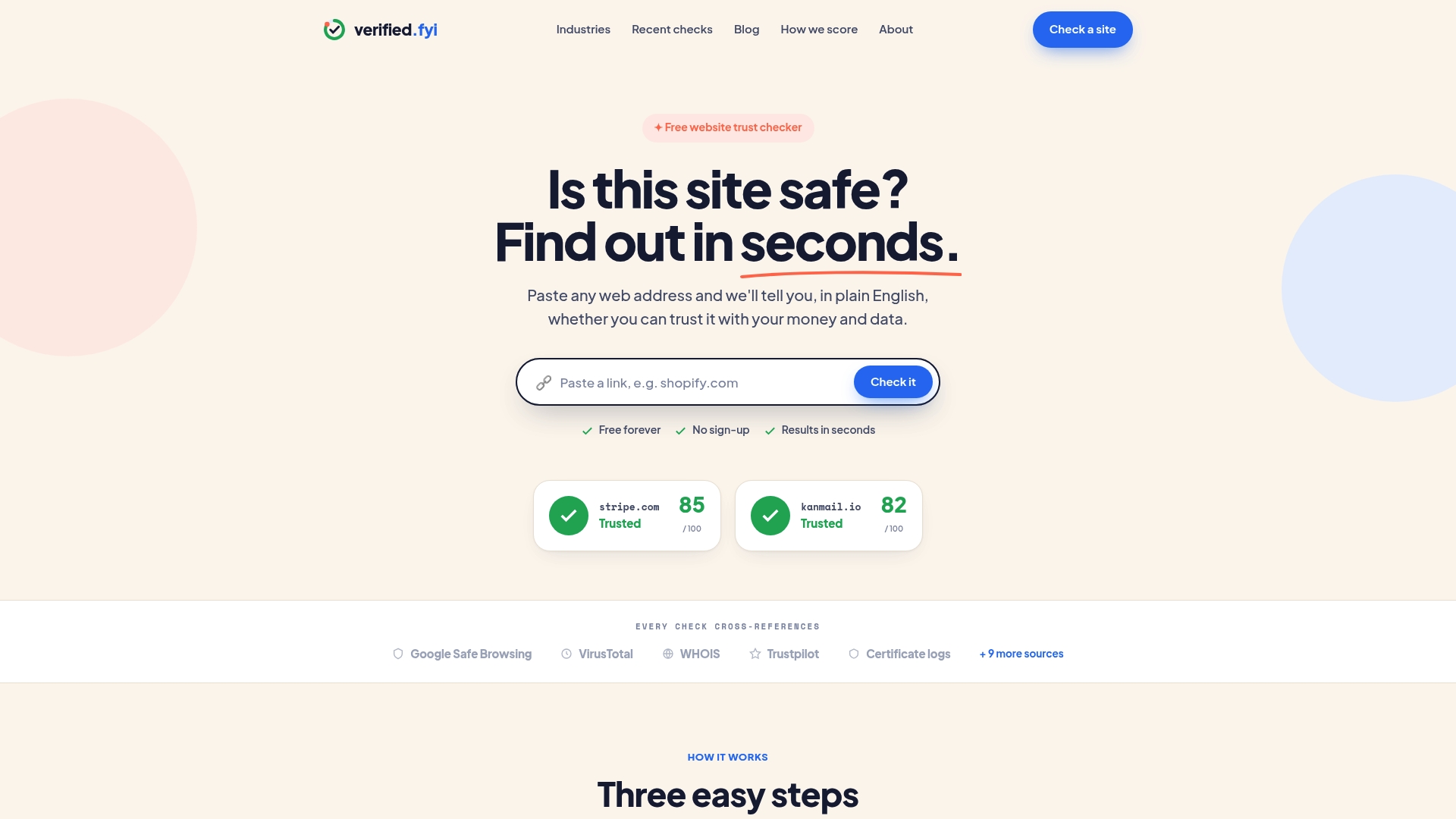
Verified fyi analyzes over 200 security and reputation signals for any website and returns a trust score from 0 to 100. Paste a URL, get a verdict. No technical knowledge required. The platform is built for shoppers who want a fast answer before paying and for business owners who want to know how their site scores before a customer does. Browse recently checked websites to see real-time results on sites others are questioning right now. For a deeper look at a specific site, Verified fyi delivers a full breakdown of what passed, what failed, and why.
FAQ
What is secure payment site verification?
Secure payment site verification is the process of confirming a website uses encryption, verified business identity, and trusted authentication before you submit payment details. It draws on standards including PCI-DSS 4.0 and NIST 800-63-4.
Does HTTPS mean a payment site is safe?
HTTPS confirms data is encrypted in transit, but it does not confirm the business is legitimate. Scammers obtain valid SSL certificates easily, so HTTPS is a starting point, not a final check.
What is Confirmation of Payee and why does it matter?
Confirmation of Payee (CoP) is a real-time service that verifies account details against bank records before a payment processes. It is the primary defense against invoice redirection and misdirected bank transfers.
How do I spot a fake trust seal?
Click the seal directly. A genuine dynamic seal opens a live verification page hosted by the security provider. A static image that does nothing when clicked is not a real security indicator.
How does Verified fyi help with payment site verification?
Verified fyi scores any website from 0 to 100 by analyzing over 200 signals, including security certificates, domain history, and reputation data. It gives shoppers and business owners an instant, independent read on a site's trustworthiness.