TL;DR:
- Keeping your browser updated is the most effective way to prevent cyberattacks that often start through browsers.
- Regularly auditing your extensions reduces attack surfaces by removing unused or risky add-ons, enhancing security.
Browser safety best practices are the set of habits and settings that prevent your browser from becoming the entry point for malware, phishing, and data theft. Half of all cyberattacks start in the browser. That single fact makes your browser the most important security boundary you manage every day. The good news is that the highest-impact steps are not complicated. They are repeatable, low-effort habits that compound over time into real protection.
1. Keep your browser updated at all times
Browser updates are the single most effective browser security measure you can take. Every update ships with security patches that close vulnerabilities attackers are actively scanning for. An outdated browser is an open door for drive-by malware downloads and phishing attacks that require no action from you beyond visiting a compromised page.
- Enable automatic updates in your browser settings so patches apply without manual effort.
- Restart your browser when it prompts you. The update is downloaded but not active until you do.
- Check your browser version monthly if you disable auto-updates for any reason.
- Treat a browser restart as a security task, not an inconvenience.
Pro Tip: Set a weekly calendar reminder to restart your browser. Most people skip the restart and run unpatched versions for weeks without realizing it.
2. Audit your browser extensions every month

Every extension you install increases your attack surface. Extensions with broad permissions like "read and change all data on websites you visit" can intercept passwords, form data, and session tokens. Attackers have purchased legitimate extensions and pushed malicious updates to their entire user base overnight.
The fix is a minimalist approach. Keep only extensions you use every week. Remove anything you installed once and forgot about.
- Open your browser's extension manager and list every installed add-on.
- Ask yourself: did I use this in the last seven days?
- Check each extension's permissions. Flag any that request access to all sites.
- Remove extensions from publishers you cannot verify through a quick web search.
- A 3-minute monthly audit is enough to catch permission creep before it becomes a real problem.
Pro Tip: Treat your extension list like your phone's app list. If you would not install it fresh today, uninstall it now.
3. Use strong authentication on every critical account
Weak passwords are the most predictable failure point in browser security. Using unique passwords and enabling multi-factor authentication on critical accounts stops the majority of daily account takeovers. The accounts that matter most are your email, your password manager, and your banking logins. Secure those three and you protect the keys to everything else.
- Use passkeys where a site supports them. Passkeys are phishing-resistant because they never transmit a secret that can be stolen.
- Use a dedicated password manager, not your browser's built-in storage. Dedicated password managers reduce token theft risk compared to in-browser credential storage.
- Generate a unique, random password for every account. Never reuse passwords across sites.
- Enable multi-factor authentication on all critical accounts. Authenticator apps are more effective than SMS codes because SMS can be intercepted through SIM-swapping attacks.
4. Configure your privacy settings before you browse
Your browser ships with privacy settings that most people never touch. Blocking third-party cookies natively reduces cross-site tracking more effectively than most extensions. That means less data collected about your habits, and fewer advertising networks building profiles on you.
The table below shows the highest-priority settings to review in any major browser.
| Setting | What to do |
|---|---|
| Third-party cookies | Block them in privacy settings |
| Safe browsing | Keep enabled at the enhanced level |
| Notifications | Block all, then allow only trusted sites |
| Camera and microphone | Set to "ask before accessing" |
| Location | Block by default; allow only when needed |
Browser notifications are weaponized by scammers to push fake virus alerts and tech support scams directly to your desktop. Blocking notifications by default removes that attack vector entirely. Review your notification permission list and revoke anything you do not recognize.
5. Build safer browsing habits day to day
Settings alone do not protect you. Your habits fill the gaps. The best practices for safe surfing are behavioral, not technical, and they cost nothing to adopt.
- Bookmark your banking, email, and payment sites. Type the URL or use the bookmark instead of clicking links in emails.
- Verify the domain before entering any credentials. Phishing sites often use domains like "paypa1.com" or "amazon-secure-login.net" that look right at a glance.
- Separate your personal and work browsing into different browser profiles. This limits cross-contamination if one profile is compromised.
- Pause before clicking any link that creates urgency. Phrases like "your account will be closed" or "verify now" are classic phishing triggers.
- Use Verified fyi to check a site's safety before entering sensitive data on an unfamiliar page. The platform analyzes over 200 security and reputation signals and returns a trust score from 0 to 100 in seconds.
Pro Tip: When a site feels off, read the full URL out loud. Your eye glosses over subtle misspellings. Your voice catches them.
6. Respond fast when something looks suspicious
Speed matters after a suspicious click or an unexpected redirect. Stopping interaction, running a scan, and resetting passwords after a suspicious event reduces the damage window significantly. Every minute you stay on a compromised page increases exposure.
- Close the tab or the entire browser immediately. Do not click anything else on the page.
- Run a full scan with your endpoint security software before doing anything else online.
- Change passwords for any account whose credentials you entered on the suspicious page. Do this from a different, trusted device.
- Review your browser's extension list and recently granted permissions for signs of hijacking.
- Enable login alerts on your email and financial accounts so you catch unauthorized access early.
Learning to read browser security warnings correctly is part of this response. A red warning page from your browser is not a suggestion. It is a hard stop.
Key takeaways
The most effective browser safety strategy combines updated software, minimal extensions, strong authentication, and calm, consistent habits rather than complex technical setups.
| Point | Details |
|---|---|
| Update your browser | Apply patches immediately; restart when prompted to activate them. |
| Minimize extensions | Keep only weekly-used add-ons and audit permissions every month. |
| Use a password manager | Store unique passwords outside the browser and enable MFA on critical accounts. |
| Block third-party cookies | Use native browser settings to reduce tracking without relying on extensions. |
| Respond quickly to threats | Close, scan, and reset credentials the moment something looks wrong. |
Why I think most browser security advice overcomplicates things
Most guides I read bury the practical steps under layers of technical setup that most people will never finish. The truth is that calm, repeatable habits outperform elaborate configurations every time. You do not need a VPN, a hardened browser build, and a custom DNS resolver to be meaningfully safer online.
What actually moves the needle is this: update your browser, cut your extensions to the ones you genuinely use, get a password manager, and turn on multi-factor authentication. Those four steps address the vast majority of real-world threats. Everything else is fine-tuning.
The habit I see people skip most often is the monthly extension audit. It takes three minutes. It has caught malicious or overly permissive add-ons for me more than once. Set a recurring reminder and do it. The safe browsing checklist I return to every year keeps this process from feeling like a chore.
One more thing worth saying plainly: you do not need to be paranoid to be safe. You need to be consistent. A skeptical pause before clicking an unfamiliar link costs you two seconds and can save you hours of recovery work. That trade is always worth it.
— Nick
Verified fyi makes website checks instant and reliable
Before you enter your email, payment details, or personal information on an unfamiliar site, one quick check can tell you whether that site is trustworthy. Verified fyi analyzes over 200 security and reputation signals and returns a clear trust score in seconds.
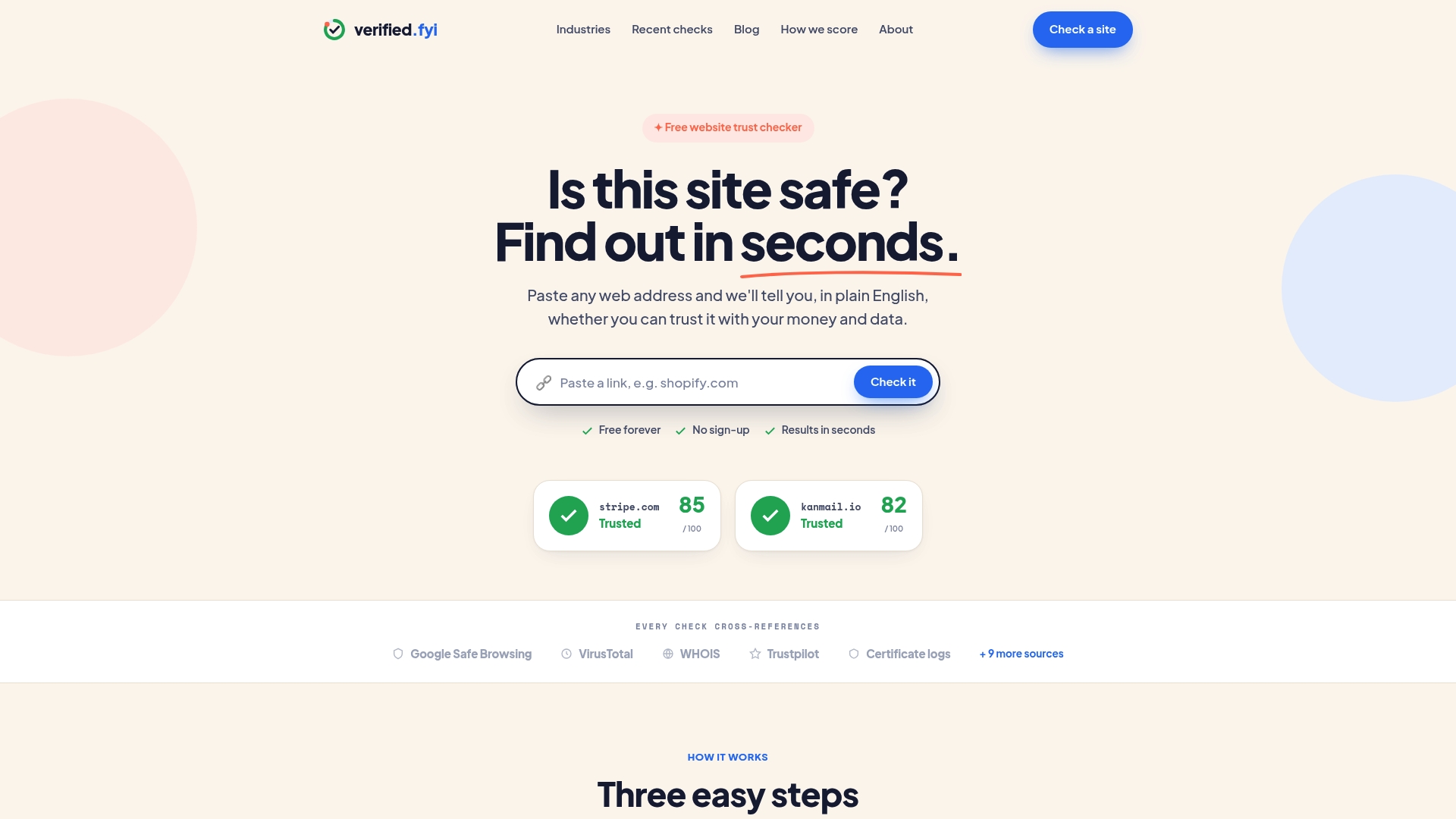
You can browse recently checked websites to see what other users have flagged, or paste any URL directly into Verified fyi for an instant verdict. The platform also tracks trending scam sites so you stay ahead of new threats without doing extra research. Pair that with the secure browsing techniques in this guide and you have a practical, complete defense for everyday online activity. Small businesses can also benefit from reviewing website security fundamentals alongside these personal habits.
FAQ
What is the most important browser safety practice?
Keeping your browser updated is the single most critical step. Half of all cyberattacks originate through browsers, and patches close the vulnerabilities those attacks exploit.
How do I protect my online privacy in the browser?
Block third-party cookies in your browser's native privacy settings and disable ad profiling. Native blocking outperforms most privacy extensions at reducing cross-site tracking.
Are browser extensions safe to use?
Extensions are safe when they come from verified publishers and request minimal permissions. Every added extension expands your attack surface, so limit installs to tools you use weekly and audit them monthly.
What should I do after clicking a suspicious link?
Close the browser tab immediately, run a security scan, and change any passwords you may have entered. Enabling login alerts on your accounts helps you catch unauthorized access before it escalates.
Is SMS-based two-factor authentication good enough?
SMS codes are better than no multi-factor authentication, but authenticator apps are the stronger choice. SMS can be intercepted through SIM-swapping, while authenticator apps generate codes locally on your device.