TL;DR:
- Anonymous websites often lack accountability, increasing risks of harassment, fraud, and data theft. Free proxies and tools like Tor have technical vulnerabilities, exposing users to leaks and malicious activities. Using verified, paid privacy tools and checking website trust scores help protect your online safety.
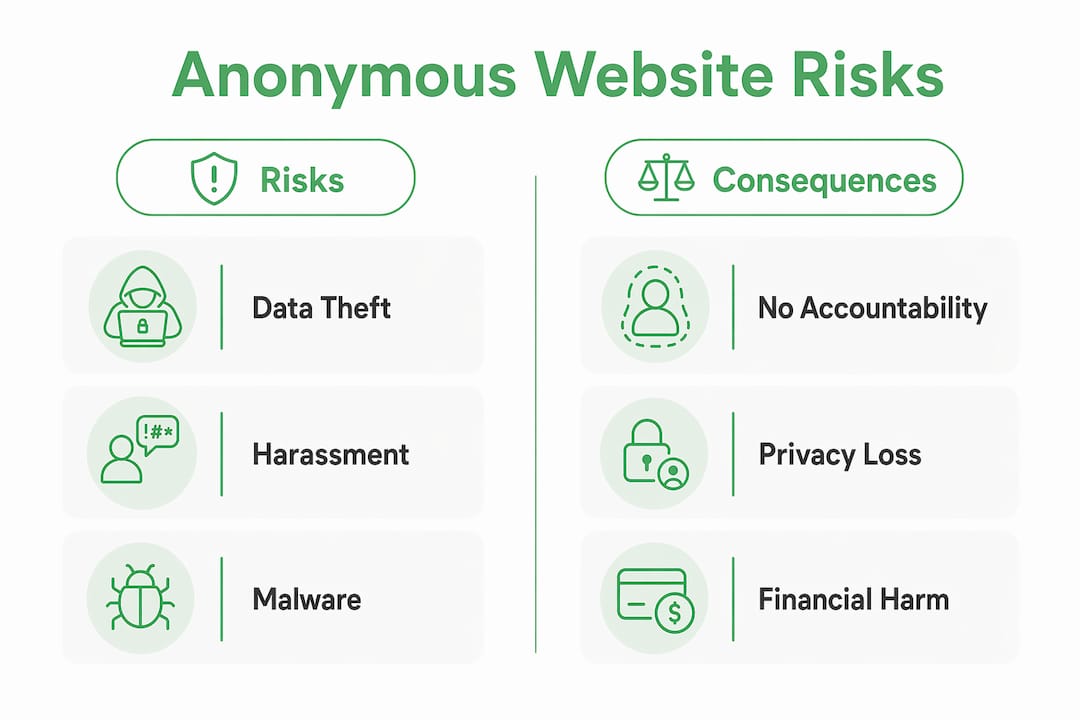
Anonymous websites are defined as online platforms that allow users to interact, post, or transact without revealing their real identity. That lack of accountability is exactly why anonymous websites are dangerous. Without a traceable identity, harmful actors face no consequences, and the infrastructure behind many anonymous tools actively works against you. This guide covers the psychological, technical, and economic threats these sites create, and what you can do to protect yourself.
Why anonymous websites are dangerous: the accountability gap
Anonymity removes the social contract. When users cannot be identified, harmful behavior increases significantly. Research confirms statistically significant differences in harm perception between anonymous and non-anonymous interactions, with anonymous commenters far more likely to engage in vulgar, hateful conduct.
The eSafety Commissioner identifies this as a structural "accountability gap." Platforms struggle to moderate hate speech and misinformation when they cannot verify who is posting. Perpetrators know this, and they exploit it.
"Anonymity creates conditions where the normal social deterrents to harmful behavior simply do not apply. Victims feel targeted by an invisible force, which intensifies the psychological damage far beyond what a named attacker would cause."
Victims of anonymous harassment report feeling helpless and self-doubting because they cannot confront or identify their attacker. This effect is especially pronounced among young people on anonymous social media platforms and chat rooms. The harm is not abstract. It shows up as anxiety, depression, and withdrawal from online spaces entirely.
- Anonymous forums and fake profiles enable coordinated harassment campaigns with no paper trail.
- Misinformation spreads faster on anonymous platforms because no one is accountable for accuracy.
- Moderation tools built on user reporting fail when the abuser simply creates a new anonymous account.
- Youth are disproportionately targeted because they are more active on anonymous social apps.
How do free proxy services put your data at risk?
Free proxy servers are among the most common anonymous browsing tools, and they are also among the most hostile. Security experts classify most free proxies as hostile infrastructure. That classification is not hyperbole. It reflects what these services actually do with your traffic.
Here is what happens when you route your connection through a free proxy:
- Traffic logging. The proxy operator records every URL you visit, every form you submit, and every search you run. That data is sold to data brokers or used for targeted attacks.
- SSL stripping. The proxy downgrades your HTTPS connection to plain HTTP. Your passwords and session cookies travel in plaintext. 38% of tested free proxies actively perform this attack.
- Script injection. Malicious proxies insert crypto miners or phishing redirects directly into the web pages you load. You see a normal-looking site. The proxy is running code in the background.
- Session hijacking. By capturing your session cookies, the operator can impersonate you on any site where you are logged in, including banking and email.
- Man-in-the-middle access. Free proxies decrypt and inspect your traffic with complete visibility. Nothing you send is private.
| Risk | What it means for you |
|---|---|
| SSL stripping | Passwords sent in plaintext, visible to the proxy operator |
| Script injection | Malware or miners run silently on your device |
| Session hijacking | Attacker logs into your accounts using stolen cookies |
| Data selling | Your browsing history sold to third parties without consent |
Pro Tip: Before using any proxy or VPN, check the provider's privacy policy for explicit no-logging commitments. If the policy is vague or absent, treat the service as hostile.
Are Tor and other trusted anonymity networks actually safe?
Tor is the most recognized anonymity network, and it does hide your IP address from basic observers. The problem is that Tor does not protect you from everything. Tor does not defend against browser exploits, phishing attacks, or malware delivered at the application layer.
The risks of anonymous browsing on Tor go deeper than most users realize:
- WebRTC leaks. Your browser can reveal your real IP address through WebRTC requests, bypassing Tor's anonymity circuits entirely. This happens silently, with no warning.
- DNS leaks. If your DNS queries resolve outside the Tor circuit, your internet provider can see which sites you visit even while you think you are anonymous.
- Browser fingerprinting. Your screen resolution, installed fonts, and browser settings create a unique fingerprint that can identify you across sessions, regardless of IP masking.
- Malicious exit nodes. Tor traffic exits through volunteer-operated nodes. A malicious node operator can intercept unencrypted traffic and modify content.
Pro Tip: Disable WebRTC in your browser settings when using any anonymity network. On Firefox, set media.peerconnection.enabled to false in about:config. On Chrome, use a dedicated WebRTC blocking extension.
The false sense of security Tor creates is itself a danger. Users who believe they are fully protected take risks they otherwise would not. Device compromise and financial loss follow.
Why free anonymous tools treat you as the product
The economics of free anonymous services explain their behavior. If a service costs nothing, the operator earns revenue some other way. Free anonymizers monetize user traffic data, selling browsing histories and credentials to data brokers and malicious actors. You are not the customer. You are the inventory.
This model is not unique to shady operators. It is the standard business model for free anonymity tools. Understanding why personal data gets scraped and sold helps explain why free tools cannot be trusted with sensitive browsing.
Paid privacy tools operate differently. A reputable paid VPN earns revenue from subscriptions, not from selling your data. The incentive structure is aligned with protecting you rather than exploiting you. The most trusted VPN services publish independent audit results confirming their no-log policies.
Pro Tip: Treat any free privacy tool the same way you would treat a stranger offering to hold your wallet. The service may work, but the incentives are not in your favor.
How to stay safe when dealing with anonymous websites
Protecting yourself from the risks of anonymous sites requires specific habits, not just general caution.
- Avoid free proxy servers entirely. Use a reputable paid VPN with a verified no-log policy and published third-party audits.
- Enable browser security features. Modern browsers flag dangerous sites. Review your browser security warnings and do not dismiss them without reading them.
- Install trusted anti-malware software. Tools like Malwarebytes detect script injections and malicious redirects that proxies introduce.
- Limit personal information on anonymous platforms. Even if your identity is hidden, the data you share can be used to identify or target you.
- Report abusive behavior. Document harassment with screenshots and report to the platform and, when threats are credible, to law enforcement.
- Verify sites before engaging. Paste any URL into Verified fyi before entering credentials or payment details on an unfamiliar site.
Follow the safe browsing habits checklist to build these practices into your daily routine.
Key Takeaways

Anonymous websites are dangerous because they remove accountability, enabling harassment, data theft, and malware delivery with no consequences for the attacker.
| Point | Details |
|---|---|
| Accountability gap drives abuse | Anonymity removes social deterrents, making harassment and misinformation far more common. |
| Free proxies are hostile infrastructure | Most free proxies log traffic, strip SSL, and inject malicious scripts into your sessions. |
| Tor has real technical limits | WebRTC and DNS leaks can expose your real IP even when using Tor correctly. |
| Free tools exploit user data | Free anonymizers earn revenue by selling your browsing history, not by protecting it. |
| Verification before engagement | Check any unfamiliar site with Verified fyi before sharing personal or payment information. |
Anonymity is a tool, not a shield
I have spent years watching people conflate anonymity with safety. They are not the same thing. Anonymity protects your identity from observers. It does nothing to protect you from the infrastructure you are trusting to deliver that anonymity.
The most dangerous assumption I see is that "anonymous" means "safe." A free proxy can be anonymous and hostile at the same time. Tor can hide your IP while your browser leaks it through WebRTC. The gap between perceived protection and actual protection is where most people get hurt.
Anonymity has genuine value. Whistleblowers, journalists, and people in authoritarian countries depend on it. The problem is that the tools marketed to ordinary users as "free anonymous browsing" are almost never built with those users' interests in mind. They are built to monetize traffic.
My honest recommendation: treat every free anonymity tool as a red flag until proven otherwise. Pay for privacy tools with audited no-log policies. And before you engage with any site you found through an anonymous channel, run it through a site verification check. The online privacy risks that seem abstract become very concrete the first time your credentials are stolen.
— Nick
Check any site before you trust it
Anonymous websites often look legitimate. That is the point. Verified fyi analyzes over 200 security and reputation signals for any URL you submit, returning a trust score from 0 to 100 in seconds.
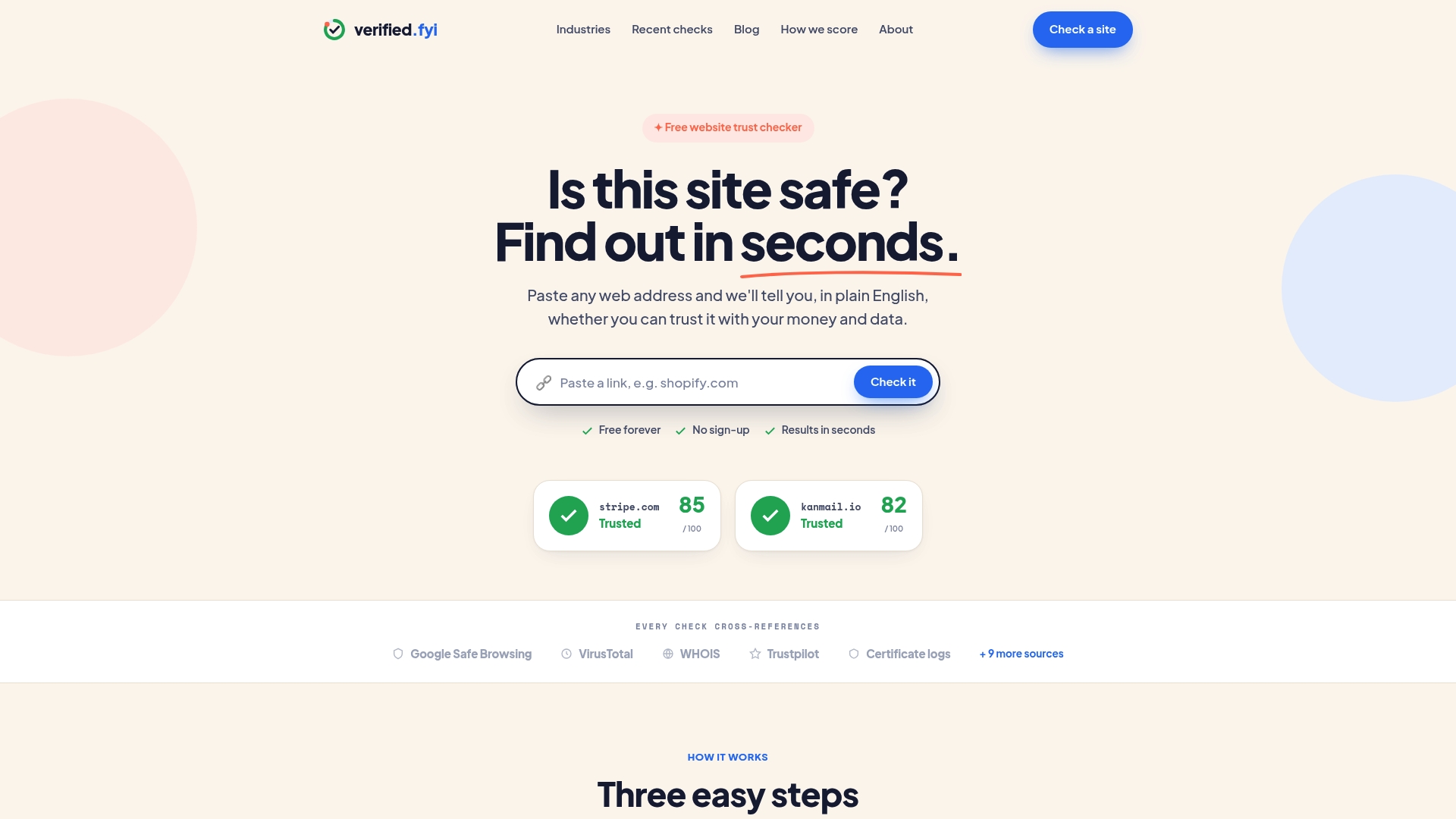
Paste a suspicious URL into Verified fyi and get an instant verdict on whether the site is safe to use. You can also browse recently checked websites to see what others have flagged. For privacy tools specifically, the trusted VPN and security list covers vetted services with confirmed no-log policies. Knowing a site's trust score before you enter your email or payment details takes seconds and can prevent serious harm.
FAQ
What makes anonymous websites dangerous?
Anonymous websites remove accountability, which enables harassment, fraud, and data theft without consequences for the attacker. The eSafety Commissioner identifies this accountability gap as the primary driver of toxic online behavior.
Are free proxy servers safe to use?
Free proxy servers are not safe. Most log your traffic, sell your browsing data, and some actively strip HTTPS encryption to capture passwords and session cookies.
Does Tor make you completely anonymous?
Tor hides your IP address but does not protect against browser exploits, phishing, or technical leaks like WebRTC and DNS, which can expose your real IP without warning.
How can I tell if an anonymous site is a scam?
Paste the URL into Verified fyi, which checks over 200 security and reputation signals and returns a trust score instantly. A low score is a clear red flag to avoid the site.
What is the safest way to browse anonymously?
Use a reputable paid VPN with a published no-log audit, disable WebRTC in your browser, and avoid free proxy services entirely. Paid tools have financial incentives to protect your data rather than sell it.