
What does it mean to verify crypto?
Crypto verification covers two distinct processes: confirming that a communication (an email, a link, a social media message) actually comes from a legitimate source, and confirming that a blockchain transaction is valid and final. Both matter, and confusing them is where most people get into trouble.
The irreversible nature of crypto transfers is what makes verification non-optional. Once funds leave your wallet, no bank, no support team, and no central authority can retrieve them. The FTC warns that offers promising guaranteed returns or lacking asset transparency are almost always scams. Phishing attacks exploit exactly this irreversibility: get you to send first, ask questions never.
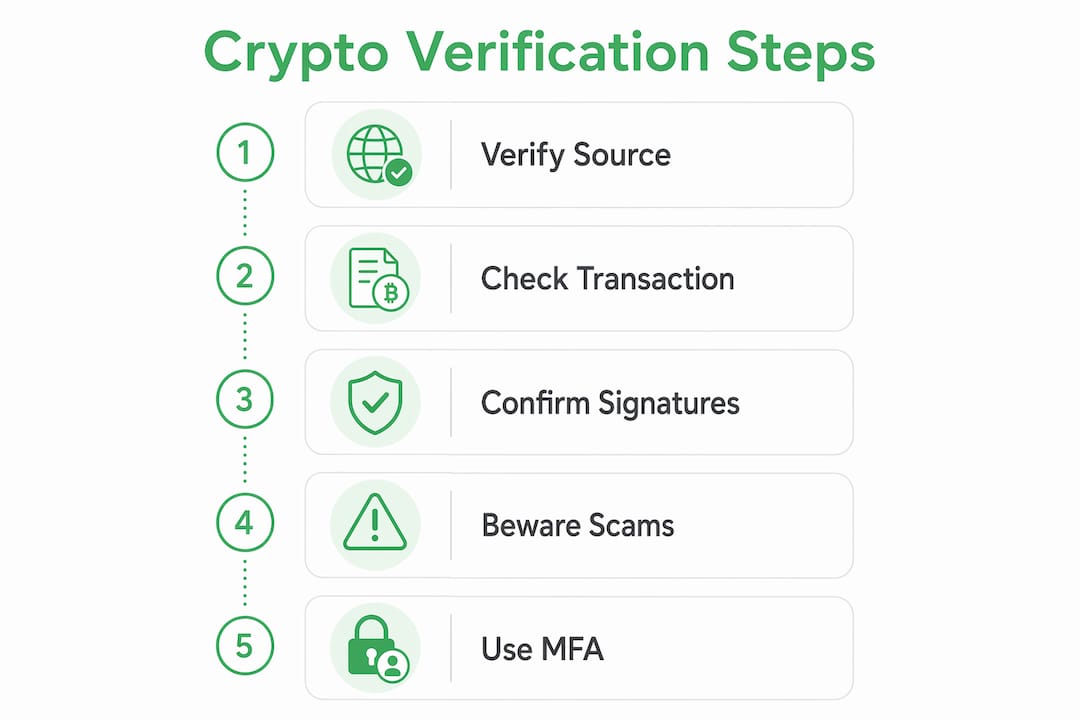
Here is what crypto verification covers in practice:
- Communication verification: Checking whether an email, URL, or social media account is genuinely from the company it claims to represent
- Transaction verification: Using a block explorer to confirm a transaction's status, destination address, amount, and confirmation count on the public ledger
- Ownership verification: Confirming that a wallet address or smart contract belongs to the entity you intend to transact with
How to verify crypto communications using Crypto.com Verify
Crypto.com Verify is a free phishing check tool that lets you submit a URL, email address, or social media handle to confirm whether it is an official Crypto.com channel. Scammers routinely impersonate major exchanges, so having a direct lookup tool from the exchange itself closes a real gap.
- Go to verify.crypto.com in your browser.
- Paste the suspicious URL, email address, or social media ID into the search field.
- Review the result. A green confirmation means the channel is official. Anything else is a red flag.
- If the result is unverified, do not click any links in that communication and do not send funds.
- Report the suspicious contact to the FTC at ReportFraud.ftc.gov and to Crypto.com's support team.
Crypto.com Verify only covers Crypto.com's own channels. For other platforms or crypto offers, you need a broader approach.
Pro Tip: Before you even open a suspicious email, read the sender address aloud. Your eye glosses over "[email protected]"; your voice catches the hyphen immediately. Pair that habit with multi-factor authentication (MFA) on every exchange account. MFA means a stolen password alone cannot unlock your funds.

How to check a crypto transaction on a block explorer
A block explorer works like a package tracker for blockchain data. You enter a transaction ID (also called a TXID or transaction hash) and instantly see timestamps, sender and recipient addresses, fee amounts, and confirmation counts. No account or wallet connection needed.
Steps to verify a transaction:
- Copy your TXID from your wallet app or exchange confirmation screen.
- Open the correct explorer for your blockchain (see table below).
- Paste the TXID into the search bar and press enter.
- Check the status field: Pending, Confirmed, or Failed.
- Confirm the recipient address matches the one you intended character by character.
- Review the confirmation count to assess finality.
A failed transaction means funds did not leave your wallet, though you may still lose the gas fee. A pending status means the network has not yet included it in a block.
| Blockchain | Explorer |
|---|---|
| Bitcoin (BTC) | Mempool.space |
| Ethereum (ETH) | Etherscan |
| BNB Chain | BSCScan |
| Polygon | PolygonScan |
| Avalanche | Avalanche Explorer |

Pro Tip: Always check the transaction hash directly on a block explorer rather than relying solely on your wallet or exchange interface. The explorer gives you immutable, independent proof of where funds actually went.
Understanding confirmations, clipboard risks, and smart contract checks
How confirmations work
A transaction confirmation occurs each time a new block is added to the chain after the block containing your transaction. One confirmation means your transaction is in the chain. Six confirmations is the widely accepted standard for Bitcoin to be considered irreversible, because each additional block makes a double-spend attack exponentially harder. Ethereum requires multiple confirmations for the same level of security, but six confirmations remains the Bitcoin benchmark. Timing varies with network congestion and transaction fees.
Industry standard: 6 confirmations for Bitcoin is the accepted threshold for high-value transactions. Waiting for fewer confirmations on large transfers is a real risk.
Clipboard hijacking
Clipboard hijacking is malware that silently replaces a copied wallet address with the attacker's address the moment you paste it. You copy a legitimate address, paste it, and send funds straight to a thief. The defense is simple but requires discipline: after pasting any wallet address, compare the first five and last five characters against your original source before confirming.
Best practices for verifying ownership and smart contracts:
- Verify every wallet address character by character before sending, especially for large amounts.
- For hardware wallets (Ledger, Trezor), always confirm the full recipient address on the device screen, not just on your computer monitor.
- Check smart contract addresses on the project's official website first, then cross-reference on a block explorer. Never use a contract address shared only through a direct message.
- Watch for red flags on contract pages: urgent language, very few prior transactions, or addresses that differ by even one character from the official source.
- Send a small test transaction before transferring a large amount to a new address.
Pro Tip: Hardware wallets display the full recipient address on their own screen, which malware on your computer cannot alter. For any transfer above a few hundred dollars, that physical confirmation step is worth the extra ten seconds.
How Verified fyi helps you assess crypto websites and offers
Verified fyi analyzes over 200 security and reputation signals using AI to produce a trust score from 0 to 100 for any website. Paste a URL and you get an instant verdict on whether a crypto platform, offer page, or exchange is safe to engage with. The platform also maintains a curated list of Most Trusted Crypto Sites, which is useful when you encounter an unfamiliar exchange or token project.
Verified fyi's AI-driven scoring weighs signals across domain age, SSL configuration, blacklist status, user reports, and dozens of additional reputation factors. The result is a single, clear score that tells you whether a site warrants further investigation or an immediate exit.
Where Verified fyi fits into your verification workflow:
- You receive a link to a "new crypto investment platform." Before clicking, paste the URL into Verified fyi.
- A low score (below 40) is a strong signal to walk away. A high score does not guarantee legitimacy but removes the most obvious red flags.
- Use it alongside Crypto.com Verify and a block explorer for a layered approach: check the communication source, check the site, then check the transaction.
You can see recently checked crypto sites on the platform to get a sense of what flagged sites look like in practice.
Running a phishing check on crypto communications
Phishing in crypto typically arrives as an email, a text, or a social media message impersonating a known exchange or wallet provider. The goal is always the same: get you to click a link and enter credentials or send funds. Knowing how to spot fake sites before you interact with them is the first line of defense.
Check the sender domain carefully. Legitimate exchanges do not send from Gmail accounts or domains with extra hyphens. Never click a link in an unsolicited message; navigate directly to the exchange's official URL instead. The FTC is explicit: no legitimate business will ever demand payment in cryptocurrency or ask you to move funds to "protect" them.
How digital signatures protect crypto communications
Every cryptocurrency transaction is digitally signed using cryptography before it is broadcast to the network. That signature proves the transaction originated from the holder of the private key without revealing the key itself. Proof of Work and Proof of Stake consensus mechanisms then validate these signed transactions across the network, with penalties for malicious actors who attempt to submit false entries.
For communications outside the blockchain (emails, API calls, signed messages from wallets), the same principle applies. A wallet can sign a message to prove ownership of an address without moving any funds. If a platform asks you to verify wallet ownership, this signed-message method is the legitimate approach. Any platform that instead asks you to send a small amount to "verify" your wallet is running a scam.
Crypto scams beyond phishing: what else to watch for
Phishing is the most common attack vector, but it is far from the only one. Investment scams promise guaranteed returns or celebrity endorsements. Impersonation scams involve fraudsters posing as Amazon, Microsoft, or government agencies demanding crypto payment. Fake job listings ask you to pay a fee in crypto before you can start work. Romance scams build trust over weeks before steering you toward a fraudulent investment platform.
The FTC's guidance is consistent across all of these: no legitimate entity guarantees crypto profits, demands upfront crypto payment, or contacts you out of the blue with an investment opportunity. Before engaging with any offer, search the company name plus "scam" or "complaint" online. For identifying fake company websites, look for mismatched domains, missing contact information, and pressure tactics.
Why automated transaction verification tools matter
Manual block explorer checks work well for individual transactions, but active traders and developers need automated solutions. Tools like Etherscan's API, BSCScan's API, and GetBlock's explorer API let you query transaction status, wallet balances, and contract data programmatically. This is how exchanges and wallets surface real-time confirmation counts in their own interfaces.
For users rather than developers, the practical takeaway is this: if your wallet or exchange does not show a transaction hash you can independently look up, that is a red flag about the platform itself. Any legitimate service gives you a TXID. Reviewing secure document and data sharing practices is also worth your time if you are building or integrating crypto verification into your own workflow.
Why multi-factor authentication is a non-negotiable for crypto accounts
MFA adds a second verification layer so that a stolen password alone cannot compromise your account. For crypto exchanges, the strongest MFA options are authenticator apps (Google Authenticator, Authy) or hardware security keys (YubiKey). SMS-based MFA is better than nothing but is vulnerable to SIM-swapping attacks, where a fraudster convinces your carrier to transfer your number to their device.
Enable MFA on every exchange account, email address tied to crypto, and password manager you use. The National Cryptocurrency Association recommends treating your email account as a crypto asset in its own right, since most exchange password resets flow through email. A compromised inbox is often the first step in a full account takeover.
Key Takeaways
Verifying crypto requires checking both the source of communications and the on-chain record of transactions before you send any funds.
| Point | Details |
|---|---|
| Two-layer verification | Always check both the communication source and the blockchain transaction record independently. |
| Bitcoin confirmation standard | Six confirmations is the accepted threshold for treating a Bitcoin transaction as irreversible. |
| Clipboard hijacking risk | Malware can replace copied wallet addresses; compare the first and last five characters after every paste. |
| Verified fyi for site checks | Paste any crypto site URL into Verified fyi to get an AI-scored trust rating based on 200+ signals. |
| MFA protects accounts | Use an authenticator app or hardware key, not SMS, for multi-factor authentication on all exchange accounts. |
FAQ
What is crypto verification?
Crypto verification covers two things: confirming that a communication (email, link, or social media message) comes from a legitimate source, and confirming that a blockchain transaction is valid using a block explorer and transaction hash.
How do I verify my crypto transaction?
Copy your transaction ID (TXID) from your wallet or exchange, paste it into the block explorer for your blockchain (Etherscan for Ethereum, Mempool.space for Bitcoin), and check the status, recipient address, and confirmation count.
How do I check if a crypto offer or site is legit?
Search the company name plus "scam" or "complaint" online, and paste the site URL into Verified fyi for an AI-scored trust rating. The FTC advises that any offer guaranteeing profits or demanding upfront crypto payment is a scam.
How long does it take to verify a crypto transaction?
Confirmation timing varies by blockchain and network congestion. Bitcoin transactions are generally considered secure after multiple confirmations, with Ethereum requiring more confirmations for similar security. A single confirmation can arrive in minutes, but waiting for the full threshold is advisable for high-value transfers.
Is my crypto verified after one confirmation?
One confirmation means your transaction is included in a block, but it is not yet considered final. For Bitcoin, six confirmations is the industry standard for irreversibility, because each additional block makes a reversal attack significantly harder.