TL;DR:
- AI website security analyzes web traffic and signals to detect threats using adaptive machine learning models. It continuously monitors scripts and user behavior to catch runtime attacks and prioritize threats based on actual impact. Verified fyi provides instant safety scores for any URL, leveraging AI to deliver quick, comprehensive assessments without technical expertise.
AI website security analysis is defined as the automated process of evaluating web traffic, domain signals, and runtime behavior to detect threats and assign a safety verdict to any given site. Where traditional rule-based tools rely on fixed signatures, AI adapts. It learns from new attack patterns, scores risk in context, and catches threats that no static blocklist ever could. If you want to understand how AI analyzes website safety before trusting an unfamiliar URL, this guide breaks down exactly what happens under the hood.
What data and signals does AI analyze to assess website safety?
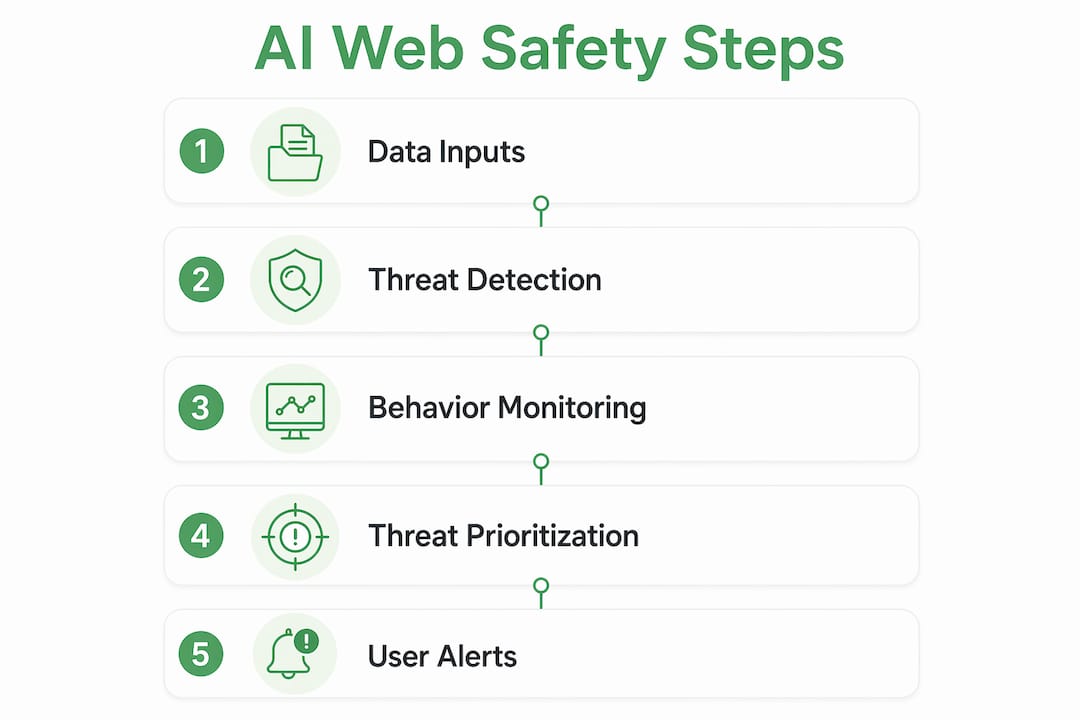
AI-driven website risk analysis starts with raw data. Every HTTP request carries information: headers, payloads, URL structure, and query parameters. AI systems ingest all of it simultaneously, not just one layer at a time.
The signals AI evaluates fall into several distinct categories:
- HTTP request content: Headers, cookies, and POST body payloads are parsed for injection patterns, encoding anomalies, and suspicious parameter values.
- URL and domain relationships: AI models map connections between domains, subdomains, and IP addresses to identify hosting patterns common to scam networks.
- Script behavior: Every JavaScript file loaded on a page is inventoried and monitored for unexpected changes or data exfiltration attempts.
- User session and traffic patterns: Unusual click sequences, rapid form submissions, or bot-like navigation trigger anomaly flags.
- Multi-modal data inputs: Modern AI systems apply text analysis, computer vision, and graph-based modeling to detect threats that appear in images, page layout, or link networks.
That last point is underappreciated. A phishing page may look clean to a text parser but reveal itself through visual layout analysis or suspicious domain graph connections.
Pro Tip: Before entering personal information on any site, check its domain age and hosting relationships. AI tools like Verified fyi analyze over 200 signals including these, giving you a trust score from 0 to 100 in seconds.

How do AI machine learning models detect and classify web threats?
AI classifies web threats using a layered pipeline of machine learning models, not a single algorithm. Each layer handles a different type of threat.
- Signature and IP blocklisting: The first layer filters known malicious IPs and matches request patterns against a threat database.
- Supervised classification: Models like Random Forest are trained on labeled attack datasets. Random Forest achieves 91.5% accuracy classifying SQL injection, cross-site scripting (XSS), and other common attack types. That accuracy comes from training on 61,065 samples from the CSIC 2010 HTTP dataset, one of the most widely used benchmarks in web security research.
- Anomaly detection: Models like Isolation Forest identify requests that deviate from normal baselines, catching zero-day attacks that supervised models have never seen before.
- Semantic analysis: Natural language processing reads the meaning of request content, not just its structure, to catch obfuscated attacks.
- Multi-step validation: Findings are cross-referenced across layers before an alert fires, reducing noise.
The contrast with traditional web application firewalls (WAFs) is stark. Rule-based and blacklist approaches fail against polymorphic and adversarial threats that mutate their signatures on every request. AI detection adapts continuously.
| Detection method | Threat type covered | Limitation |
|---|---|---|
| Signature matching | Known attack patterns | Blind to new variants |
| Supervised ML | Labeled attack categories | Requires training data |
| Anomaly detection | Unknown and zero-day threats | Higher false positive rate |
| Semantic analysis | Obfuscated and encoded attacks | Computationally intensive |
Pro Tip: When evaluating any website safety assessment tool, ask whether it uses anomaly detection alongside supervised models. A tool that only matches signatures will miss novel threats entirely.
How does AI leverage real-time behavioral monitoring to catch runtime threats?
Static analysis only catches threats at the network perimeter. The most dangerous modern attacks happen inside the browser, after a page has already loaded. AI addresses this through persistent runtime monitoring.
Runtime threats like formjacking and data skimming are specifically designed to bypass perimeter tools. AI agents continuously monitor every script and data flow across websites and mobile apps, blocking threats before data leaves the user's device. This matters because a legitimate site can be compromised by a single malicious third-party script injected into its checkout page.
Key capabilities of AI runtime behavioral monitoring include:
- Client-side script inventory: AI catalogs every script running on a page and flags any new or modified script that was not present during the last verified scan.
- Session-level analysis: Persistent session monitoring covers every user interaction without sampling gaps, meaning no session goes unobserved.
- Formjacking detection: AI watches for scripts that intercept form submissions and copy payment or login data before it reaches the server.
- OWASP and NIST CSF alignment: Runtime monitoring tools map their detections to OWASP's client-side security standards and the NIST Cybersecurity Framework, giving security teams a compliance-ready audit trail.
The practical advantage over static tools is significant. A static scanner checks a site once and moves on. AI behavioral monitoring treats every page load as a new event worth examining.
How does AI prioritize and contextualize threats to reduce false positives?
Detecting threats is only half the problem. Security teams and users need to know which findings actually matter. AI addresses this through contextual prioritization, not just raw scoring.
Canary-based baseline comparison is one of the most effective methods for eliminating false positives. AI scanners send known-safe "canary" requests and compare responses against suspicious ones. If a flagged response looks identical to a clean baseline, the alert is suppressed. This removes the noise that makes traditional scanners exhausting to use.
Beyond false positive reduction, AI maps multi-step attack paths that link individual vulnerabilities into full exploit chains. A single misconfigured header may look low risk in isolation. When AI shows it connects to an authentication bypass and then to a database exposure, its business impact becomes clear. Findings ranked by business impact rather than raw CVSS scores give security teams a practical remediation order, not just a list of technical findings. The agentic AI security risks emerging in enterprise environments make this kind of contextual prioritization even more critical as AI systems themselves become attack surfaces.
Key Takeaways
AI analyzes website safety by combining supervised classification, anomaly detection, and real-time behavioral monitoring across multiple data layers to catch both known and unknown threats with far greater accuracy than rule-based tools.
| Point | Details |
|---|---|
| Multi-signal data analysis | AI evaluates HTTP requests, domain graphs, scripts, and session behavior simultaneously. |
| Layered ML detection | Supervised models like Random Forest and anomaly models like Isolation Forest work together for full threat coverage. |
| Runtime behavioral monitoring | AI watches every script and session in real time, catching formjacking and skimming that perimeter tools miss. |
| Canary-based false positive reduction | Comparing scanner results against clean baselines removes noise and focuses alerts on real risks. |
| Business-context prioritization | Attack path mapping ranks vulnerabilities by actual impact, not just technical severity scores. |
AI website safety analysis: what I've actually seen work
The most common mistake I see security-conscious readers make is treating website safety as a binary. Safe or not safe. The reality AI reveals is a spectrum, and the signals that matter most are rarely the obvious ones.
A site can have a valid SSL certificate, a clean Google Safe Browsing record, and still be running a compromised third-party analytics script that skims payment data. Traditional tools give that site a green light. AI behavioral monitoring flags the script change within minutes of injection. That gap between "looks clean" and "is clean" is exactly where modern attacks live.
The other thing worth saying plainly: AI is not infallible. Adversarial attacks specifically designed to fool machine learning models are a real and growing threat. Evasion techniques that mimic legitimate traffic patterns can slip past anomaly detectors. The best AI systems address this through continuous retraining and compliance-aligned governance frameworks that keep models current. A model trained on last year's attack data is already partially blind.
My advice for anyone serious about online security: use tools that combine multiple detection layers, check sites before you engage with them, and pay attention to trust scores that reflect behavioral signals, not just surface-level checks. The unsafe website signs that AI catches are often invisible to the human eye. That is exactly why the technology exists.
— Nick
Verified fyi makes AI-powered safety checks fast and accessible
AI website security analysis at the enterprise level is sophisticated. Getting the benefit of it as an individual user should not require a security degree.
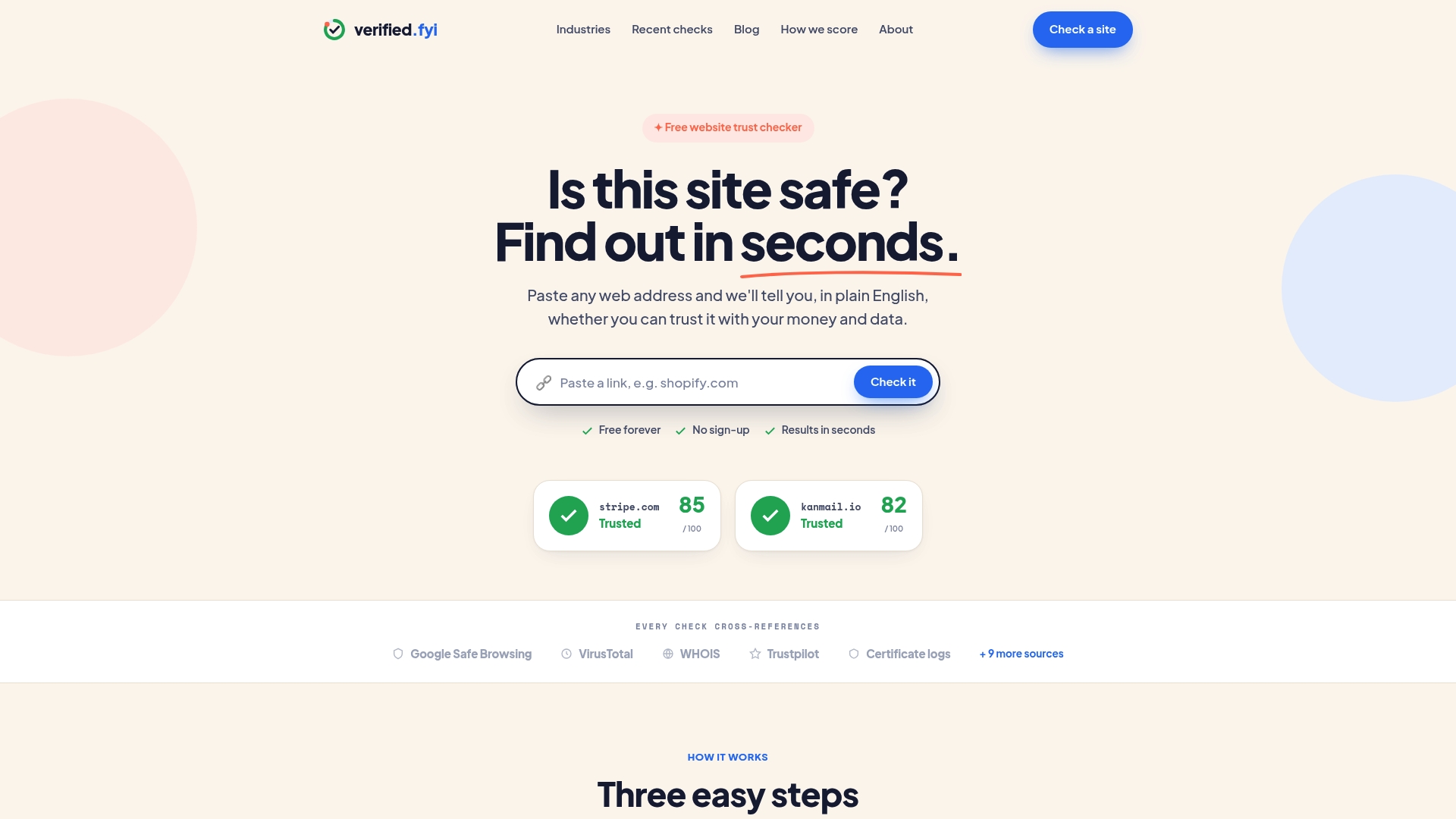
Verified fyi analyzes over 200 security and reputation signals for any URL you submit, then delivers a trust score from 0 to 100 with a clear safety verdict. The platform uses AI to weigh signals including domain age, SSL configuration, blacklist status, behavioral indicators, and reputation data. You can check any website's safety in seconds, without installing anything or creating an account. For a broader look at how sites are being assessed right now, the recently checked websites feed shows real-time safety reports across hundreds of domains. If you want to build safer browsing habits alongside using AI tools, the 2026 safe browsing checklist is a practical starting point.
FAQ
How does AI analyze website safety differently from traditional tools?
AI uses machine learning models and behavioral monitoring to detect both known and unknown threats in real time. Traditional tools rely on fixed signatures that fail against polymorphic or novel attacks.
What is formjacking and how does AI detect it?
Formjacking is a runtime attack where malicious scripts copy form data, such as payment details, before it reaches the server. AI detects it by continuously monitoring every script running on a page and flagging unauthorized changes.
What is a canary-based baseline in AI security scanning?
A canary baseline is a known-safe reference request that AI scanners use to compare against suspicious responses. If a flagged response matches the clean baseline, the alert is dismissed as a false positive.
How accurate are AI models at classifying web attacks?
Machine learning models like Random Forest reach 91.5% accuracy on standard web attack datasets, including SQL injection and XSS categories, when trained on benchmarks like the CSIC 2010 HTTP dataset.
Can I check a website's safety without technical knowledge?
Yes. Tools like Verified fyi let you paste any URL and receive an instant AI-generated trust score based on over 200 signals, with no technical setup required.