TL;DR:
- Online scams involve internet fraud designed to steal money and personal information by exploiting trust and urgency. Recognizing common tactics like phishing emails, fake websites, and social media impersonation helps prevent falling victim. Using verification tools and maintaining skeptical habits are essential defenses against evolving online threats.
Online scams are fraudulent schemes carried out over the internet to steal your money, personal information, or both. They work by exploiting trust, urgency, and the sheer volume of digital communication most people navigate every day. The FBI's Internet Crime Complaint Center reported substantial losses in 2025, with investment-related internet fraud leading all categories. That number keeps climbing because scammers adapt fast, and most people don't know what to look for until it's too late.
Here's what you're up against:
- Phishing emails and fake websites designed to mimic legitimate companies
- Phone calls and SMS messages using spoofed numbers to appear trustworthy
- Social media impersonation and fraudulent ads targeting everyday users
- Investment and cryptocurrency fraud promising unrealistic returns
- Tech support scams that gain remote access to your device
Understanding how these schemes work is the first step toward not falling for one.
How do scammers reach you online?
Scammers don't rely on a single channel. They go where you are, and they rotate methods constantly to stay ahead of filters and awareness campaigns.

Email remains the most common entry point. Phishing messages mimic banks, government agencies, or retailers, asking you to click a link or confirm account details. The Office of the Comptroller of the Currency notes these emails typically include spelling errors and generic greetings rather than your name, though AI-generated messages are making even that tell less reliable.
Phone calls and SMS are the next major vector. Scammers use technology to spoof caller ID, so the name and number you see can be completely fabricated. A call appearing to come from the Social Security Administration or your bank may originate from an overseas call center. In 2025, tech support and government impersonation call center complaints were numerous, associated with significant financial losses.
Other channels include:
- Social media platforms: Fake profiles impersonate friends, celebrities, or brands to push fraudulent investment opportunities or request money.
- Malicious ads: Paid advertisements on legitimate platforms can redirect you to scam sites or fake customer service numbers.
- Fake websites: Fraudulent e-commerce or banking sites mimic real ones with slight domain misspellings and outdated logos to capture your credentials or payment details.
- Cloud documents: Scammers now embed invisible malicious pages inside shared Google Docs or Dropbox files, a tactic flagged in Google's June 2026 fraud advisory.
Pro Tip: Before calling any number you received in an unsolicited message, look up the organization's official contact directly on their website. Never dial back a number from a text or voicemail you weren't expecting.
What are the most common types of online scams?
Knowing the specific playbook each scam type follows makes them far easier to recognize in the moment.
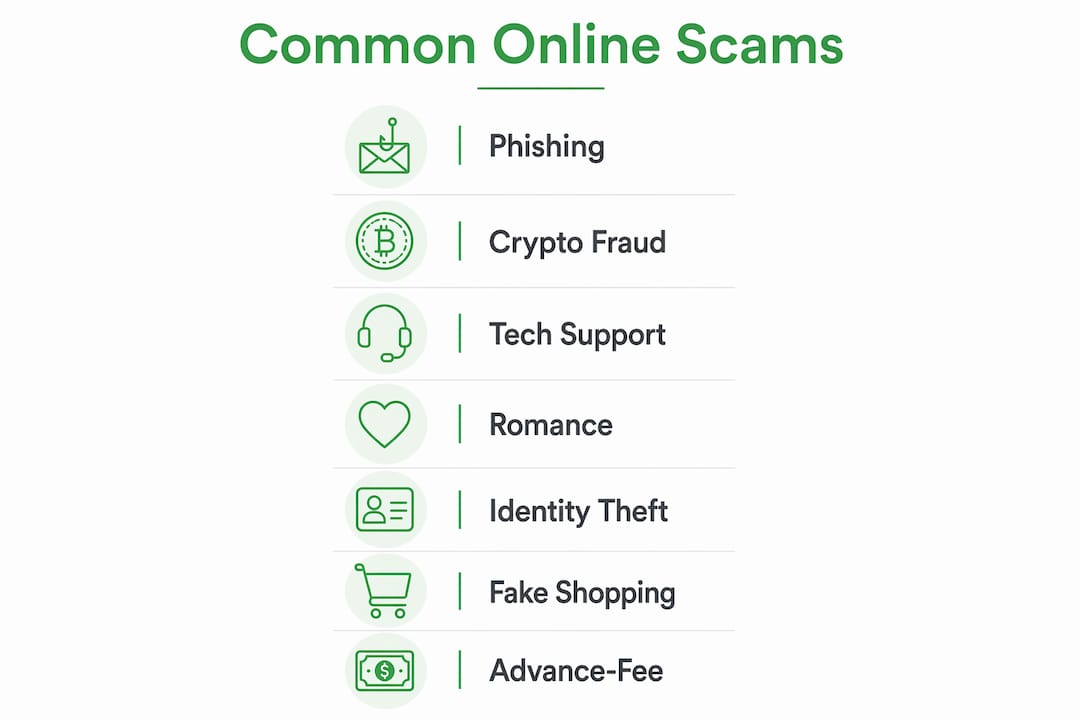
Phishing
Phishing is the practice of sending fake messages that appear to come from a trusted source to steal login credentials, Social Security numbers, or financial data. It's the most widespread form of internet fraud. Spotting phishing website warning signs early, such as mismatched URLs or missing HTTPS, can stop an attack before any data is compromised.
Investment and cryptocurrency fraud
This is the costliest category. Cryptocurrency investment fraud alone accounted for $7.2 billion in reported losses in 2025. Scammers typically initiate contact through text messages, social media, or dating apps, then move the conversation to a private messaging platform. Victims are introduced to fake investment platforms showing fabricated profits. When they try to withdraw funds, they're hit with "taxes" and "fees" before the scammer disappears entirely. Understanding how cryptocurrency trading works can help you distinguish legitimate platforms from fraudulent ones.
Tech support scams
A pop-up or cold call claims your computer has a virus and instructs you to call a number or grant remote access. Once in, scammers install malware, steal data, or demand payment to "fix" a problem that never existed. The FBI's Operation Level Up, launched in January 2024, has helped reduce victims' losses by identifying and notifying targets before funds are transferred.
Romance and relationship scams
These are long-game operations. A scammer builds a relationship over weeks or months through a dating app or social media, then invents a crisis requiring money. Victims often send funds multiple times before realizing the person they trusted was never real.
Identity theft
Scammers collect fragments of your personal data across multiple breaches or phishing attempts, then use them to open credit accounts, file tax returns, or access financial accounts in your name. The Consumer Financial Protection Bureau notes that identity theft can cause lasting financial damage well beyond the initial incident.
Fake e-commerce sites
Fraudulent shopping sites advertise products at steep discounts, collect payment, and either ship nothing or send a cheap counterfeit. These sites often appear in paid search results, making them easy to mistake for legitimate retailers.
Advance-fee scams
You're promised a large sum of money, a prize, or a loan, but first you must pay a small fee to release it. The fee grows with each request. The promised reward never arrives.
How to identify an online scammer before it's too late
The FTC identifies four core red flags that appear across virtually every scam type, regardless of the story being told.
- Impersonation of a known organization: Scammers pretend to be the IRS, FTC, Social Security Administration, Medicare, your bank, or a tech company. They use real names and real logos. Caller ID can be spoofed to show a legitimate number.
- Claims of a problem or prize: You owe money to the government, your account has been hacked, a family member is in trouble, or you've won a sweepstakes. These stories are designed to provoke an emotional reaction.
- Pressure to act immediately: Scammers want you to move before you think. They'll threaten arrest, deportation, account closure, or legal action if you don't comply right now.
- Unusual payment demands: Requests for cryptocurrency, wire transfers through services like Western Union or MoneyGram, payment apps, or gift cards are a near-certain sign of fraud. Legitimate organizations don't ask for payment this way.
The psychology behind these tactics is deliberate. The FTC and the National Council on Aging both explain that scammers trigger panic specifically to shut down your critical thinking. When you're afraid, you act. That's the entire mechanism.
Modern scams have added a technical layer that makes them harder to detect. Session token theft now allows attackers to bypass two-factor authentication entirely by stealing an active login session rather than your password. Calendar phishing, where fake meeting invites carry malicious links, is another tactic flagged in Google's 2026 advisory.
Pro Tip: If a message creates urgency or fear, treat that feeling as the red flag itself. Pause, put the phone down, and call someone you trust before doing anything else. Scammers count on you not doing exactly that.
Practical steps to avoid falling victim to internet fraud
Prevention comes down to habits, not just awareness. Here's what actually works.
Verify before you act. If someone contacts you claiming to be your bank, the IRS, or a tech company, hang up and call the organization directly using a number from their official website. Never use a number provided in the message itself.
Don't click unsolicited links. Whether the message arrives by email, text, or social media, clicking an unexpected link is how most phishing attacks begin. Go directly to the website instead.
Resist pressure. Legitimate businesses give you time to make decisions. Anyone who insists you must act within the hour, or threatens consequences for pausing, is using a scammer's playbook. The FTC is direct on this point: honest organizations don't pressure you to pay or share personal information on the spot.
Know which payment methods are traps. Cryptocurrency, wire transfers, and gift cards are preferred by scammers because they're irreversible. Once the money moves, it's gone. Credit cards and PayPal offer fraud protection; those methods don't.
Build an action plan. The FTC recommends creating a pre-prepared list of trusted contacts and verified institutional phone numbers you can consult before reacting to any suspicious contact. Post it somewhere visible near your phone or computer.
Additional habits worth building:
- Use unique, strong passwords for every account and enable two-factor authentication where available.
- Monitor your credit reports regularly through AnnualCreditReport.com for unauthorized accounts.
- Add your number to the National Do Not Call Registry to reduce unsolicited calls.
- Check websites before entering any personal or payment information.
How AI and site verification tools help you stay safe
Technology has become one of the most practical defenses against fraud, particularly for catching fake websites before you interact with them.
AI-powered site verification works by analyzing dozens of security and reputation signals simultaneously, things like domain age, SSL certificate validity, WHOIS data, blacklist status, and behavioral patterns associated with known scam sites. The result is a trust score that tells you, in seconds, whether a site is likely safe or suspicious.
Verified fyi does exactly this, analyzing over 200 signals to produce a score from 0 to 100 for any URL you submit. You paste the address, and the platform returns a clear verdict on the site's safety. That's useful any time you encounter an unfamiliar shopping site, a link in an email, or a website you found through a paid ad.
Practical ways to use digital safety tools:
- Before you buy: Check any unfamiliar retailer's URL before entering payment details. Fake e-commerce sites often score very low on trust metrics despite looking polished.
- Before you click: If a link arrives in an email or text, copy the URL and run it through a verification tool rather than clicking directly.
- Before you invest: Verify the website of any investment platform you're considering. Fraudulent crypto platforms often have newly registered domains with no verifiable history.
- When something feels off: Trust your instincts. If a site looks slightly wrong, check it. Site verification takes seconds and can prevent losses that take years to recover from.
Antivirus software like Norton, Bitdefender, or Malwarebytes adds another layer by blocking known malicious URLs and flagging suspicious downloads before they execute. Pairing real-time antivirus protection with on-demand site verification covers most of the attack surface scammers exploit.
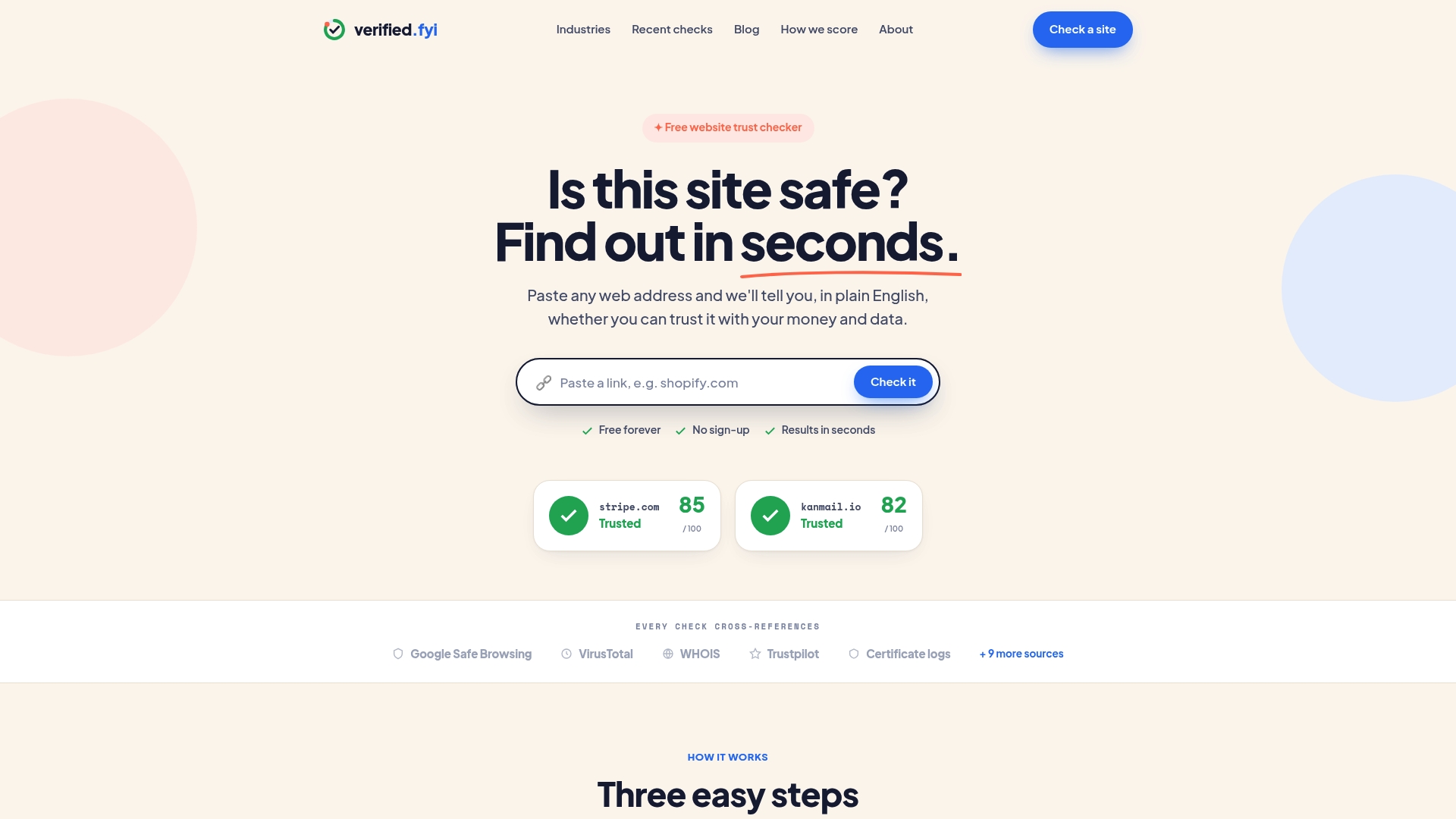
Not sure about a site you just found? Check it on Verified fyi and get an instant safety verdict before you share a single detail.
Key takeaways
Online scams cost Americans more than $11 billion in 2025, and the most effective defense combines psychological awareness with practical verification habits.
| Point | Details |
|---|---|
| Scale of losses | The FBI's IC3 reported losses exceeding $11 billion in 2025, with cryptocurrency fraud alone at $7.2 billion. |
| Four universal red flags | Impersonation, problem or prize claims, pressure to act fast, and unusual payment demands appear in nearly every scam. |
| Payment method matters | Requests for cryptocurrency, wire transfers, or gift cards signal fraud; these methods are irreversible by design. |
| Action plan defense | A pre-prepared list of trusted contacts and verified institutional numbers helps you pause and consult before reacting. |
| Verify sites before engaging | AI-powered tools like Verified fyi analyze over 200 signals to flag unsafe websites before you enter any information. |
The threat is smarter now, and so should your habits be
The conversation around online safety tends to focus on awareness, as if knowing scams exist is enough protection. It isn't. Scammers in 2026 are using AI to generate flawless phishing emails, session token theft to bypass two-factor authentication, and sophisticated fake investment platforms that show fabricated account balances for months before disappearing. The gap between a scam and a legitimate interaction has never been narrower.
What concerns me most is the repeat victimization pattern. Once someone falls for a scam, their data is often sold to other criminal networks, and they're targeted again, sometimes with a "recovery scam" promising to retrieve the money they already lost. The second hit is frequently worse than the first.
The psychological angle deserves more credit than it gets. Scammers aren't just technically sophisticated; they're behaviorally sophisticated. They know that authority plus urgency shuts down skepticism in most people, regardless of education or experience. The fix isn't to be smarter. It's to build a habit of pausing, specifically because that pause is what scammers are trying to prevent.
Verified fyi's approach of scoring websites against 200-plus signals reflects the right instinct: don't rely on gut feel alone when a data-backed verdict is available in seconds. Combine that with the FTC's action plan framework, a healthy skepticism toward any unsolicited contact, and a firm rule against irreversible payments, and you've closed off the majority of attack vectors scammers actually use.
FAQ
What are the most common online scams right now?
The most common types are phishing, cryptocurrency investment fraud, tech support scams, romance scams, and identity theft. In 2025, investment fraud and tech support scams generated the largest reported losses according to the FBI IC3.
How do I identify an online scammer?
Watch for four signals: impersonation of a known organization, claims of a problem or prize, pressure to act immediately, and demands for payment via cryptocurrency, wire transfer, or gift cards. The FTC identifies these as the four universal red flags across all scam types.
What should I do if I fall victim to a scam?
Contact your bank immediately to stop or reverse transactions, then report the scam to the FBI's IC3 and the FTC at ReportFraud.ftc.gov. Filing promptly can help law enforcement freeze stolen funds before they leave the country.
Why do scammers insist on gift cards or cryptocurrency?
These payment methods are irreversible and difficult to trace, which is exactly why scammers prefer them. Once funds are sent via cryptocurrency or a gift card number is shared, there is no fraud reversal mechanism available to the victim.
Are there tools that can help me spot scam websites?
Yes. AI-powered site verification tools like Verified fyi analyze security and reputation signals to score any website's trustworthiness. Antivirus software such as Norton or Bitdefender also blocks known malicious URLs in real time.