TL;DR:
- A site's reputation depends on a small set of verifiable signals, with technical checks like TLS, blocklist status, and domain age being most impactful. Cross-referencing multiple tools and reviewing content transparency, ownership, and user feedback provide a comprehensive trust assessment quickly. Verified fyi consolidates over 200 signals into a free, instant trust score and detailed report to help identify trustworthy websites efficiently.
A site's reputation depends on a short list of verifiable signals. Here are the indicators experts use to judge safety and credibility — organized so you can run a fast check or understand exactly why a score is low.
TL;DR quick check flow: padlock → WHOIS age → blocklist lookup → reputation scan → reviews → aggregate score.
The highest-impact website reputation indicators, in priority order:
- Valid TLS/HTTPS certificate (expired or missing SSL is an immediate red flag)
- Blocklist status (check Google Safe Browsing, VirusTotal, Spamhaus, and PhishTank for malware or phishing flags)
- Domain age and registration history (newly registered domains under 6 months carry elevated risk)
- WHOIS ownership transparency (privacy redaction alone is neutral; combined with other red flags, it matters)
- Security headers (HSTS, Content Security Policy, X-Frame-Options — missing headers raise exposure)
- Content and transparency signals (About page, Contact page, privacy policy, terms of service — all present and specific)
- Email authentication records (SPF, DKIM, DMARC configured correctly reduces phishing and spoofing risk)
- Backlink quality and spam signals (authoritative inbound links vs. link farms or keyword-stuffed anchor text)
- User reviews and third-party reputation (BBB, Trustpilot, Google Business Profile — volume, recency, and sentiment across platforms)
- Past security incidents (prior breaches, defacements, or DMCA notices on record)
- Uptime and performance history (chronic downtime or sudden hosting changes suggest instability)
- Reputation tool scores (consolidated checks from Trend Micro, Norton Safe Web, Cisco Talos, and Verified fyi give a fast aggregated view)
Trustworthy websites show consistency across identity, infrastructure, and accountability — and scam sites almost always fail on at least two of these categories simultaneously.
Table of Contents
- What do technical and security indicators tell you about a site?
- How do domain ownership and registration history affect trust?
- What content and transparency signals reveal about a site's legitimacy
- Why email authentication signals matter for domain reputation
- How do backlinks and off-site SEO signals affect a site's reputation?
- How do user reviews and third-party signals factor into reputation?
- What do reputation scores actually measure, and what's a good score?
- How does Verified fyi measure a site's reputation?
- How to check a website's reputation step by step
- What to do if a site scores poorly
- Key Takeaways
- Why grouping signals this way gives you the clearest picture
- Verified fyi gives you a fast, consolidated reputation check
- Useful sources and tools
- FAQ
What do technical and security indicators tell you about a site?
The fastest way to filter out outright scams is to run three technical checks before you look at anything else: the TLS certificate, blocklist status, and security headers. These signals are hard to fake and quick to verify.

TLS/HTTPS and certificate validity
A valid HTTPS certificate confirms that traffic between your browser and the server is encrypted. But the padlock alone is not enough. Check the certificate issuer (a reputable CA like DigiCert, Let's Encrypt, or Sectigo), the expiry date, and whether the certificate covers the exact domain you're visiting. A mismatch between the certificate's common name and the URL is a concrete red flag. Mixed content — where a page loads over HTTPS but pulls scripts or images over HTTP — undermines the certificate's protection entirely.
For a thorough TLS grade, SSL Labs' Server Test scores a domain from A+ to F and flags weak cipher suites, expired chains, and protocol vulnerabilities. It's free and takes about 90 seconds.
Security headers
Security headers are HTTP response directives that tell browsers how to handle the site's content. The three most important ones:
- HSTS (HTTP Strict Transport Security): Forces browsers to use HTTPS only; absence means a user can be silently downgraded to HTTP.
- Content Security Policy (CSP): Restricts which scripts and resources the page can load, limiting cross-site scripting exposure.
- X-Frame-Options: Prevents the page from being embedded in an iframe on another site, blocking clickjacking attacks.
You can inspect headers directly in browser DevTools (Network tab → select the document → Headers), or use a free tool like securityheaders.com for a graded report.
Blocklists and malware/phishing detection
This is where the major reputation authorities come in. Each service covers a different slice of the threat picture:
- Google Safe Browsing: Flags pages with malware, unwanted software, and social engineering. Powers Chrome, Firefox, and Safari warnings.
- VirusTotal: Aggregates results from 70+ antivirus engines and URL scanners; a single engine hit is weak evidence, but five or more hits is a serious signal.
- PhishTank: Community-verified phishing URL database; strong for credential-harvesting pages specifically.
- Spamhaus: Focuses on domain and IP blocklists tied to spam campaigns and botnet infrastructure; a Spamhaus domain reputation hit often indicates the domain has been used to send bulk malicious email.
A match on any one of these warrants caution. A match on two or more is a near-definitive signal to stop.
Uptime history and past incidents
Chronic downtime, sudden hosting migrations, or a history of defacements visible in archive snapshots (Wayback Machine) all point to operational instability. A site that was serving malware six months ago and has since "cleaned up" may still carry residual blocklist entries. Check the Internet Archive for historical screenshots and note any periods where the site redirected to unrelated content.
Pro Tip: The single fastest triage sequence is: check the padlock issuer → run the domain through Google Safe Browsing → look up the WHOIS registration date. If all three are clean, you've eliminated the majority of outright scams in under two minutes. Learn more about identifying secure websites to sharpen your eye for the subtler signals.
How do domain ownership and registration history affect trust?
Domain registration data tells you a lot about a site's intent before you read a single word of its content. Scam operations typically share a few predictable patterns.

Domain age and registration length
Very new domains — registered within the past 6 months — carry elevated risk, especially for e-commerce or financial services sites. Fraudulent sites are often spun up quickly to exploit a news event or impersonate a brand, then abandoned after a short campaign. Conversely, a domain registered for multiple years with a consistent ownership record is a positive signal. Registration length matters too: a domain paid for only one year at a time suggests the operator isn't planning long-term.
WHOIS data and privacy redaction
WHOIS records show the registrant's name, organization, email, and registration dates. Many legitimate sites use WHOIS privacy services (like those offered by Cloudflare or GoDaddy) to protect personal contact details, so privacy redaction alone is a neutral signal. Treat it as a neutral data point rather than proof of anything suspicious. Where it becomes meaningful is when it appears alongside other red flags: a brand-new domain, no About page, and privacy-redacted WHOIS together form a pattern worth taking seriously.
Look for these specific red flags in WHOIS data:
- Recent ownership transfers (especially within the past 30–90 days)
- Registrar with a high abuse history (some registrars are known to be permissive with fraudulent registrations)
- Registrant country inconsistent with the claimed business location
- Expiry date within weeks of the current date (suggests the operator may not renew)
DNS and name server history
Sudden changes in name servers — particularly to providers associated with bulletproof hosting — are a strong negative signal. Unusual TXT or MX records (for example, MX records pointing to a domain unrelated to the claimed business) can indicate the domain has been compromised or is being used for purposes other than its stated function. Tools like DomainTools and MXToolbox let you pull historical DNS records and spot these anomalies quickly.
Pro Tip: When checking a site you're considering buying from, run the domain through a fake company website detector alongside a WHOIS lookup. The combination catches impersonation attempts that either tool alone might miss.
What content and transparency signals reveal about a site's legitimacy
Content signals are slower to evaluate than technical checks, but they're often the difference between a site that looks legitimate and one that actually is. The key question: does the operator give you enough information to hold them accountable?
The non-negotiables: About, Contact, and legal pages
A credible site has a specific, verifiable About page — not a paragraph of vague mission language, but named people, a business address, and a founding story that checks out. The Contact page should list a physical address, a working phone number or email, and ideally a support path (ticket system, live chat). A privacy policy and terms of service are legal requirements in most jurisdictions and their absence is a red flag regardless of how polished the design looks.
Concrete items to verify on these pages:
- Physical address that resolves to a real location on Google Maps
- Phone number that connects to the business (not a voicemail-only line with no callback)
- Named individuals with verifiable professional profiles (LinkedIn, industry directories)
- Privacy policy that specifies what data is collected and how it's used
- Terms of service that describe refund, return, or cancellation policies clearly
Authorship, publication dates, and schema
For content-heavy sites, authorship bylines and publication dates signal accountability. Schema markup (specifically datePublished and dateModified) tells search engines — and savvy readers — when content was created and updated. Sites that strip dates from articles or use vague "last updated" language without specifics are often recycling old content or obscuring the age of their claims.
Content coherence and data requests
Brand consistency across pages matters. If the homepage claims to sell handmade jewelry but the checkout page routes to a generic payment processor with a different business name, that mismatch is worth investigating. Similarly, evaluate what personal data the site asks for relative to the transaction. A site selling a $12 e-book that asks for your Social Security number or passport scan is requesting far more than the transaction warrants.
Website trust factors for clients include checking whether on-site claims are corroborated by independent press mentions, linked social profiles, and third-party directory listings. If a company claims to have been featured in major publications, those mentions should be findable with a quick search.
Why email authentication signals matter for domain reputation
Email authentication records are invisible to most visitors, but they're one of the clearest indicators of how seriously an operator takes their domain's security posture.
SPF, DKIM, and DMARC explained
- SPF (Sender Policy Framework): A DNS TXT record that lists which mail servers are authorized to send email on behalf of the domain. A missing or misconfigured SPF record makes it easy for attackers to spoof the domain in phishing emails.
- DKIM (DomainKeys Identified Mail): Adds a cryptographic signature to outgoing emails, allowing recipients to verify the message wasn't altered in transit.
- DMARC (Domain-based Message Authentication, Reporting & Conformance): Ties SPF and DKIM together and tells receiving mail servers what to do when a message fails authentication (quarantine, reject, or do nothing). A DMARC policy of
p=rejectis the strongest configuration.
A domain with no DMARC record is significantly easier to impersonate. For a site that handles financial transactions or personal data, missing DMARC is a meaningful gap.
MX records and mail provider reputation
The MX records for a domain reveal which mail provider handles incoming email. A legitimate business typically uses a reputable provider (Google Workspace, Microsoft 365, Proofpoint). MX records pointing to obscure or bulletproof hosting providers are a yellow flag. No MX records at all means the domain cannot receive email — which is odd for any site that claims to offer customer support.
How to check email authentication quickly
- MXToolbox: Run a free DMARC, SPF, and DKIM lookup at mxtoolbox.com. The results show whether records exist, whether they're syntactically valid, and whether the policy is enforced.
- Email header inspection: If you've received an email from the domain, open the full headers in your email client and look for
Authentication-Resultsto see whether SPF and DKIM passed or failed.
How do backlinks and off-site SEO signals affect a site's reputation?
Off-site signals tell you what the rest of the web thinks about a domain. A site can control its own content, but it can't easily fake the pattern of who links to it.
Backlink quality vs. quantity
A handful of links from authoritative, relevant sources (industry publications, government sites, established news outlets) carries more weight than thousands of links from low-quality directories or link farms. The key metrics to examine:
| Signal | What to look for | Red flag |
|---|---|---|
| Referring domain diversity | Links from many distinct domains | Bulk links from a single domain or network |
| Anchor text distribution | Mix of branded, generic, and topical anchors | Over-optimized exact-match anchors dominate |
| Link source authority | Links from established, indexed sites | Links from newly registered or de-indexed sites |
| Outbound link density | Reasonable number of outbound links per page | Hundreds of outbound links on a single page |
Spam signals and doorway pages
Keyword stuffing, thin content pages designed to rank for specific queries, and doorway pages (pages that exist only to redirect traffic) are all patterns associated with low-quality or manipulative sites. These signals show up in a site crawl and in the backlink profile. A site with thousands of pages indexed but minimal unique content is worth treating with skepticism.
NAP consistency and local reputation
For businesses with a physical location, NAP (name, address, phone number) consistency across directory listings is a local reputation signal. Inconsistent NAP data — different phone numbers on Yelp, Google Business Profile, and the site itself — suggests either poor management or a site that has been scraped and misrepresented across the web. Open-source security tools can help automate parts of this audit for site owners who want a systematic approach.
How do user reviews and third-party signals factor into reputation?
Reviews are the most visible reputation signal for most readers, but they're also the easiest to manipulate. The key is triangulation across platforms and attention to patterns rather than averages.
What makes review evidence credible
A very high star average based on a small number of reviews is weak evidence, while the same rating supported by a large and well-distributed base of reviews over time is much stronger. Review recency, volume, and spread across platforms are all meaningful — a business that stopped receiving reviews 18 months ago may have changed ownership or quality significantly.
Where to check:
- BBB (Better Business Bureau): Complaint history and accreditation status; particularly useful for spotting unresolved disputes.
- Trustpilot: High volume of reviews with verified purchase flags; look for response behavior from the business.
- Google Business Profile: Tied to a physical address; harder to fake than standalone review sites.
- Reddit and industry forums: Unfiltered user experiences; search
[site name] reviewor[site name] scamon Reddit for candid discussions.
Social signals and complaint history
Active, consistent social profiles that link back to the site and have been posting for years are a positive signal. Accounts created within the past few weeks with no engagement history are not. DMCA notices, consumer agency complaints (FTC, state attorney general filings), and public data breach disclosures are all searchable and represent hard negative signals that no star rating can offset.
Pro Tip: Cross-validate reviews by checking the reviewer profiles themselves. On Trustpilot, a reviewer who has left only one review — for the site you're checking — is a weaker signal than a reviewer with a history of varied, balanced reviews across multiple businesses. Reputation platforms cross-validate sentiment and volume across sites to filter out self-posted testimonials.
What do reputation scores actually measure, and what's a good score?
Reputation scores are not magic numbers. They're weighted aggregations of the signals described throughout this article, and understanding the weighting helps you interpret a low score correctly.
How scores are calculated
Most reputation tools pull from a combination of data sources: blocklists (Spamhaus, Google Safe Browsing), malware scan results (VirusTotal), WHOIS and DNS data, backlink profiles, review sentiment and volume, email authentication status, and traffic behavior signals. Trend Micro's Web Reputation tracks credibility using signals such as domain age, location changes, and suspicious activity indicators — high scores indicate entities following security best practices.
The weighting differs by vendor. Most systems apply a veto mechanism: a single confirmed malware detection or active blocklist hit can push a score into the danger zone regardless of how well the site performs on other signals. Fixing one high-impact technical issue often restores most of the practical trust lost, because scores are frequently driven by a small number of these veto signals.
Score interpretation ranges
| Score range | Typical interpretation | Recommended action |
|---|---|---|
| 0–30 | High risk | Do not proceed; report if phishing/malware confirmed |
| 40–59 | Caution | Investigate further before sharing data or making payments |
| 70–89 | Mostly safe | Minor issues present; verify specific concerns before transacting |
| 90–100 | Trusted | Low risk; standard caution still applies |
These ranges are general guidelines. A score of 65 from a tool that weights review sentiment heavily may mean something different than a 65 from a tool focused on technical security signals.
The major tools and what each specializes in
- Google Safe Browsing: Malware, phishing, and unwanted software detection; powers browser-level warnings.
- VirusTotal: Multi-engine malware and URL scanning; best for confirming or ruling out a specific threat.
- Spamhaus: Domain and IP blocklist status; strongest for spam and botnet-related abuse.
- PhishTank: Community-verified phishing URLs; focused on credential-harvesting pages.
- Norton Safe Web: Consumer-facing safety ratings with community input.
- Cisco Talos: Enterprise-grade threat intelligence with domain and IP reputation data.
- Verified fyi: AI-driven aggregation of 200+ signals into a 0–100 trust score with categorized verdicts and remediation suggestions.
Pro Tip: Never rely on a single tool's verdict. A site flagged by one engine on VirusTotal but clean on all others may be a false positive — CDNs, staging environments, and newly launched microsites are common sources of automated false flags. Run at least two independent checks before drawing a conclusion.
How does Verified fyi measure a site's reputation?
Verified fyi uses AI to weigh over 200 signals into a single 0–100 trust score, then breaks that score into category-level findings so you can see exactly where a site falls short.
The scoring methodology draws from these core signal categories:
- Security and blocklists: TLS validity, security header grades, Google Safe Browsing status, VirusTotal results, Spamhaus and PhishTank matches.
- Ownership and infrastructure: WHOIS registration age, registrar history, DNS record consistency, hosting provider reputation.
- Content and transparency: Presence and quality of About, Contact, privacy policy, and terms of service pages; authorship signals.
- Email authentication: SPF, DKIM, and DMARC configuration and enforcement level.
- Backlinks and SEO signals: Referring domain quality, anchor text distribution, spam indicators.
- User reviews and third-party reputation: Sentiment, volume, recency, and spread across review platforms.
- Historical incidents: Prior breach records, defacement history, DMCA notices, and past blocklist appearances.
- Traffic and behavioral signals: Bot traffic patterns, bounce rate anomalies, and engagement quality.
Scoring works by normalizing each signal, applying category weights, and then running high-impact veto checks. A confirmed malware detection or active blocklist hit overrides the aggregate score and pushes the verdict into the "dangerous" or "suspicious" category regardless of other signals. The five verdict categories are: dangerous, suspicious, caution, mostly safe, and trusted.
A typical Verified fyi report includes: overall score, category-level breakdown, specific blocklist matches, recent incident flags, contact and policy check results, and a list of suggested remediation items ordered by impact.
How to check a website's reputation step by step
This sequence takes 5–10 minutes and covers the highest-impact signals in order of speed and reliability.
-
Check the padlock and certificate. Click the padlock icon in your browser's address bar. Confirm HTTPS is active, the certificate is valid and not expired, and the issuer is a recognized CA. If the certificate is self-signed or expired, stop here.
-
Look up the domain's WHOIS record. Use a free WHOIS lookup tool (ICANN's lookup at lookup.icann.org or whois.domaintools.com). Note the registration date, registrar, and whether the record has changed recently.
-
Run a blocklist check. Enter the URL into Google Safe Browsing's transparency report (transparencyreport.google.com/safe-browsing/search). Then paste it into VirusTotal for a multi-engine scan. Flag any hits for follow-up.
-
Check Spamhaus domain reputation. Visit the Spamhaus domain reputation page and enter the domain. A listing here means the domain has been associated with spam or botnet activity.
-
Inspect security headers. Use securityheaders.com or your browser's DevTools to check for HSTS, CSP, and X-Frame-Options. Note any missing headers as a secondary risk factor.
-
Verify email authentication. Run a DMARC and SPF lookup on MXToolbox. A missing or unenforced DMARC policy is a yellow flag for any site handling personal data.
-
Check user reviews. Search the site name on Trustpilot, BBB, and Google. Look at review volume, recency, and whether the business responds to complaints. Search Reddit for candid user experiences.
-
Run a consolidated reputation scan. Paste the URL into Verified fyi for a fast aggregated score and category breakdown. The report surfaces blocklist matches, certificate status, and transparency checks in one view.
-
Assess content and transparency. Open the About, Contact, and privacy policy pages. Verify that contact details are specific and that the privacy policy describes actual data practices.
-
Make your decision. If two or more high-impact signals are negative (blocklist hit, expired cert, no contact page, very new domain), treat the site as unsafe. A single minor issue warrants caution, not an automatic rejection.
If you find a confirmed phishing page or active malware, do not enter any data. Capture a screenshot, note the URL, and report it to Google Safe Browsing and PhishTank. For a faster path through steps 1–10, the website safety score checker at Verified fyi runs most of these checks automatically.
What to do if a site scores poorly
The right response depends on whether you're a user who encountered the site or an owner trying to fix it.
For users: immediate protective steps
- Stop the transaction immediately. Do not submit payment details, login credentials, or personal data.
- Capture evidence. Screenshot the URL, any suspicious content, and the date/time.
- Report to the relevant authorities. Submit phishing URLs to Google Safe Browsing (safebrowsing.google.com/report) and PhishTank. Report scam sites to the FTC at reportfraud.ftc.gov.
- Contact your bank or card issuer if you've already submitted payment information. Request a chargeback and flag the transaction as potentially fraudulent.
- Block the domain locally using your router's DNS filtering or a browser extension like uBlock Origin.
For site owners: triage and remediation
If your site has received a low reputation score, the fastest path to recovery is fixing the highest-impact issues first:
- Take malware offline immediately. Isolate the affected pages or take the site down temporarily while you clean. Leaving malware live while you investigate extends the damage.
- Fix TLS issues. Renew expired certificates, resolve mixed content warnings, and confirm HTTPS redirects are working across all pages.
- Remove malicious content and patch vulnerabilities. Update your CMS (WordPress, Drupal, etc.), plugins, and themes. Outdated plugins are the most common entry point for site compromises.
- Verify and update your SPF, DKIM, and DMARC records. Misconfigured email authentication is often a quick fix with a significant reputation impact.
- Request delisting from blocklists. Each blocklist has its own process. For Google Safe Browsing, use Google Search Console's Security Issues report to request a review after cleanup. For Spamhaus, submit a removal request with documented evidence of remediation.
What blocklist appeals require
Most blocklist maintainers respond faster when you provide: exact dates of when the issue was identified and resolved, specific remediation steps taken (with file paths or plugin names where relevant), and evidence of cleanup (scan results from VirusTotal or a security plugin showing clean status). Vague appeals without documentation typically sit in the queue longer. Realistic timelines range from 24 hours for Google Safe Browsing (after a clean review) to several days for Spamhaus, depending on the severity of the original listing.
Key Takeaways
A site's reputation is determined by a small number of high-impact signals — and fixing or verifying just the top three (TLS status, blocklist hits, and domain age) eliminates the majority of outright scams.
| Point | Details |
|---|---|
| Prioritize veto signals first | A blocklist hit or expired TLS certificate overrides all other positive signals; check these before anything else. |
| WHOIS privacy is neutral alone | Privacy-redacted WHOIS is only a red flag when combined with other negatives like a new domain or missing contact pages. |
| Cross-check multiple tools | No single reputation tool is definitive; run at least two independent checks before drawing a conclusion. |
| Reviews need volume and spread | A high star rating based on few reviews is weak evidence; look for consistent sentiment across BBB, Trustpilot, and Google. |
| Verified fyi consolidates the check | Verified fyi analyzes 200+ signals into a 0–100 score with category breakdowns, blocklist matches, and remediation steps in one report. |
Why grouping signals this way gives you the clearest picture
Most reputation guides hand you a flat list of 50 signals and leave you to figure out which ones actually matter. The grouping here — technical, ownership, content, email, SEO, and user feedback — is deliberate, and it reflects how risk actually concentrates in practice.
Technical and ownership signals are the fastest to check and the hardest to fake. A scam site can copy a legitimate brand's design in an afternoon, but it can't easily acquire a years-old domain with a clean blocklist history and a valid TLS certificate from a reputable issuer. That's why those signals sit at the top of the list. Content and transparency signals come next because they reveal accountability: a site that won't tell you who runs it or where it's located is a site that doesn't want to be held responsible.
The weighting also reflects a practical reality: most people checking a site are doing it quickly, under mild time pressure, because they're about to make a purchase or share personal information. A grouped checklist that moves from fastest-to-verify to slowest respects that reality. You should be able to rule out the most dangerous sites in under two minutes and reserve the deeper checks for sites that pass the initial screen but still feel uncertain.
One thing worth saying plainly: no single score from any tool is a final verdict. False positives exist, especially for CDNs, newly launched sites, and microsites on shared IP ranges. The value of a consolidated score like the one Verified fyi produces is not that it's infallible — it's that it surfaces the specific signals driving the result, so you can make a judgment call with real information rather than a single number.
Verified fyi gives you a fast, consolidated reputation check
Checking a site's safety shouldn't require opening six different tools and manually reconciling the results. Verified fyi runs over 200 security, ownership, transparency, and reputation signals automatically and delivers a single 0–100 trust score with a full category breakdown — free, in seconds.
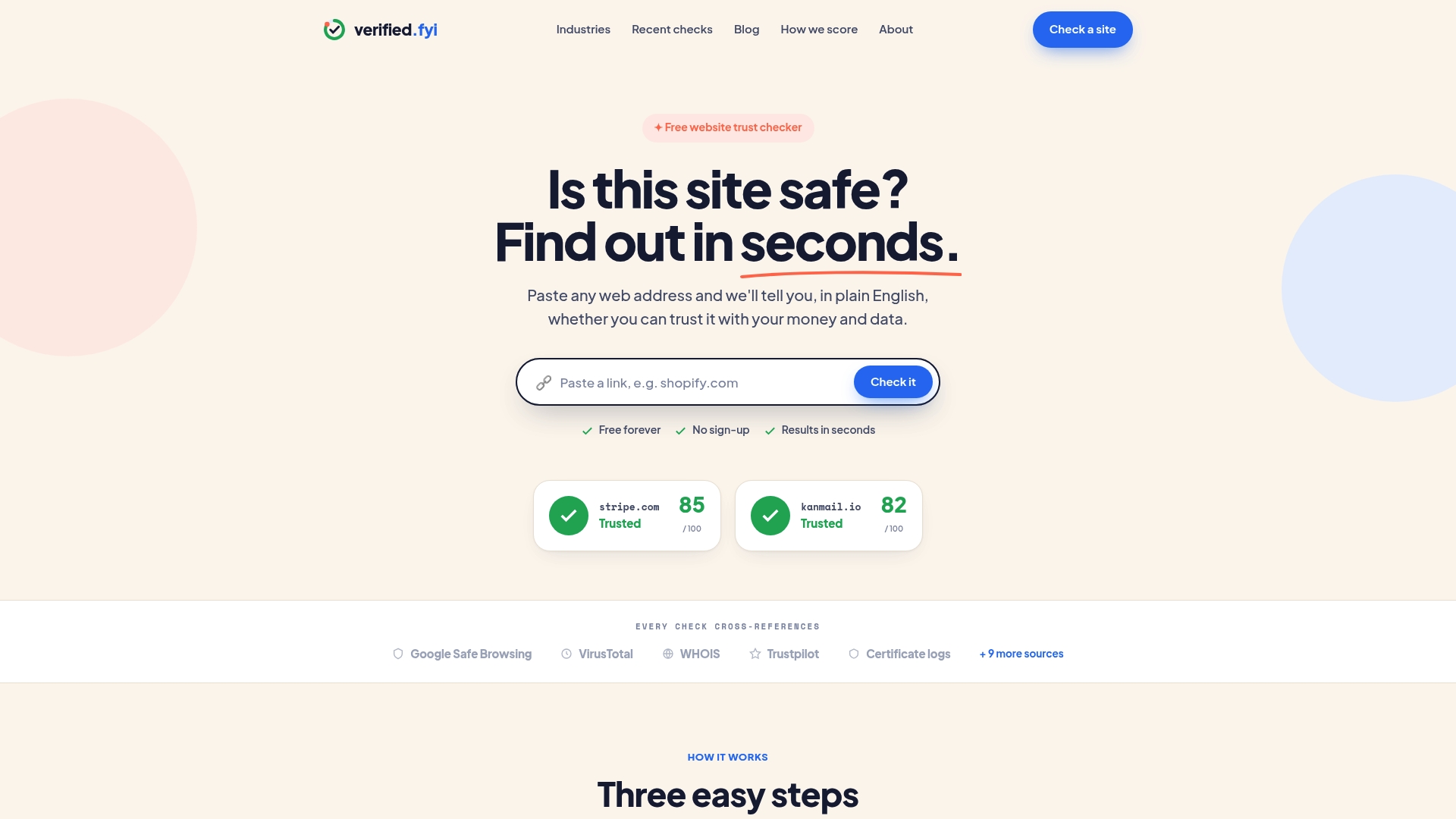
Paste any URL into Verified fyi and your report includes:
- Overall trust score (0–100) with a plain-language verdict (dangerous, suspicious, caution, mostly safe, or trusted)
- Category-level breakdown showing where the site passes and where it falls short
- Blocklist match results from sources including Google Safe Browsing, VirusTotal, and Spamhaus
- Certificate and security header status
- WHOIS and domain age summary
- Remediation suggestions ordered by impact, so owners know what to fix first
For readers who want to understand the scoring logic, the methodology page describes every signal category and how weights are applied. Browse recently checked sites to see real reports before running your own check.
Useful sources and tools
Quick links to run the checks described in this article:
- Google Safe Browsing Transparency Report: Check any URL for malware, phishing, and unwanted software flags.
- VirusTotal: Multi-engine URL and file scanner; best for confirming or ruling out a specific threat.
- Spamhaus Domain Reputation: Domain and IP blocklist lookup; strongest for spam and botnet-related abuse history.
- PhishTank: Community-verified phishing URL database; focused on credential-harvesting pages.
- SSL Labs Server Test: Full TLS/SSL grade including cipher suites, certificate chain, and protocol support.
- ICANN WHOIS Lookup: Registration date, registrar, and ownership history for any domain.
- MXToolbox: Free DMARC, SPF, DKIM, and MX record lookups; essential for email authentication checks.
- Verified fyi: Consolidated 0–100 trust score from 200+ signals; fastest single-tool check for overall site reputation.
FAQ
How do you check a website's reputation?
Start with a Google Safe Browsing lookup and a VirusTotal scan, then check the domain's WHOIS registration age and run a consolidated score through a tool like Verified fyi. The full process takes under 10 minutes and covers technical, ownership, and review signals in sequence.
What is a good domain reputation score?
Scores of 90–100 indicate a trusted site with no significant flags across blocklists, technical checks, and review signals. Scores of 70–89 suggest mostly safe with minor issues worth verifying; anything below 40 warrants serious caution before sharing personal data or making a payment.
What is a web reputation score?
A web reputation score is a numeric summary of how trustworthy a domain appears based on signals like blocklist status, domain age, TLS validity, backlink quality, and review sentiment. Different tools weight these signals differently, so scores are best used as a starting point for investigation rather than a definitive verdict.
What is the Trend Micro Web Reputation approved list?
Trend Micro's Web Reputation approved list allows specified domains, IP addresses, or URLs to bypass its scanning and blocking under managed security policies. It's an enterprise feature for IT teams managing known-good internal or partner domains — not a public trust certification that affects how a site appears to general users.
What does Verified fyi check when it scores a site?
Verified fyi analyzes over 200 signals across security, ownership, content transparency, email authentication, backlinks, user reviews, and historical incidents, then applies AI weighting to produce a 0–100 score with a category breakdown and specific remediation suggestions.