TL;DR:
- Website trust in B2B depends on observable signals like security, certifications, and verifiable case studies, not feelings. Running quick checks for HTTPS, compliance pages, and contact details helps assess vulnerability and credibility rapidly. Building trust requires clear, operational proof such as SLAs, detailed case studies, and verified certifications.
Website trust in B2B is the cumulative weight of visual, textual, and operational signals that let procurement and technical teams verify a vendor's reliability, capability, and accountability before committing budget or data. It is observable and testable, not a matter of gut feeling.
Run these three checks in under 60 seconds before you go any further:
- SSL/TLS active? Look for the padlock in your browser's address bar and confirm the URL starts with
https://. - Security or compliance page present? Search the site for a dedicated page listing certifications, data handling practices, or audit reports.
- Named case study or verifiable contact? Scan for a case study with a real company name and outcome metric, plus a physical address or direct phone number.
If any of these are missing, flag the vendor for deeper review before scheduling a demo.
Table of Contents
- What is website trust in B2B, and why does it change procurement outcomes?
- How do the seven trust levers show up on a B2B website?
- Which technical signals should you check immediately?
- What operational signals prove a vendor's claims are real?
- How do you run a practical vendor vetting process?
- What are the most common performative trust signals, and how do you verify them?
- Verified fyi speeds up vendor triage with instant site scoring
- Key Takeaways
- The trust gap is usually an organizational problem, not a design one
- Useful sources and further reading
- FAQ
What is website trust in B2B, and why does it change procurement outcomes?
Website trust directly affects whether a vendor makes the shortlist, how long procurement takes, and whether buyers are willing to pay a premium. This is not a soft marketing concern.
Forrester's research found that B2B buyers were twice as likely to recommend trusted companies and nearly twice as likely to pay a premium to continue working with them. That data point alone reframes trust from a branding exercise into a commercial lever.
Missing signals cause concrete delays. A vendor without a visible compliance page stalls deals the moment a security reviewer gets involved. 54% of B2B buyers said that a lack of thorough contact information reduced credibility enough to make them abandon a vendor website. Buyers in enterprise and regulated industries treat missing compliance certifications like SOC 2 or ISO 27001 as a disqualifier, not a neutral omission.
| Signal gap | Procurement impact |
|---|---|
| No HTTPS / expired certificate | Immediate disqualification by security reviewers |
| No named case studies | Delayed shortlisting; champion cannot build internal case |
| Missing contact details | 54% of B2B buyers said this reduces credibility enough to make them abandon a vendor website |
| No compliance or security page | Stalls regulated-industry deals at procurement stage |
| Generic testimonials only | Reduced negotiating credibility; harder to justify premium pricing |
Vendors that fail to establish trust early become invisible to buyers during the dark funnel, the research phase that happens before any sales contact.
How do the seven trust levers show up on a B2B website?
Forrester identifies seven trust levers: consistency, competence, dependability, accountability, empathy, integrity, and transparency. Consistency, competence, and dependability rank most important for enterprise buyers. Here is what each looks like on an actual site:
- Consistency: Messaging aligns across the homepage, product pages, case studies, and careers section. Contradictions between what sales says and what the site shows are an immediate red flag.
- Competence: Specific, outcome-anchored case studies. Not "we helped a logistics company grow" but "a 40-truck regional logistics firm reduced dispatch errors by 31% in 90 days."
- Dependability: Published SLAs, uptime history, and a clear escalation path. If a buyer cannot find how you handle outages, they assume you do not have a plan.
- Accountability: Named team members with real titles and photos. Stock photos of models in headsets signal the opposite of accountability.
- Empathy: Stakeholder-specific content paths. A CFO and a security engineer need different proof; a site that serves both shows the vendor understands its buyers.
- Integrity: Transparent pricing or clear pricing-on-request language. Hiding costs reads as evasive.
- Transparency: A privacy policy, data processing agreement (DPA), and data residency statement that are easy to find and written in plain language.
Pro Tip: A testimonial earns trust only when it includes a full name, job title, company, and a specific measurable outcome. "Great service, highly recommend" is noise. "We cut onboarding time from six weeks to nine days" is signal.
Cremanski & Company frame this as "structural trust": internal GTM processes, forecasting accuracy, and sales-to-CS handoffs must align with what the site claims, or the signals read as performative.
Which technical signals should you check immediately?
Start with the browser, then go deeper. Here is the ordered checklist:
- HTTPS and valid TLS certificate. Click the padlock. Confirm the certificate is current, issued to the correct domain, and not self-signed.
- HTTP Strict Transport Security (HSTS). Run
curl -I https://[domain]and look for theStrict-Transport-Securityheader. Its absence means the site can be downgraded to HTTP. - Security headers. Use a free tool like securityheaders.com to check for
Content-Security-Policy,X-Frame-Options, andX-Content-Type-Options. Missing headers are a yellow flag for security reviewers. - Certificate transparency logs. Search crt.sh for the domain to verify certificate history and spot unexpected subdomains.
- Known vulnerability disclosures. Check the vendor's security page or search their domain on NIST NVD for recent CVEs tied to their products.
- Third-party attestations. Look for SOC 2 Type II and ISO 27001 certificates. A dedicated security page listing these, along with data residency and audit report availability, materially reduces procurement friction for regulated buyers.
SOC 2 Type II is the US standard most enterprise procurement teams expect. ISO 27001 is the international equivalent and carries weight in regulated industries globally. Absence of either is not automatically disqualifying for a small vendor, but it will trigger additional questionnaires and slow the deal.
For a deeper look at what website trust factors actually signal to buyers, Verified fyi's blog covers the structural elements in detail.
What operational signals prove a vendor's claims are real?
Surface signals are easy to fake. Operational artifacts are harder to manufacture. Buyers in enterprise procurement look for:
- Case studies with a Problem → Approach → Result structure, including named client context (industry, size, situation) and a before/after metric. Vague paragraphs about "partnering for success" convince no one.
- Service-level commitments that specify response times, uptime guarantees, and escalation contacts, not just a general "we're here to help" statement.
- A DPA and privacy policy that name the data controller, list sub-processors, specify data residency, and reference applicable regulations (GDPR, CCPA, HIPAA where relevant).
- Verifiable certifications. SOC 2 and ISO 27001 certificates should include the issuing auditor's name and the audit period. Ask for the certificate directly if it is not publicly posted.
- Career pages and press coverage as stability signals. Enterprise buyers check whether a vendor is hiring, growing, and publishing thought leadership. A stale news page or a careers section with no open roles raises questions about organizational health.
A specific case study reassures the champion. A recognizable client logo reassures the CFO. A clear security page reassures IT. When these are missing, the visitor fills the gap with doubt, and doubt is the default state online. — Lead The Way
Understanding how to manage compliance artifacts efficiently is a practical starting point for vendors who need to surface these signals quickly.
How do you run a practical vendor vetting process?
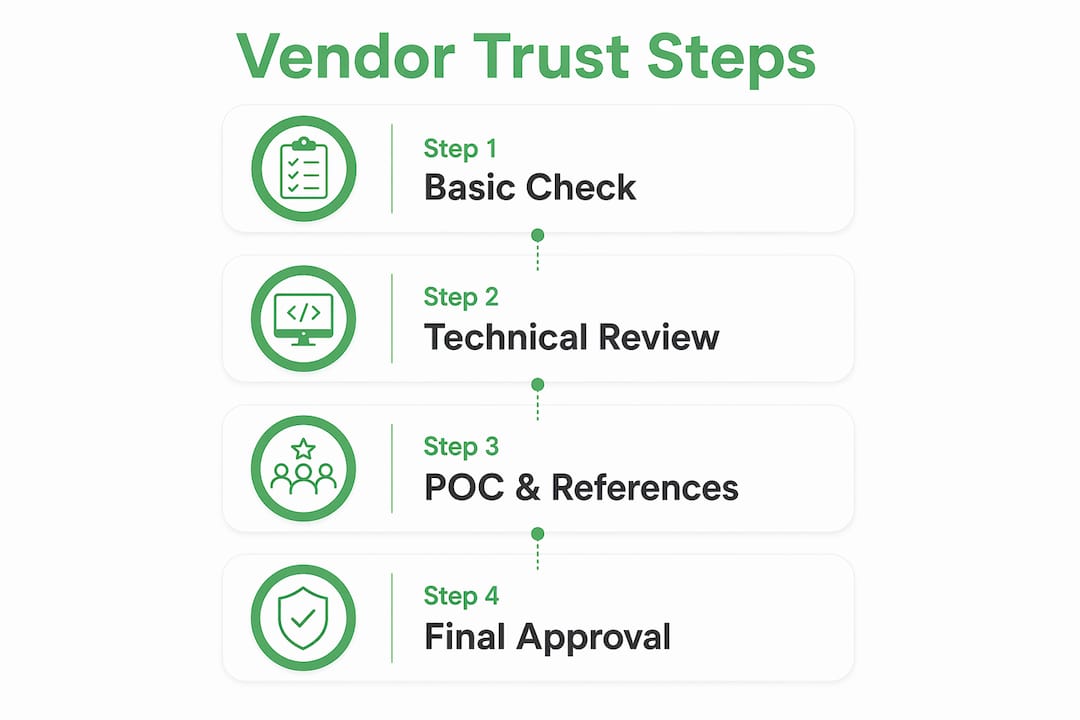
A three-stage process covers most B2B vendor evaluations without wasting time.
Stage 1: 60-second triage. Check HTTPS, locate a security or compliance page, and confirm at least one named case study and a direct contact method. Red = missing two or more. Amber = one missing. Green = all present.

Stage 2: 2–3 hour diligence. Run the technical checks above (TLS, security headers, attestations). Read two case studies in full. Verify that client logos link to real companies. Check third-party review platforms (G2, Capterra, or Google Business Profile) for recent, detailed reviews. Buyers check homepage, case studies, About/team, and services pages before responding to outreach, so focus your diligence there.
Stage 3: POC and reference stage. Request the SOC 2 or ISO 27001 certificate directly. Ask for two named references in your industry. Review the DPA and SLA before any data sharing begins.
| Stage | Time | Escalate if… |
|---|---|---|
| 60-second triage | Under 1 minute | Two or more basics missing |
| Technical diligence | 2–3 hours | Security headers fail; no attestations |
| POC and reference | 1–2 weeks | References unavailable; DPA incomplete |
For a copyable checklist that maps to this workflow, the third-party vetting guide from Verified fyi is a practical reference.
What are the most common performative trust signals, and how do you verify them?
Six red flags appear repeatedly in B2B vendor evaluation:
- Logo walls with no links or case studies. Ask the vendor for a named reference at one of those accounts. If the relationship was thin, the bluff collapses fast.
- Generic testimonials. No name, no title, no company, no metric. These are not credible to enterprise buyers.
- Outdated case studies. A case study from 2019 does not prove current capability. Check the publication date and ask for something recent.
- Claimed certifications without documentation. Ask for the certificate with the auditor's name and audit period. A badge image alone proves nothing.
- Missing or boilerplate privacy policy. A policy that does not name sub-processors or data residency is a red flag for any deal involving personal or sensitive data.
- Contact form only, no physical address or phone. This reads as fly-by-night to most B2B buyers, and credibility drops sharply as a result.
Pro Tip: A fragmented site build, where the homepage, blog, and legal pages have visibly different design systems or inconsistent messaging, often signals that content was outsourced without a coherent strategy. That inconsistency tends to correlate with shallow operational claims elsewhere.
Verified fyi speeds up vendor triage with instant site scoring
Manually running every check above takes time, especially when you are evaluating multiple vendors in parallel. Verified fyi analyzes over 200 security and reputation signals for any website and returns a trust score from 0 to 100 in seconds.
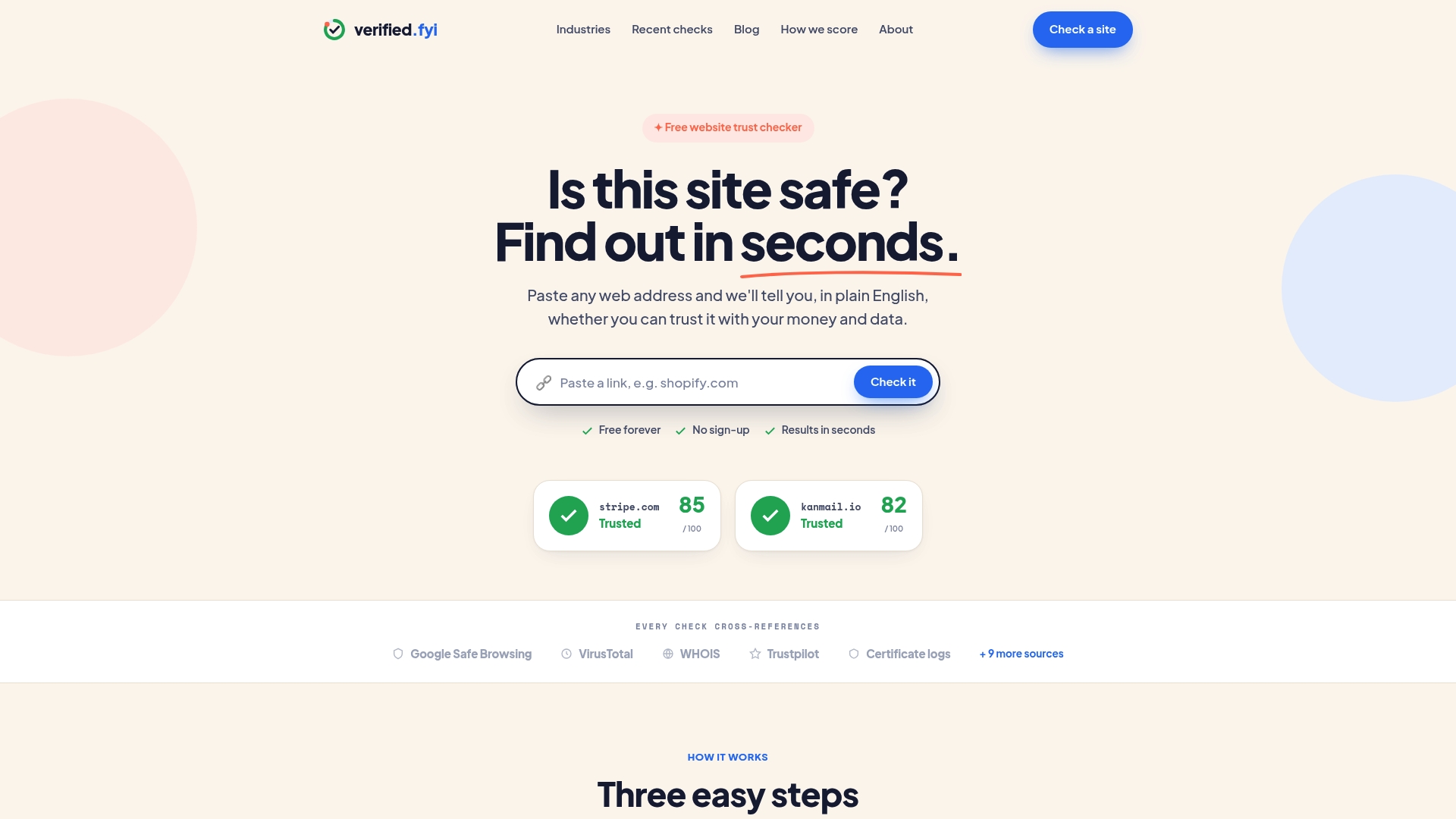
Paste a vendor's URL into Verified fyi and you get an instant read on security posture, reputational signals, and compliance indicators, without opening a terminal or cross-referencing multiple tools. For procurement teams doing a fast first-pass filter, this cuts initial triage from hours to minutes. For security reviewers doing a preliminary check before a formal questionnaire, it surfaces the issues worth escalating immediately.
You can review the scoring methodology to understand exactly which signal categories feed the score, which matters when you need to explain a vendor flag to a legal or security stakeholder. See recently checked sites to get a sense of how scores look in practice across different vendor types.
Key Takeaways
Website trust in B2B is an operational property, not a design feature. Procurement teams that treat it as a structured checklist shorten evaluation timelines and reduce vendor risk.
| Point | Details |
|---|---|
| Start with three basics | HTTPS, a security page, and a named case study are the minimum viable trust signals. |
| Specificity separates real from performative | Testimonials and case studies need a name, title, company, and measurable outcome to carry weight. |
| Technical checks take minutes | Security headers, TLS validity, and attestation verification can be done with free tools in under an hour. |
| Operational artifacts are harder to fake | SLAs, DPAs, verifiable certifications, and named references are the proof that site claims are real. |
| Verified fyi shortens triage | Paste any vendor URL into Verified fyi to get an instant 0–100 trust score across 200+ signals. |
The trust gap is usually an organizational problem, not a design one
Most vendors with weak trust signals are not being deceptive. They are disorganized. The sales team promises one thing, the website says another, and the customer success team inherits a relationship built on misaligned expectations. That gap shows up in procurement reviews as inconsistency, and inconsistency is the single fastest way to lose a shortlist position.
The habit change that matters most is requiring named, outcome-specific case studies before any new customer goes live, not after. If you wait until a deal closes to document the result, you lose the detail, the urgency, and often the client's willingness to be quoted. Build the case study into the onboarding process as a default deliverable.
The second habit: mandate a security page before any proof-of-concept begins. Not a badge on the footer. A page that lists certifications, audit periods, data residency, and escalation contacts. Aligning sales, customer success, and product around that page as a shared artifact is what makes trust structural rather than something marketing patches together before a big deal.
Useful sources and further reading
The sources below are the ones cited in this article, plus a few tools worth bookmarking for ongoing vendor evaluation.
- Forrester: The Trust Advantage for B2B Firms — Forrester VP Ian Bruce on the seven trust levers and survey data on buyer behavior. Start here for the strategic framework.
- Lead The Way: Trust Signals on a B2B Website — Ranked breakdown of trust signals by buyer impact and effort. Useful for prioritizing what to fix first.
- Search Engine Journal: Addressing the B2B Trust Deficit — Covers dark-funnel dynamics and shortlist behavior. Read this for the commercial ROI argument.
- Cremanski & Company: The Trust Layer in B2B GTM — Seven-part framework for structural trust. Useful for GTM and revenue operations teams.
- Brand Finance: Building Trust with Intent — Functional, relational, and principled trust dimensions with sector-specific investment guidance.
- Verified fyi: Website Trust Score Explained — How scoring components and signal categories work; useful for procurement teams that need to explain a score to stakeholders.
- Verified fyi: How We Score — Full methodology for the 200+ signal categories. Reference this when a vendor challenges a score.
FAQ
What is website trust in B2B, exactly?
It is the cumulative weight of observable site signals and operational proof that let procurement and technical teams verify a vendor's reliability and accountability. It covers technical security, organizational credibility, and documented outcomes.
Which trust signals matter most to enterprise buyers?
Detailed case studies with named outcomes, SOC 2 or ISO 27001 certifications, and a dedicated security page carry the most weight with enterprise and regulated-industry buyers, according to B2B trust signal research.
How do you verify a vendor's claimed certifications?
Ask for the certificate directly, including the issuing auditor's name and the audit period. A badge image on a website is not proof. For SOC 2, the auditor should be a licensed CPA firm; for ISO 27001, a recognized accreditation body.
Can a trust score tool replace manual vendor diligence?
No, but it shortens the first stage significantly. Verified fyi's 0–100 score across 200+ signals surfaces the issues worth escalating, so your security and legal teams spend time on real problems rather than basic checks.
What is the fastest way to close a B2B trust gap on a vendor site?
Add one named case study with a measurable outcome, a real physical address and phone number, and a security or compliance page. Those three changes address the most common reasons procurement teams stall or disqualify a vendor early.